Wednesday, September 14, 2011

Notes from the Cave

"Well, here we are in the Fabulous Forties, and life couldn't be better.  Sports!!"

Sorry, that's an inside joke that only my sister and parents are going to get.  Just seemed like a good way to start off this latest edition of Notes from the Cave.

Someone asked me today for my thoughts on the classic Thomas Paine treatise "The Age of Reason," which is one of the most widely-read pieces of literature from 18th century America.  Paine was an Enlightenment thinker and philosopher, and one of the most influential figures of the American Revolution, and this work is a well-known pamphlet discussing Paine's views on religion and the role of the Church.  I haven't actually read the entire thing, but in perusing it a bit this evening, I was struck right off by what he says in the opening section.
I believe in one God, and no more; and I hope for happiness beyond this life. I believe in the equality of man; and I believe that religious duties consist in doing justice, loving mercy, and endeavoring to make our fellow-creatures happy...I do not believe in the creed professed [by any church]...My own mind is my own church.
This passage resonates strongly with me, to say the least.  In short, it sums up my own feelings perfectly.  My perception of God is probably different than Paine's was, and my reaction to "the Church" (as an institution) is probably somewhat different than Paine's, because "the Church" has a different role in society today than it did then, but the overall theme and feeling is definitely identical.  His description of "religious duties" could be my own spiritual mantra.  Later in the opening section, he says that all religious institutions, whether "Jewish, Christian, or Turkish" ("Turkish" referring to Islam), are "human inventions, set up to terrify and enslave mankind, and monopolize power and profit."  If you think this sounds inflammatory today, imagine how it sounded in 1794 Puritan America!!

Unlike Paine, who was a deist, I have come to realize in recent months that I can best be described as a panentheist.  I realize that most of my readers will not be familiar with this word or what it means.  It is a bit difficult to describe, and I have no doubts that some people will think it's just some fancy philosophical idea that would only appeal to someone who thinks way too much about things.  Well, that's me.

You may notice right off that the word is similar to "pantheist."  A pantheist, of course, is someone who views the universe - the cosmos - as one and the same with God.  To the pantheist, nature itself is sacred.  Pantheism can be characterized by the fact that it does not hold to beliefs in any personal god, supernatural creator, or divine being.  Pantheism, then, differs from atheism only in that it affirms the sacredness of the cosmos itself.

Panentheism is similar in many ways, but vitally different in one way in particular.  Like pantheism, panentheism affirms the sacredness of the world and the cosmos.  However, where the pantheist says that God and the universe are identical, and one does not exist without the other, and one completely encompasses the other, the panentheist says that the observable universe is only a part of what God is.  In other words, God encompasses the universe, but the universe does not encompass all that God is.

Because of this vital difference, panentheism is not a form of atheism.  In fact, it specifically affirms that God exists, encompassing and embodying the universe, but also separate from and greater than the universe.

A good analogy to better understand the difference here is one that I like to call the "severed arm" analogy.  The pantheist looks at a severed arm and calls it complete.  The panentheist, on the other hand, looks at a severed arm and says it is incomplete.  It is only part of a much larger system, namely the human body.

In the same way, the pantheist views the universe as the sum total of what God is.  The panentheist, however, says the universe is only part of the reality of God.

As a panentheist, I believe God exists, and I believe the universe, and everything in it, is suffused by God and encompassed by God.  But I don't believe the universe is God.  It is only part of God's reality.  I do not believe God is a personal deity or a supernatural being.  I don't view God in anthropomorphic terms - that is, I don't believe God has a gender, or a body, or eyes to see with, or a voice to speak with, or kidneys or skin.  God can be seen by humans, but only in the sense that we have eyes to observe the world and the cosmos around us.  When you look at a flower, you are looking at a part of what God is.  When you look in the mirror, for that matter, you are looking at a part of what God is.         
  
What's funny about all this is that I was first introduced to the concept of panentheism almost seven years ago now, when I first began delving into religious philosophy and scholarship.  It resonated with me at the time, but it's almost like I sort of tucked it in the back of my mind and have only recently begun pulling it back out again and really thinking it through.  It's almost like I wasn't quite ready for it before, but now I am.

I still have all the same feelings and beliefs that I have always had in regards to the life and teachings of Jesus.  In that sense, I don't have a problem being called "Christian."  If a Christian is someone who tries to emulate the ethical message of Jesus, then I'm a Christian.  But I have started using that term less and less to describe myself simply because I have begun to realize that it is simply inadequate, and way too top heavy with theological and institutional religious baggage of which I want absolutely no part.

Well.  I didn't exactly mean for this to become a serious theological post.  So on now to some more mundane bullshit.

I have been doing a lot of shifts in the OR at work lately, and it's starting to piss me off.  I don't mind OR work, but when I have to be up there three or four days a week, every week, I start to get irritated.  Today I was expecting, based on my shift, not to be up there at all, and instead I came in and had to work there all day because of a call-in.  Tomorrow I am working a swing shift - 11-7:30 - and so I shouldn't have to do anything in the OR (fingers crossed).

I think I've mentioned before how I have started working this year with an old friend from high school who has started an online business giving English speaking and writing lessons to Japanese people.  Last week, I did my first "solo" lesson over Skype, and then did another the following day.  Both went reasonably well, and now I feel much more confident going ahead with this in the future.  I am also going to begin keeping a company blog to talk about writing, and I've already recorded a podcast on writing tips, which is part of the free content on the website.  I don't know yet what this work is going to promise me from a financial standpoint, but it's fun doing it for what it's worth.  If I can make a few extra dollars on the side, all the better.

I tried to watch the GOP debate the other night on CNN.  I really did give it a good faith effort.  But I only lasted about 10 minutes.  They weren't even done with the first question when I decided it was better to turn it off than sit there and get pissed.

I finally finished The Girl With the Dragon Tattoo, which took me about three or four weeks to get through.  I've heard other people say that it starts slow and gets better later, and that is definitely how I felt about it.  It's a 600 page novel, and I didn't really feel like the plot started moving in any significant way until about 300 pages in.  Despite this, I would still recommend it, because it was entertaining, and the last half of the book is a definite page-turner.  The writer simply takes too long to get to the good stuff.  Since he died shortly after sending the manuscript to his publisher, I can't help but wonder if they wouldn't have done some more work on it had he lived.  In any case, I intend to read the remaining two books in the series.

For now, however, I am reading Gideon's Sword, by Douglas Preston and Lincoln Child.  These two people coauthor intelligent thrillers together, and they are among my dwindling list of authors whose books I always buy in hardback.  I used to have four or five of these "hardback" authors, but nowadays I'm down to just them and maybe one other person.    

On the non-fiction front, I am reading scholar James Tabor's book "The Jesus Dynasty."  I've been slowly moving through this book since early in the summer, but I don't think I've touched it since before our vacation in July.  It's not that it isn't any good, I just haven't been all that interested.

OK, I guess that's it.


Monday, September 12, 2011

The Tea Party and Libertarianism

If you Google the incomplete phrase "Are tea partiers," the first suggestion that pops up is: "Are tea partiers racist?"  The second is: "Are tea partiers libertarian?"  Considering that those suggestions pop up based on the number of times people enter them in the search box, the question of the connection between Libertarianism and the Tea Party movement is clearly a prominent one among Americans.

It seems that in mainstream society, there is quite a bit of confusion about this.  I have had people tell me personally that they believe the Tea Party movement is just a "rebranding" of the Libertarian movement.  I was thinking about this today, and decided it might be instructive to write a brief post about it.

In a word, the Tea Party is not Libertarianism rebranded.  In fact, if you want to think of the Tea Party as a rebranding of something, it is most simply a rebranding of Republicanism.

In a nutshell, the thing that has always differentiated Libertarians from Republicans or Democrats is that their party is a true amalgam of traditional conservative values and traditional liberal values.  Put simply, Libertarians are known for being fiscally conservative (low taxes, limited government involvement in the private sector), and socially liberal (individual freedoms and civil liberties).  Their overarching desire it to see a truly "small government" - one that pretty much stays out of your job and out of your home.

As such, Libertarians have always been supporters of typically conservative ideals like low taxes and very limited government spending.  They support balanced federal budgets, free market capitalism, and greatly reduced interference by the federal government in the business sector.  They have also long supported a greatly reduced military budget and military presence around the world, and have generally been considered "isolationist" from a military standpoint.  For a Libertarian, the U.S. has no business engaging in military nation building or foreign military intervention.  

In keeping with their "small government" ideals, they also support typically liberal notions about government involvement in people's private lives.  For instance, they have long supported abortion rights and gay rights, including gay marriage rights, the legalization of things like prostitution and certain drugs - especially marijuana - physician-assisted suicide and other end-of-life considerations, and have even lobbied for changes to statutory rape laws, allowing minors and their legal guardians to determine the appropriate age for a minor to begin having sex.  They also believe very strongly in a "wall of separation" between Church and State - in other words, keep God out of government.  In short, they believe in personal rights, privileges, and responsibilities.  This goes hand in hand with their commitment to a truly limited federal government.

The Tea Party, on the other hand, has nothing at all in common with this second aspect of traditional Libertarian values.  To begin with, many Tea Party groups are strong supporters of blurring the lines of Church and State.  One Tea Party website I visited (teaparty.org/about.php) explicitly says that America is a "Christian nation" and goes on to say that: "The Tea Party dream includes all who possess a strong belief in the foundational Judaic/Christian values embedded in our great founding documents."  This same site explicitly states, among their 15 "non-negotiable core beliefs," that the U.S. must have a "stronger military."  Clearly these are not Liberatarians.

In addition to this, and much more significantly, the Tea Party supports limited government from a government spending standpoint (low taxes, decreased federal budget, decreased government presence in the business sector), but has no problem at all with government telling you who you can and can't marry, what you can and can't do when you are pregnant, and who you can or can't have sex with when you are 17.  They have no problem controlling what patients and their physicians do in end-of-life scenarios, and they are not concerned with the government telling people what they can or can't smoke, or under what conditions two consenting adults can or can't have sex.  In short, the Tea Party consists of people who are fiscally conservative and socially conservative.

This doesn't make them Libertarians, it makes them conservative Republicans.

Sunday, September 11, 2011

Thoughts On the 10th Anniversary of 9/11

Rather than go into a long exposition about my opinions and feelings about 9/11 and its aftermath, I decided today to simply post the journal entry I wrote the day the attacks took place.  I think these words say far more than I could say today, looking back in retrospect.  This is the first time I've ever made anything in my journal public.  I've copied it word for word.

*****************

September 11, 2001

That date seems so insignificant looking at it here on the page, but I know in the future, it will be a day that will be well remembered by all Americans.  Today, the twin towers of the World Trade Center were destroyed, and the Pentagon was attacked, all with hijacked airliners on a kamikazee-style mission.  It was utterly horrifying.  Never in my life have I felt panic over a world event.  Vietnam was over before I was born, I was too young to care about Reagan’s near assassination, The Gulf War wasn’t really much of a war, and Waco, the ’93 World Trade Center bombings, and the ’98 US Embassy bombings didn’t phase me much.  But today, for the first time in my life, I felt true panic as I watched smoke and flame pouring out of the Pentagon, America’s symbol of military strength and power. 

I was sitting at my desk this morning at 9:00, like I do every morning.  It was a pretty day – pleasant temperatures and clear skies.  It didn’t seem like a special day.  I got up at about 7:20 and took a long shower as usual.  I got out of the shower, got dressed, took the dog out, read a note from my wife saying that her sister Sarah would be bringing my lunch with her to work (and noted that I wouldn’t need it as I already had lunch plans), and then gathered my planner and tennis shoes for working out, and walked out the door.  The drive to work was pleasant.  I said my morning prayer and then listened to a Guns n’ Roses CD.  Walking into work, I met up with the head of the sales department and we had a friendly conversation about Melanie and her pregnancy and how things are going.  Neither of us had the slightest concern for the security of the United States.  At the same moment we were walking into Tempur-Pedic together, there were people walking into the World Trade Center buildings, blissfully unaware that within an hour they would die in the worst terrorist attack in world history.    

At 9 a.m., my co-worker, Bill, was on the phone with our Connecticut warehouse.  The owner of the warehouse has a home office, and he evidently had the radio or television on.  He told Bill that a plane had hit one of the twin towers in New York.  Bill relayed the information to me and I sort of filed it away, assuming it was a small, private plane.  No big deal.  No panic.  Ten minutes later, our local warehouse manager came over and told us two planes had hit the twin towers.  I was incredulous.  “You mean to tell me that two separate planes randomly hit the World Trade Center towers five minutes apart?  That’s impossible.”  He assured me it was indeed possible and that the word was it was terrorists.  Strange.  But not strange enough for panic.  Not long after that, one of our executives tuned into CBS News on the internet and we watched as Dan Rather talked about the tragedy.  They showed footage of the second plane as it hit the tower, exploding in a belch of flame and smoke.  We were amazed and awed.  But still no panic.  We discussed the possibilities.  The ramifications.  Very strange indeed.  I returned to work.

By now I was emailing like crazy.  My friends and family were talking about it and sending me emails.  I was having a hard time concentrating on work.  Then, from inside his office, our exec said, “I knew it.  They got the Pentagon.”  And now the panic set in.  We rushed into his office and saw the image of the Pentagon in flames.  We were confused and scared.  Was it a bomb?  Was it another plane?  What was happening?  What would happen next?  The White House?  Where was the President?  I tore myself from the screen and went back to my desk.  My hands felt cold and my stomach was in knots.  I felt like I was on the verge of a panic attack.  I called a friend at home and he was watching the telecast (he’d read one of my emails about the tragedy and thought I’d been joking).  He told me that Tom Brokaw was reporting that one of the towers had collapsed.  “Collapsed?” I asked.  “What do you mean it ‘collapsed?’”  He told me it had evidently collapsed.  Again I asked, “What do you mean by collapsed?  You’re telling me that one of the World Trade Center towers has fallen?  It’s completely gone?”  Evidently, he told me.  I felt slightly light-headed and still didn’t quite believe him.

A few minutes later we were back in the exec’s office, watching the telecast via the internet.  CBS was interviewing an eyewitness to the Pentagon explosion, but the camera view was still showing the single twin tower.  The upper floors were in flames and black smoke poured into the sky.  As the interview went on, the burning portion of the tower suddenly disintigrated.  On television, it looked like it had been turned to dust.  Then the building imploded on itself, falling straight down.  It was as if it had been vaporized.  The interview went on for a few seconds longer until Dan Rather cut in and told America that the second tower had fallen.  The camera angle panned out.  Where the two twin towers used to stand, regal and mighty, symbols of America’s economic strength, there was only dust and smoke and debris.  Unbelievable.  Amazing.  Like a movie.  How could they be gone?  How could such a well known pair of buildings – buildings I’d seen a million times on television and in pictures – be reduced to rubble in less than an hour?  The twin towers of Manhattan, GONE!  Wiped out.  No longer in existence.  Once the tallest structures in the world, now just a pile of debris.  Sitting here at half past midnight, fifteen hours after it happened, it still feels surreal.  Is it really true?  It can’t be.  But it is. 
 
Words can’t describe the feeling after seeing the second tower fall on live television.  Work stopped.  I couldn’t concentrate on anything.  I got NOTHING accomplished all morning.  I was on edge.  When would the next bit of news come over the wire that another place had been hit?  What was the deal with all the stories of hijackings?  Were there passengers on the planes?  We didn’t know.  It was a mass of confusion.  Rumors flew.  Bombs seemed to be exploding everywhere, planes crashing everywhere.  It was impossible to separate fact from fiction.

And sitting here tonight, there are still many questions and few answers.  We still don’t know how many are dead.  Perhaps thousands.  We know that four airliners were hijacked.  All four were transcontinental flights, full of fuel.  All four had passengers aboard.  It’s believed that the hijackers themselves wrested control of the plane from the pilots and guided the planes into the targets.  Two hit the twin towers in New York.  A third hit the Pentagon.  And a fourth crashed in rural Pennsylvania.  At this time, it is not known what happened to that flight.  Did the hijacker lose control and crash the plane?  Did the pilot crash the plane on purpose to avoid disaster?  Was there a struggle in the cockpit that caused the plane to lose control?  What was the intended target?  The White House?  The Capital?  Some other military or government installation?  We don’t know the answers to any of these questions right now. 

And so I’m left considering the ramifications.  What does all this mean for the future?  War?  Perhaps.  I think that war is the most extreme possibility.  Retaliation from the U.S. is almost certain.  Osama Bin Laden is suspected as the mastermind.  He also suspected to be in Afghanistan.  These two facts have led public opinion against Afghanistan.  Would air strikes in Afghanistan be worth it?  Right now, I say yes.  The sense of revenge is strong within me.  For all my liberality, I’d like nothing more than to see every major city in Afghanistan razed by air and missle strikes.  Show them we mean business and that we won’t take this lying down.  I don’t generally have a patriotic bone in my body, but when someone sneaks into your house and starts trashing it, it makes you want to retaliate.

What about the impact on America?  How will this change things as we know it?  Security concerns will certainly be prevalent in airports.  How could four separate domestic flights be hijacked successfully from three different major airports?  Is it really that easy to hijack a domestic US flight?  What about further terrorist acts?  What will happen tomorrow?  Boston?  Miami?  Houston, where my parents live?  L.A.?  San Fransisco?  How vast is this ring of terrorism?  Too many questions, too few answers.

But the possibility of war frightens me.  We haven’t had a major war in this country in nearly 30 years.  That’s a long time, especially by the standards of the last 150 years.  Could this be the beginning of another world war?  A year from now, might we be bogged down in a war with Afghanistan and its allies?  Again, my gut feelings says no.  But I suppose only time will tell. 

************

As a sort of post-script, here is a portion of the entry I made the next night, on September 12th.

In light of the events of the last 36 hours, I felt I needed to write in my journal again, to put on paper the strange coincidence I’ve just discovered in my novel.  I’m working on a book right now tentatively called Everyday Experience.  In it, my main characters are on an international crime spree, and currently, they have just completed the succesful robbery of a death mask from a previously undiscovered tomb beneath the Great Sphinx.  I’m in the process of developing a mini-plot that involves the death mask and the curse of the pharaoh from whom it was taken.  In the story, I am leading my characters through an array of accidents and mishaps and catastrophes (or rather, they are leading me), all with the ultimate goal of showing the reader that the curse of the pharaoh is real.  The section that I am in the middle of right now has the main characters in their hotel room in Cairo.  They have just woken up to the sounds of fire alarms.  The building is on fire.  They run out to the veranda to look for a way out.  Smoke and flame are pouring from the windows.  One of the characters says the following: “We’ve got to get down!” Henry said.  “The fire’s below us . . . that means the floors above the flames will start caving in.  The entire building is in danger of collapsing!”  Strangely enough, this was where I left off when I finished last time.  The very last line I wrote.  That was on Monday night, around midnight.  Septebmer 10, 2001.  About 9 hours later, the World Trade Center was attacked and the twin towers collapsed in smoke and flame, due to the caving in of floors.  I find it very odd, and bit unnerving, that when I wrote that passage, I had no idea such real events would take place in America in just a few hours.

Thursday, September 01, 2011

Thoughts About "Third Reich: The Rise & Fall"

This was the name of a recent 4-hour documentary on the History Channel in two parts - split between the rise of the Nazi Party, and it's fall.

I watched the first part today and was totally blown away.  Let me just say at the outset that if you have any interest in history in general, and the World War II era in particular, or if you are one of the many people who have ever wondered how the Germans could have let Hitler come to power, this is an absolute must-see.

The entire two-hour episode, from the first minute to the last minute, consists of historical video footage.  Unlike typical documentaries, which consist of still images and diagrams shown with narration, interviews with experts and eye-witnesses, and re-enactments of historical events, this documentary consists entirely of real video footage of Nazi Germany.  The producers use everything from news reel footage and Nazi propaganda movies, to amateur films and private home videos.  Some of the video footage has never before been shown on American television, and several of the pieces are still banned to this day in Germany (such as the propaganda film "Triumph of the Will," which was released in 1935).

In addition to narration, the episode includes dozens of relevant quotes from journalists, writers, diarists, and letter writers from the era, both pro- and anti-Nazi.

Because of these personal quotations, and especially because of the non-stop, period video footage, you feel - as the viewer - as though you are right there inside it, experiencing it first hand, rather than sitting back and having the story told to you second hand.  The narration aids in this, because the narrator frequently starts new sections with phrases like: "If you had been a German in Berlin, in February of 1934, you would have...," and so on.  It really draws you in, makes you see things through the perspective of the time.  It's a highly effective documentary technique.    

In short, the episode looks not at the political machinations behind Hitler's rise to power, but instead attempts to address the questions of why and how the German people allowed this to happen.  In that sense, it's not a political or military documentary per se, but instead provides a much more personal, sociological, and psychological view of the situation than what you typically find in documentaries and books discussing the rise of Nazism.

I think this documentary struck home so much with me because this very question - how could this have happened - is the primary question I was left with earlier in the year when I finished reading Herman Wouk's epic novels on World War II, "The Winds of War" and "War and Remembrance."  I think when most Americans consider things like the rise of the Taliban in Afghanistan, the rise of Saddam Hussein in Iraq, or the genocide in Somalia in the 1990's, they just assume that things like that are prone to happen in backwater, third-world nations.  Much more difficult to understand is how Hitler and the Nazis - and all the terrible things they perpetrated - could have happened in a modern, industrialized, well-educated, Christian, western European nation.  And if it happened there, could it happen here?

That question has been raised practically since the Nazis first came to power.  I'm reminded of a Sinclair Lewis novel from about 1937 called "It Can't Happen Here," which fictionalized the rise of Fascism in America.  I don't think it was Lewis's best book from a fiction standpoint, but the question he addressed was definitely a relevant one.

Some may argue that it's not relevant today.  Sure, it's disturbing that this could happen in a western European country populated by well-educated Christians who were basically decent people.  But then again, this was 80 years ago, so it's not exactly a pressing concern, or necessarily analogous to the world today.

I would agree, of course, that we probably aren't in any danger from neo-Nazis or neo-Fascists.  They have been effectively stamped out and sent underground, much like the Ku Klux Klan and other racist organizations.  But on a much broader level, we have to ask whether or not we, too, like the Germans of the 1930's, could ever let extremism - in whatever form - take control where we live.

This, I think, is the important question, and I think Germany of the 1930's is terribly relevant and analogous in this regard.  In a general sense, it certainly seems to me that extremism is on the rise, both in this country and around the world.  The Tea Party movement is an example of this.  Of course I'm not saying that Tea Party activists are Nazis who want to commit genocide or take over the world.  In fact, the Tea Party, from a political standpoint, couldn't be more unlike National Socialism under the Nazis.  Nevertheless, the Tea Party is an extreme, nationalistic response to a perceived crisis in government and culture, just as Nazism was an extreme, nationalistic response to a perceived crisis in government and culture.

What is even more disturbing to me than political activists who want to virtually eliminate the powers of the federal government, are the individuals loosely associated with the Tea Party movement who have much more insidious opinions and views.  I can't tell you how often I've heard people lament at all the Spanish they hear spoken around them all the time, and how they have to choose which language they want on an automated phone menu or ATM machine.   I can't tell you how many times I've heard people talk about how we need to shore up immigration and stop the flow of people across the border, whether illegal or otherwise.  I can't tell you how many times I've heard people talk about the loss of American values, corruption of the Constitution and the principles of the Founding Fathers, and the secularization of society.

All of these things stink of extremism, and have parallels in the Nazi movement as well as many other extremist movements throughout history.  Among the so-called "25 Points" of Hitler's National Socialist movement were clauses about shoring up immigration, returning to the principles of German law and customs, and advocating Christianity as a uniting religious principle to undermine secularism.

I tend not to be an alarmist.  I tend not to assume that events in the world spell looming and imminent disaster.  I think people who have "survival kits" at home are ridiculous (I heard a show about this the other day on a public radio call-in show, and I swear to God the people calling in sounded like they actually can't wait for some horrible disaster to befall the country so they can play Survivorman).  But I have been feeling increasingly concerned in recent weeks and months about the general undercurrent in America these days.  There is something decidedly insidious about many of the attitudes and opinions I encounter in daily life and how widespread they seem to be.

Mistrust of scientists in general, and scientific principles in particular, is especially disconcerting.  In a 2009 Gallup Poll, only 39% of Americans affirmed that they believe in evolution (of course, using the phrase "believe in" regarding a scientific principle is ridiculous and just shows how totally distorted by religion the issue has become, but that's beside the point).  Among regular church goers, the number dropped to 24%.  Granted, a significant number of people - nearly 1 in 3 - answered "no opinion."  But the very fact that 1 in 3 Americans could claim "no opinion" on something as basic as evolution is disturbing in its own right, and I suspect that anyone who would claim "no opinion" is basically saying they aren't sure - in other words, they have doubts.  It's a little like claiming "no opinion" on whether you "believe in" the theory of gravity.

In June of this year, a New York Times poll found that 64% of Americans agree that global warming is happening.  However, only 47% agree that human activity is the leading cause.  Perplexingly, 76% said they trusted the scientists of the National Oceanic and Atmospheric Administration.  Of course, the NOAA strongly asserts that global warming is real and is primarily caused by human activity, so one has to wonder why people claim to trust them, but don't actually trust their conclusions.  This, of course, simply shows that many people simply don't know what they are talking about.  

Even more than this mistrust and misinformation regarding basic scientific principles, is the rise in recent years of extremist religious views in America.  America has always had a lot of crazy-ass fundamentalist Christians.  No one is disputing that.  But they are becoming more and more vocal and are beginning to infiltrate some of the highest offices in the country.  This is not so surprising, considering that religion, as a whole, is on the decline.  In 2010, for instance, 20% of respondents in a Gallup poll said that religion was "not important" in their lives.  That's the highest ever since the question was first asked in 1992 (that year, it was 12%).  Similar polls show that in 2010, 61% of Americans were member of a church or synagogue.  However, only about 40% of them attended regularly.  In 1992, 70% were members, with nearly 45% attending regularly.  

Despite this, the same Gallup polls show that Christians who consider themselves "evangelical" or "born again" Christians (which, of course, is a nice way of saying "fundamentalist Christians") are actually increasing in number.  In 1992, 36% of Christians claimed to be evangelical, with nearly 60% of Christians saying they were not evangelical Christians.  By 2010, evangelicals had risen to 42%, with non-evangelicals dropping to 53%.

I would argue that this illustrates my argument - religion as a whole may be on the decline, but extremist forms of religion are actually on the rise.

Well, I've managed to take this post in an unexpected direction.  I hadn't originally intended to go off on this tangent about modern American perspectives on science and religion.  But I think it's a good exercise in understanding why I am feeling increasingly alarmed at the mood in modern America, and the general undercurrent of extremism.  And this whirlpool has been stirred by watching this incredibly well-made documentary on the rise of Hitler and the Nazis in 1930's Germany.  Look for it on the History Channel and DVR it or something.  It's worth watching.

Also, thanks to the Rev for suggesting, via Joseph Campbell, that I cut off my head.  It seems to have worked :)  

Saturday, August 27, 2011

Notes from the Cave

I wonder if I'll ever actually write another essay for my blog?  The prospect seems dim at the moment.  Even my reading has fallen off the map.  I've only finished two books since the beginning of June, and none since the end of July.  I can't seem to stay focused on the books I've been trying to read.

I went out last night for Happy Hour with friends from work.  We had a really good time, although I drank too much.  Have paid the price for it today, but expect to get a good night's sleep tonight.  A bunch of people showed up, so it was a good time.  My face hurt from laughing so much.  I'm sure I made an idiot out of myself.

I slept funny last night or something, because my ear - and particularly my ear lobe - has been numb all day.  I first noticed it in the shower this morning after I had been leaning kind of funny on my shoulder, so I'm not sure if it started at that point, or if I had actually done it during the night.  In any case, I'm guessing it must be a nerve in my neck that is irritated or something.  Either that, or a tumor is cutting off the blood supply to my ear.  I did have a few moments of panic at the thought that I was having a stroke.

In-laws are coming over on Sunday for dinner, so we have been cleaning around the house today, which is even less fun with a hangover.  I did nap for a while to the soft sounds of the Weather Channel reporting on Hurricane Irene.  The Weather Channel is a great station for napping.

I think maybe I'm having a mid-life crisis.

Sunday, August 21, 2011

Notes from the Cave

Hello, Blogosphere.  Sorry for being so hit or miss lately.  I haven't had much in the creativity tank.  I actually tried to write some poetry a few weeks back, but it went nowhere.  I couldn't get it out.  I'm creatively constipated.

I worked third shift last weekend, as I always do on my weekend rotations, but for some reason I feel like I never got back on track from it this week.  I've been exhausted and sleeping a lot all week.  I hope this is just an aberration, because it's going to make things pretty miserable if I have to go through this every three weeks after my weekend shifts.

I managed to get out and mow the lawn today for the first time in almost a month.  I think I mowed it the weekend after we got back from vacation - July 24th or so - and hadn't mowed it since then.  It was actually good for the lawn, because it had time to get nice and lush.  Now that's it's freshly mowed, it looks good.

We got a new dog shortly after getting back from vacation.  Our last dog died about a year ago, and our daughters were begging for another one, so we caved in.  He is a Maltese-Havanese mix, and his name is Finley Henry Longshanks.  We call him Fin.  He's about 6 pounds with furry white hair.  He doesn't shed and his coat is supposed to be hypo-allergenic, so he was a good choice for our allergy-suffering family.  He's basically a lap dog.

Haven't seen much of the horses in the backyard lately.  They've been going out at night because of the heat during the daytime.  I see their shadows out there in the evenings every now and then.  I've also discovered that we have a lot of bats in the trees behind our house (the horse pasture basically comes up to our backyard through a break in the trees).  If I go out on the deck around sundown, I always see five or six bats flitting around the sky, searching for bugs.  I always vaguely wonder if they will echo-locate onto the end of my cigarette, but it hasn't happened yet, thankfully.

I had a rather interesting experience a few weeks ago.  I don't really want to talk about it publicly, because there are at least a few people I wouldn't want to tell, but if you want to know, email me and I'll tell you (unless you are one of the people that I don't want to tell, of course; in that case, I'll probably make up a lie and tell you something else, so you won't know you are one of the people I don't want to tell).

Does my tone in this post sound depressed?  I think I'm depressed.  My wife told me tonight that I just have a "depressive" personality.  That's fantastic.  Just what I always wanted!  It might help if I could actually get a good night's sleep once every couple of months or so.

I want to write more, but I just don't have anything.
 

Wednesday, August 03, 2011

Notes from the Cave

Just a quick entry tonight so that my readers don't think I have fallen off the face of the earth.

Went on vacation in mid-July with my in-laws to Isle of Palms, South Carolina, which was very nice.  A real tropical paradise, and the weather was perfect the entire time we were there - literally not a drop of rain all week.

Since getting back, I have stopped smoking again - today is Day Five.  In case you hadn't known, I had stopped back in October, only to start again in March.  Quitting this second time around has been harder, perhaps because my heart has not been in it as strongly as it was in October.  I want to quit, but I also don't want to.  So it's been a hard and stressful week.  I was a total monster this past weekend.  Embarrassed myself a bit.

Work is fine as always - really, really love my job and my co-workers.  This has proven to be such a positive move for me - which is even more remarkable considering how it happened and how crappy I felt about it at the time.  Hard to believe I've been there for a year already.

I literally can't think of anything else worthwhile to say.

Saturday, July 09, 2011

The Casey Anthony Saga

I didn't follow this case at all.  It appears from where I sit that most of the intense interest in this case came from women.  In any case, I wanted to share a few thoughts on this issue.

Back in 1995, when I was 20, I was outraged when O.J. was found innocent.  Are you kidding me?  They let him off??  It remained a burr under my saddle for a long time.  I felt smug satisfaction when he got arrested later for threatening someone with a gun and got a heavy jail sentence.  'Bout time.

But in all honesty, as I have gotten older, fine-tuned my sense of mercy, and learned a bit more about the justice system, I am no longer sure that I disagree anymore with O.J.'s jury.  I'm also not sure that I disagree with Casey Anthony's jury.

Here's why.

First and foremost, I think it's probable, even likely, that both O.J. and Casey Anthony are guilty.  In other words - and keep this in mind in what I am about to say - I think they probably did it.

Be that as it may, it is important to recognize that the U.S. justice system requires that a person be found innocent unless it is proven beyond a reasonable doubt that they are guilty.  That key phrase there - "reasonable doubt" - is somewhat vague on purpose.  Ultimately, what constitutes "reasonable doubt" is up to the person slated to review the evidence - in most cases, a jury.  Essentially, "reasonable doubt" implies that no other logical conclusion can come from the facts of the case.  If other logical conclusions can be drawn, then that represents reasonable doubt - even if those other logical conclusions seem unlikely.  That's where the "reasonable" part comes in, and that is perhaps the most subjective part of determining guilt.  What is reasonable to one person may be unreasonable to another.  This is why juries are made up of 12 people instead of just 1.

What all this means is that, in a manner of speaking, it doesn't actually matter whether a person is guilty or not.  What matters is whether the prosecution can prove beyond a reasonable doubt that the person is guilty.  They may be guilty as sin, but if it can't be shown without reasonable doubt, then they must, by law, be found innocent.  Otherwise, people could be convicted merely on suspicion, reputation, convenience, or any number of other irrelevant factors.  That's what happens in Third World dictatorships and Medieval theocracies, and we call such courts "kangaroo courts" because they are a joke, a farce of real justice systems.  If we value the freedoms and traditions we have in the United States, we certainly wouldn't want courts like this.  You can't convict people just because you think they are guilty, or simply because you don't like them or think they are a bad person, or whatever.

This is the case with Casey Anthony.  I don't think anyone would disagree that she is a despicable and disturbed individual.  Anyone who doesn't apparently care about the disappearance and death of their child is clearly emotionally sick.  But not loving your child doesn't make you a murderer.  While I think it is likely that she killed her baby, the prosecution did not prove beyond a reasonable doubt that she did, in fact, kill her baby.  It was a case of circumstantial evidence, and any prosecutor in the country will tell you that these kinds of cases are very, very difficult to win.  They are so difficult because when only circumstantial evidence is being presented, there is almost always going to be room for reasonable doubt - room for interpreting the events differently, even if those interpretations don't seem as likely.  Remember, alternate interpretations of circumstantial evidence don't have to be as reasonable as the main interpretations, they just have to be reasonable interpretations (as opposed to unreasonable).   

In the case of Casey Anthony, I think there was reasonable doubt, and clearly the jury did too.

I think this is probably true in the O.J. situation as well, although there was some physical evidence in that situation.  I honestly don't remember all the details now, but clearly the jury felt like there were reasons to doubt his guilt.

And that's where my aforementioned sense of mercy comes in to play.  I remember being outraged at the O.J. jurors, virtually accusing them of letting O.J. off the hook because he was black and a lot of the jurors were black.  A lot of people now are saying similar things about Casey Anthony - that they let her off the hook because she was a woman.  The implication is that it is some vast jury conspiracy to let murderers go free.  The fact is, in both these cases, the juries were sequestered to keep them from being influenced by the media hype surrounding the case.  They heard no reports, saw no interviews with lawyers or legal experts, got no Facebook updates, didn't hear a word spoken by Nancy Grace or Geraldo.  All they had were the facts as they were presented in court.  Without the thrust of public opinion - which clearly was against Casey Anthony - they simply made a decision based on the facts they were given.  And those facts left room for a reasonable doubt, even if the alternative theories didn't seem as likely - and even if Casey Anthony probably was guilty.  You simply can't convict someone of a crime - especially a murder charge carrying the death penalty - based on "probably."

And so I feel merciful towards the Casey Anthony and O.J. juries because they were simply doing the best they could do, with the evidence they had, shouldering an enormous social burden to make the right choice.  Imagine being faced with the possibility of putting someone in the electric chair who is innocent, or letting a murderer go free.  And imagine knowing that whatever choice you make, people are probably going to send you death threats.  I don't envy that responsibility, especially in such a high profile media frenzy case like both of these were.  I applaud the juries for doing the best they could do in an impossible situation, and recognizing that the laws of the United States require a person to be guilty beyond a reasonable doubt before convicting them.  

Tuesday, June 28, 2011

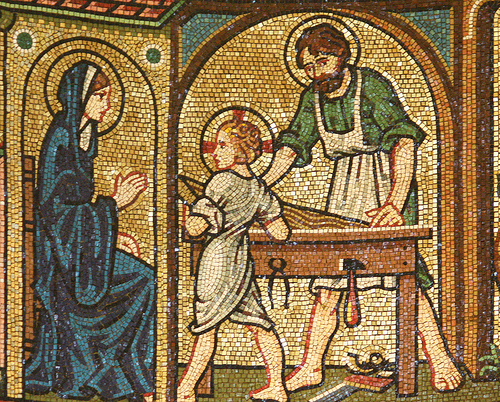
Jesus' Occupation: Was Jesus a Carpenter?

Jesus was a carpenter, right?  It’s one of the most widely known “facts” about Jesus’ life prior to his ministry.  In many ways, it is the only “fact” we know about Jesus’ life before his baptism by John the Baptist. 


Surprisingly, no text of the New Testament tells us that Jesus was a carpenter.

In only one Gospel is there any hint as to what Jesus’ occupation was prior to the start of his ministry.  This comes from the Gospel of Mark, where he notes that Jesus was a tekton – that is, a builder or craftsman.  In the Greek version of the Old Testament, this same word (tekton) is used to translate the Hebrew word charash, which means the same thing – artisan, craftsman, engraver, etc.

The only other time the word tekton appears in the New Testament is in the Gospel of Matthew, where the writer tells us that Jesus was the son of a tekton.  Perhaps Matthew was implying that Jesus followed in his father’s footsteps, but in any case, the only explicit reference in the New Testament comes from Mark.

Tekton, as stated above, is a word meaning “builder” or “craftsman.”  Literally, it means “someone who creates.”  It certainly can refer to something like a carpenter – that is, a woodworker.  But, like our own word “builder,” it does not exclusively refer to the profession of carpentry.  Unfortunately, there is no context in Mark’s passage (or Matthew’s, for that matter) to imply exactly what sort of tekton Jesus was. 

The tradition that tekton, in the Gospels, referred specifically to carpentry seems to be an early one.  Justin Martyr, writing in the mid-2nd century (only about 80 years after the first Gospel), states that Jesus was a carpenter who built yokes and plows like his father before him.  Justin tells us that Jesus used his woodworking trade to teach “the symbols of righteousness” to his followers and to encourage them to be productive. 

Sometime later, around 200 C.E., another Church father – this time the prolific writer Origen – denies that Jesus was a carpenter and notes explicitly that the Gospels do not, in fact, tell us this widely known “fact” (clearly Origen understood that “tekton” was not a specific reference to carpentry). 

We are left them with a problem: the word used in the New Testament is vague, and the debate about what, exactly, this word referred to is as old as Christianity itself.  How can we possibly hope to clear up the confusion?  Our only option is to look at other available evidence, both textual and historical, and when we do, it seems likely that Jesus was not, in fact, a carpenter.

One of the ways that scholars attempt to better understand the so-called “lost years” of Jesus’ life is by looking at the content of his parables.  What sorts of things did Jesus talk about?  What images and metaphors did he like to use in teaching?  In his parables, we never find references to anything having to do with woodworking – nothing about boat building, for instance, or fashioning plows or yokes (as per Justin Martyr), etc.  What we do find there, however, are parables about stone-working – consider, for instance, the parable of the foolish builders, where Jesus brings up the image of a man digging into solid ground to build a firm (i.e. “stone”) foundation for his house; or consider when Jesus quotes a passage from the Old Testament dealing with “the stone the builders rejected” and how it would become “the cornerstone.”  Think also of when Jesus nicknamed his closest companion, Simon.  Simon did not become “the Hammer.”  No, he became “the Rock” – the foundation on which Jesus’ movement would be built.   

In fact, Jesus brings up images of stone-working quite frequently in his sayings.  The parable of the wise and foolish builders, in particular, seems to imply a fairly intimate understanding of stone building practices in general. 

In addition to these clues, consider also the historical context.  It is known that there was very little in Galilee during Jesus’ lifetime that was made of wood.  Wood, in fact, was a scarce commodity in 1st century Galilee.  Houses, for instance, were made of stone or mud-brick, typically with thatched roofs.  Carpentry would not have been a very common trade.  Masonry, on the other hand, would have been a major industry, employing hundreds, if not thousands, throughout Jesus’ homeland. 

During the “lost years” of Jesus’ life, the major Galilean town of Sepphoris was rebuilt.  Sepphoris had been destroyed in the wake of the death of Herod the Great, and his successor, Herod Antipas, wanted to rebuild it to honor his Roman overlords.  Sepphoris, as it happens, was about 4 miles away from Nazareth – literally a new, shining white city on the hill visible from the valley in which the village of Nazareth set.  If Jesus and his family members had anything at all to do with the building industry, it is a virtual certainty that they would have spent a significant amount of time working in Sepphoris.  The buildings in Sepphoris were not made of wood.  They were made of stone.

Might Jesus have lain these stones inside a ritual Jewish bathing pool in Sepphoris?
It's not outside the realm of possibilities.

Considering these textual and historical clues, it seems probable that Jesus was, in fact, someone who worked with stone rather than wood.  Given his background and the historical context, it is likely that he was simply a laborer who helped haul stones and put them in place, rather than actually carving the stones himself.  He was probably not, in other words, an actual stone mason.  Of course, we can never know for certain.  But then again, we can rarely know anything in ancient history “for certain.”  The best we can do is collect evidence and piece together the resulting puzzle.  And in this case, the puzzle puts a rock in the hands of Jesus, not a hammer and nails.  

Friday, June 24, 2011

My Attempt at Vlogging

Okay, so if you don't know what vlogging is, it's basically blogging by video. For those poor saps who either can't write well or are too lazy, vlogging allows you to post thoughts and commentaries about things by just talking about it.

I have no intention of becoming a vlogger. But I've recently purchased a webcam, so I thought I'd make a video. This is really, really embarrassing. Do I really look and act like this when I'm talking about something? I'd make a terrible TV personality. This is why I write.  This is also why women think I'm a creeper.

Thursday, June 23, 2011

New Testament Authors, Part II: The Third and Fourth Gospels and Acts

Read Part I


The Gospel of Luke
Date: 90 C.E.
The Acts of the Apostles
Date: 95 C.E.
Textual Claim: Anonymous
Church Tradition: Luke, a Gentile physician and companion of Paul

The Third Gospel is the only text of the New Testament traditionally attributed to a Gentile – that is, a non-Jewish – author.  This is based on the tradition that its writer was Luke, a companion of the apostle Paul who seems to be called a Gentile in one of Paul’s letters.  The book of Acts is a virtual “second volume” to the Gospel of Luke, and it is widely recognized, understood, and agreed that whoever wrote Luke also wrote Acts.  The writing style and theology is the same, and the author himself – though he does not provide his own identity – does state, at the start of Acts, that he is writing a second volume to continue where the story of the Gospel of Luke left off.  He also addresses both books to the same person – someone named Theophilus. 

Perhaps the best place to start here is over the issue of whether Luke was, in fact, a Gentile.  Many who are familiar with this very widespread notion may be surprised to discover that there is virtually no evidence to suggest Luke was a Gentile, other than a somewhat vague statement in the New Testament letter of Colossians.  There, Paul lists the names of three of his companions, stating that they are the only Jews who work with him.  He then goes on to list several others, including Luke.  This, then, appears to be evidence that Luke was a Gentile. 

There are two problems here.  The first problem is that Paul doesn’t actually use the word “Jew” in the passage.  Instead, he refers to that first group of people as “those of the circumcision group.”  In other places, Paul uses this colloquialism as a way of referring not necessarily to people who are Jewish by ethnicity or even by religion, but to Christians who believe one must follow the Law of Moses in order to be a Christian.  This group, then, could be made up of either ethnic Jews or ethnic Gentiles.  As a group, they are usually referred to by historians as “Jewish Christians,” but there would certainly have been plenty of ethnic Gentiles among them. 

As a result, those people – including Luke – who are not, according to Paul, “part of the circumcision group,” are not necessarily Gentiles.  They could be Jews who, like Paul, have stopped following the Law of Moses. 

That’s the first problem.  The second problem involves the authorship of Colossians itself.  Since I will be talking later about Colossians, I’ll simply note that many scholars doubt that Paul actually wrote Colossians.  If, in fact, Colossians is a forgery in Paul’s name, then any biographical detail – like the names and ethnicities and religious persuasions of his personal companions – is historically unreliable anyway.  It is important to note here, as an aside, that Colossians is our only source for Luke’s profession as well – that he was a doctor.  If Colossians is a forgery, then there may be no reason to suppose Luke was a physician either. 

The writer of Luke/Acts shows a remarkably high level of understanding of Jewish culture, traditions, history, geography, and scriptures.  Coupled with the fact that there is virtually no reliable evidence suggesting the writer was a Gentile anyway, the most likely conclusion, in my mind, is that the writer was a Jew.

With that established, we turn now to the author himself – Luke the companion of Paul.  Regardless of whether he was Jewish or Gentile, what is the evidence that he is the author of the texts that bear his name? 

Our oldest evidence for the tradition dates to the late 2nd century.  Around 180 C.E., Iranaeus, Bishop of Lyons, refers numerous times to the texts in question, and states that they were written by Luke, without making any indication that there might be some doubt as to the author’s identity.  Clearly the tradition of Lukan authorship was well-entrenched by this time.

Unfortunately, Iranaeus was writing nearly 100 years after the texts themselves were composed, and we don’t have much evidence for the tradition of Lukan authorship prior to Iranaeus.  At best, scholars can trace the tradition to about 150 C.E.  As such, it becomes necessary to look at the internal evidence of the texts themselves. 

Within the Gospel of Luke, there is very little to go by.  However, in his second volume, Acts, there are in fact some internal clues that might help us answer the question of whether Luke was the writer.

The most famous pieces of evidence are the so-called “we” passages of Acts.  In these passages, the author suddenly switches the narrative from third-person into first-person – that is, he begins using “we” and “us” – as though he was there in the story himself.  These passages occur during the missionary travels of Paul.  This has led a lot of scholars and armchair enthusiasts to conclude that the tradition of Lukan authorship may have a basis in fact.  Early tradition tells us it was Luke, Acts has first-person passages, so Luke must be the author.

Other scholars, however, have noted several alternate theories.  First, the “we” passages might, in fact, indicate that the writer was an eyewitness to these events, but that does not necessarily mean that the author was actually Luke.  Maybe it was some other eyewitness.  Second, the “we” passages might be the result of what textual experts call “redaction.”  That is, the writer was using another text as source material for these passages, and simply retained the first-person perspective.  And finally, some scholars have noted that in Greek travel literature of the time, it was common for writers to use the first-person when describing sea voyages.  Since the “we” passages in Acts all correspond to sea voyages taken by Paul, perhaps the writer was simply employing a common stylistic convention.

All of these alternative theories cast doubt on the significance of the “we” passages.  They might indicate an eyewitness, and that eyewitness might have been Luke, but the passages don’t really represent the evidential “homerun” that they might appear to represent at first glance.

Perhaps the biggest argument against Lukan authorship is the fact that he seems to get so many things wrong about Paul.  We know this, of course, because we have a number of Paul’s own writings in the New Testament.  In many cases, scholars can compare what Luke says about an event in Paul’s life with what Paul himself says about the same event.  More often than not, Luke’s version of the story differs dramatically from Paul’s version.  For the sake of space, I won’t detail all these scenes, but will simply note that they are there, and the contradictions are plain for any reader to see.  If the Gospel of Luke and the book of Acts were written by one of Paul’s companions, why would he get so much vital information so dramatically wrong? 

In the end, I think Luke is the most difficult attribution to nail down.  Scholars apparently feel the same way, because the field is fairly well divided, with many good scholars arguing for Lukan authorship, and many other good scholars arguing against it.  Ultimately, the jury is still out, because the evidence is not conclusive in either direction. 

If you're interested in a bit more on this subject, I've written about it more fully in a previous blog post, from last February.  

The Gospel of John
Date: 95-100 C.E.
Textual Claim: “The disciple whom Jesus loved”  
Church Tradition: John, son of Zebedee, a disciple of Jesus

Even though it was the last Gospel written, the Fourth Gospel has perhaps had the most impact on Christian theology through the ages.  Traditionally it is attributed to John, one of Jesus’ most prominent and beloved disciples. 

Scholars across the theological spectrum agree that the disciple John almost certainly did not write this text.  In fact, there are very few reputable scholars out there today who still argue for Johannine authorship.  There are numerous reasons for this. 

To begin with, we know John from the Gospels as an uneducated fisherman from the backwoods of Galilee who spoke Aramaic.  That he might later have learned not only to speak, but to write in highly literate Greek is extremely improbable.

Second, our earliest sources for this tradition are, themselves, vague and contradictory.  Iranaeus, for instance, seems to believe there were two Johns among the early Christian evangelists, and it is not entirely clear which one he thinks wrote the Gospel.  Other early writers provide similarly confusing accounts. 

Third, textual scholars have identified several probable textual sources for the Gospel of John, and this begs the question of why a disciple of Jesus and eyewitness to all the events he describes would need to use other sources for information.

Fourth, textual scholars have also identified multiple layers within the Gospel where the text has been redacted – that is, changed, edited, updated, and collated with other sources – implying that the text we have today is not a single document written in a single time period by a single person, but rather a sort of community effort of several writers writing over the course of a number of years/decades. 

Fifth, since most scholars agree that the text was written near the end of the 1st century, the likelihood that John was still alive and able to write coherently (in another language, no less) is very, very low.

Sixth, much of the Gospel’s content differs dramatically from the stories in the other three Gospels, leading even many early Christian writers to admit that the author had a more spiritual purpose than historical purpose, which would seem odd if it was written by an eyewitness who actually knew the accurate historical situation.

This list could go on and on.  Simply put, there is virtually no evidence to support Johannine authorship, while there is overwhelming evidence to doubt Johannine authorship.  Put together, this is the reason why virtually every reputable scholar on the planet agrees that the Fourth Gospel was the work of a community, rather than any single person, and certainly not John, son of Zebedee.  It may well be that the community in question was a community founded by John, or otherwise devoted to John – that, in fact, is a very common conclusion among scholars – but there can be little doubt that John, himself, did not author this text. 

Sunday, June 19, 2011

Happy Father's Day

My father: Byron


My Father-in-Law: Gerald


My Paternal Grandfather: Arthur


My Maternal Grandfather: Oscar


My Maternal Great-Grandfather: Joe


My Paternal Great-Grandfather: Luke


My Paternal Great-Great-Grandfather: John


My Paternal Great-Great-Great Grandfather: Andrew

Saturday, June 18, 2011

New Testament Authors, Part I: The First and Second Gospels

INTRODUCTION

I’m often amazed at how disinterested most Christians seem to be on the question of who wrote the Bible.  This perplexes me because it seems, to my mind anyway, that it should matter where the texts came from, who wrote them, when, and why.  Yet these questions don’t seem to concern many Christians that I know. 

Just to test this theory out, I ran it by some of my Christian family members.  None of them cared.

Be that as it may, the authorship of the Bible is an important issue, and some folks may be surprised to discover just how little we really know about who wrote these texts and where they came from.  The history of how we got the Bible is complex and can fill volumes.  Here, I intend simply to provide, in a continuing “series,” an overview of the authorship for each of the 27 books of the New Testament, briefly discussing the various perspectives.  My hope is to keep these discussions brief and accessible, while still detailing the pertinent information. 

THE GOSPELS

Any discussion of the New Testament usually starts with the four Gospels.  These are the books that tell us intimate details about the life of Jesus, from his birth up through his baptism, ministry, and death in Jerusalem.  Almost as interesting as the content of these texts is the discussion about who, exactly, wrote them.  In what follows, it is important to keep in mind that the Gospels, themselves, are anonymous.  They did not come with titles, and nothing in the text tells us who the writer is.  The authors of these Gospels clearly figured their audience would know who they were. 

The Gospel of Mark
Date: 70 C.E.
Textual Claim: Anonymous
Church Tradition: John Mark, a companion of Peter and Paul

Mark is not the first Gospel in our Bibles, but it was the first Gospel to be written, composed somewhere around 70 C.E., about the time that Jerusalem was falling to the Roman legions and the Jewish people were being dispersed throughout the Mediterranean world.  Because it was traditionally believed to have been the second gospel written, it is typically referred to as the Second Gospel.  I put it first simply because scholars now know that it was, in fact, the first to be written.   

Church tradition has attributed this Gospel to a man named John Mark, said to have been a companion of Paul and later a secretary to Peter.  This view goes back quite a long way, all the way back to the first part of the 2nd century, with a writer named Papias, who, we are told, was the leader of the church in Heirapolis, in modern day Turkey. 

Scholars tend to date Papias’ work to roughly 115 C.E.  As far as post-New Testament authors go, Papias is one of the very earliest that we know about.

None of Papias’ writings have survived for scholars to read.  We know of him and his work only because he was quoted by Christian writers who came after him.  As such, we have a few statements from Papias, but no complete works.

One of his quoted pieces deals with the authorship of Mark.  He states: “Mark having become the interpreter of Peter, wrote down accurately whatsoever he remembered.” 

This isn’t much, of course, but it’s enough to establish that by the first part of the 2nd century, Christians were attributing some text or another to Mark, a companion of Peter.  Whether Papias understood this to be the same Mark who had previously been a companion of Paul (and who, according to Acts, parted ways early on with Paul) is unclear.  It is also not clear exactly what text Papias is talking about.  Is he referring to our Gospel of Mark?  Or some other text purportedly written by Peter’s companion?  There is nothing in our Gospel of Mark to suggest that it was written by a companion of Peter (one might expect, for instance, that it would be heavily “pro-Peter” if it was written by one of his followers, but it is not). 

There are other reasons to suspect that Papias may have been talking about a different text.  To begin with, Papias quotes several stories that are not found in any of the four Gospels of the New Testament.  He gives, for instance, an account of the death of Judas that is completely different from the ones found in Matthew and Luke.  Additionally, he quotes a parable of Jesus that is not found in any other source, either inside or outside the New Testament.  Could these stories have come from the text that Papias believed was authored by Mark?  If so, then he certainly was not referring to the text we know as the Gospel of Mark. 

In addition to the general doubts about what text Papias was talking about, there is also the issue of who, exactly, John Mark was.  We know from the letters of Paul that he had a companion by this name, though Paul simply calls him “Mark.”  “John Mark” is how he is referred to in the book of Acts.  In Acts, Mark and Paul have a falling out, and Mark abandons him, never to return to the story.  In the book of 1 Peter, ostensibly written by the apostle Peter, Mark is also referenced as sending his greetings to the recipients of the letter.  Is this, perhaps, where the tradition comes from that Mark, after abandoning Paul, became the secretary of Peter?  Perhaps, but there is nothing in the text itself to indicate that this is the same Mark.  In Acts, for instance, when Mark leaves Paul, he doesn’t go to Peter, but instead sets out with Barnabas.

In the end, it seems likely that the text we know as the Gospel of Mark was probably not written by anyone who was a companion of Peter or Paul, or even by anyone named Mark.  The attribution to Mark, the secretary of Peter/companion of Paul, seems to be a “best guess” by early Church fathers attempting to assimilate the available data and add authority to those texts considered pure and orthodox by the emerging Church.     

The Gospel of Matthew
Date: 80-85 C.E.
Textual Claim: Anonymous
Church Tradition: Matthew the tax collector, also called Levi, a disciple of Jesus

Matthew is typically called the First Gospel, even though it is now known to have been the second gospel written.  When it comes to this text, the waters become even murkier than with the Gospel of Mark.  Perhaps the best place to start is with the identity of the person we call Matthew.

In Church tradition, Matthew was also known as Levi, and he was a tax collector.  In Mark’s Gospel, this connection is not explicit.  There is a story about Jesus calling a man named Levi, who is a tax collector, but later – when Mark provides a list of the 12 disciples – Levi is absent.  A man named Matthew is named as one of the disciples, but there is no suggestion by Mark that this is the same person as Levi the tax collector.  In the Gospel of Matthew, the conundrum is cleared up.  When this author re-tells Mark’s story about Levi the tax collector, he doesn’t call him Levi at all, but instead calls him Matthew.  Luke does not tell the story of the tax collector, but does mention that one of the disciples was named Matthew.

We also have a reference to a disciple named Matthew in the Gospel of Thomas, though no biographical information is provided.  Additionally, there is a reference in the Gospel of Peter to a disciple named Levi, but again there is no biographical information.

Clearly, the author of the Gospel of Matthew believed that Levi the tax collector and the disciple Matthew were one and the same.  This, in and of itself, causes one to wonder if that does not explain where the tradition of Matthean authorship comes from – the assumption being that the author of this text knew Matthew and Levi were the same person quite simply because the author was, in fact, Matthew himself.

Whether that is the source for the tradition of Matthean authorship or not, our earliest reference to this tradition again comes from the aforementioned Papias.  Papias says: “Matthew put together the oracles [sayings of Jesus] in the Hebrew language, and each one interpreted them as best he could.” 

We are faced again with the same problem we saw with Mark.  Is Papias talking about the same text we know as the Gospel of Matthew?  Here, the doubt is even greater, because as anyone familiar with the Gospel of Matthew knows, it is not simply a list of sayings (“oracles”) of Jesus, but an entire “gospel” detailing Jesus’s life from birth to death.  Papias’ description actually sounds more like the Gospel of Thomas than the text we know as the Gospel of Matthew.  Furthermore, the Gospel of Matthew was written in Greek, not Hebrew.  Before you wonder if it might have originally been written in Hebrew, and simply translated later into Greek, there is no evidence to suggest this.  I am certainly no ancient Greek scholar, but those folks who are scholars of ancient Greek have ways of determining if a Greek text is an original Greek composition or a translation from some other language.  From what I understand, it is widely agreed that this text is an original Greek composition. 

There is one more point to be made about Papias’ identification: recall from the discussion of Mark that Papias gives an account of the death of Judas which is different than the account found in Matthew and Luke.  If the text Papias knew as Matthew was the same text we know as Matthew, why would Papias give an account of Judas’ death that differs from what is found in Matthew? 

It seems likely to me that whatever text Papias was talking about, it was not the Gospel we know as Matthew. 

Again, we are in a position similar to the one we faced with Mark: the disciple Matthew almost certainly didn’t write the text we know as the Gospel of Matthew, and even the disciple Matthew’s very identity is in question. 

In Part II, we will look at the authorship of the Third and Fourth Gospels, Luke and John. 

Sunday, June 05, 2011

Notes from the Cave

Yikes, it's been way too long since I posted on my blog.  Sorry for the absenteeism.  Very busy, as usual.

Work has really taken off in the last few weeks.  It seems like every shift I work now is really busy, and I'm still working at least some overtime every week.  From here forward, I'll be working third shift on my weekends.  We rotate weekends so that we basically work every third weekend, with two weekends off in between.  I like the occasional third shift, so this is a good thing, but it's really difficult to switch back and forth, and my schedule will generally only give me one day off in between.  So, for instance, I will work third on Saturday and Sunday, then have Monday off (which is mostly spent sleeping), then have to be right back at 8 a.m. (or earlier) on Tuesday morning.  When I've done this in the past, even when I've gotten enough sleep the night before, I am always dragging that next day.  It's just hard on the body to switch back and forth like that.  I'm actually facing that scenario right now - worked third shift last night, and have to be at work tomorrow morning at 7 a.m.

I finished Swan Song by Robert McCammon last week - I think I mentioned this book in my last update.  As a counterpart to Stephen King's more famous book, The Stand, there is virtually no comparison.  Swan Song was significantly better.  I had expected this to be the case, since I had read Robert McCammon before and considered his books to be much more readable and enjoyable than Stephen King.  I highly recommend Swan Song.  I've now moved on to book three in the saga of Henry II by Sharon Kay Penman.  I've also started a new non-fiction book called Forged, by biblical scholar Bart Ehrman.  It discusses the authorship of various books within and outside of the New Testament.

I really wish I had more to talk about, but this is about all I've got.  It's hot and dry, after a wet and cool spring, and the grass needs to be mowed, but I failed to do it today.  I did feed the horses for a few minutes though.  There were a bunch out there today, including some that, judging by the looks of them, must have been race horses of some kind.