Despite being a lifelong Christian, one raised in a family that was in Church three times a week, and despite having heard literally hundreds and perhaps thousands of sermons in my life and attended countless Sunday school classes, I do not think that I have ever heard a teaching from the Old Testament book of Esther. Recently, however, I read a short synopsis of what the book was about, and found it intriguing, so I decided to sit down and read it for myself.
Esther is a short book, comprising only nine chapters, and it is unique in the Bible as being the only book that never, either implicitly or explicitly, mentions God in any form. There are no references at all to God or the Lord, and no common reference found in other Old Testament books to prominent figures and events like Moses, Elijah, Abraham, the Exodus, the Temple, Jerusalem, or the Mosaic Law. In fact, the whole story takes place not in the Promised Land, but entirely in the kingdom of Persia, specifically the capital city of Susa, and centers around the court of King Xerxes. Rather than reading like a religious text, it reads instead like a work of ancient creative writing, similar in style to The Odyssey or The Iliad. Like a work of good fiction, it has all the elements of a captivating ancient drama: a lovely naïve virgin from the fringe of society who wins the heart of the king and is made queen, thwarted assassination attempts, revenge-fueled genocidal pogroms against an entire race of people, impalings on ancient gallows, a vicious antagonist with a vendetta, and a climatic battle where the “good guys” are ultimately the victors.
The story begins in the early days of Xerxes’ reign, historically set during the 5th century B.C.E. He throws an elaborate banquet, and when it is over, he sends word to the queen – who like most wives of ancient rulers lived in a separate part of the palace – that she should come to him. She spurns his request, however, and refuses to come. The text does not elaborate on her reasons, leaving it open to creative interpretation. Perhaps she had a lover and no longer wanted to provide sexual favors to the king; perhaps she was secretly conspiring against him. Whatever her reason, she refuses to see him. Naturally, this raises Xerxes’ ire, and he sends her away, effectively divorcing her and excommunicating her from his court.
Following this, the king sends out a proclamation to all his lands that he is in the market for a new wife, and he commands all the people to send him their most available virgins for him choose from. At this point we are introduced to the character of Mordecai. Mordecai was a Jew, working in some unnamed manner in the court of the king. The Jews, as a race of people, had come to be in the Persian kingdom about one hundred years earlier, when they were deported there by the then ruling Babylonians. The Babylonians had subsequently been overthrown by the invading Persians, and the Persians had permitted the Jews to return to their homeland. However, since most of the Jews who were living by that time had been born and raised in Babylon and not Judea, many were not interested in returning to an unfamiliar homeland, and preferred instead to stay in the place that was familiar. This was further encouraged by the Persian propensity to allow freedom of religion and to even allow non-Persians to hold important positions in society. For this reason, Mordecai the Jew was able to work in the capital city, in the court of the king himself.
Mordecai, the text tells us, had adopted his female cousin Esther, after her parents – Mordecai’s uncle and aunt – had died. Esther was, apparently, quite a bit younger than her cousin Mordecai, and Mordecai had essentially raised her as his own daughter. She was a beautiful and charming young virgin, and Mordecai brought her to the king’s court to be considered by Xerxes. Xerxes, in turn, was immediately taken in by her beauty and charm, and subsequently chose her as his new wife. Suddenly Esther, a non-Persian from ignoble origins, had become the most powerful woman in the kingdom.
Sometime after Esther’s ascendancy, Mordecai, as an employee at the king’s court, got word of a secret plot by two of the palace guards to assassinate Xerxes. Mordecai, who was still in touch with Esther, told her about the plot, and Esther in turn revealed it to the king. Xerxes arrested the conspirators and had them publicly impaled on the gallows, and his commitment to his new queen was further deepened, as Esther had been the one who had revealed the plot to him. At this point in time, Xerxes did not apparently know that Mordecai had actually been the revealer of the conspiracy.
After the thwarted assassination attempt, the text tells us that one of the king’s chief advisors, a man named Haman who is described as an Agagite, won special favor with the king and was elevated to second in command in the kingdom. The text does not tell us what Haman did to win the king’s favor. Perhaps he won a decisive military victory – again, the lack of information leaves it open to creative interpretation. Either way, the king ordered all of his advisors, counselors, and officials to bow down in respect to Haman whenever they were in his presence, much the same way that they would be required to show obeisance in the king’s presence. Mordecai, however, refused to do this. As an Agagite, Haman was descended from a group of people who were one of Israel’s ancient enemies, and as such, Mordecai apparently could not bring himself to bow before Haman.
Naturally, Haman did not respond well to Mordecai’s insubordination. However, instead of simply taking revenge on Mordecai personally, Haman is depicted as deciding that the entire Jewish population of the Persian kingdom needed to be eradicated. Throughout the text, Haman is referred to as “the enemy of the Jews.”
In order to carry out his dastardly scheme, Haman went to the king and informed him that there was a group of people within the kingdom who were a threat to the king and to the stability of his lands, and that they should therefore be gotten rid of. Not having any clue just who this race of people consisted of (Xerxes is routinely depicted throughout the story as a sort of absent-minded but loveable despot), Xerxes approves Haman’s request, and gives him his signet ring, permitting him to draw up a proclamation, seal it with the royal ring, and send it out to all the lands of the kingdom. At this point, Haman draws lots to determine the day upon which the slaughter should take place, and it comes to pass that the day is chosen for some eight or nine months down the road. Subsequently, Haman draws up a proclamation in the king’s name, ordering all able-bodied men to form armies and slaughter all the Jews – elderly, women, and children included – on the appointed day. Since Persian law and tradition held that any proclamation by the king was binding for all time, the order to slaughter the Jews could not ever be rescinded, even by the king himself.
Needless to say, Mordecai very quickly became aware of Haman’s plot to eradicate the Jewish people. He felt that the only way to subvert this plot was to go to Esther and ask her to appeal on behalf of the Jewish people to the king. When she learns of the plot, Esther is horrified by what Haman is planning, but is also hesitant to approach the king about the subject. If she seeks an audience with the king, and the king is not pleased, the punishment is death. She asks Mordecai to tell the Jews to fast three days for her, while she makes her decision as to whether or not she will risk the king’s displeasure and her own demise by approaching him with this issue. This request for fasting is the only passage in the entire text that either implicitly or explicitly refers to any sort of religious ritual or practice.
In the end, Esther decides to approach the king, but decides that trying to charm him is the smartest route. Therefore, instead of entering his chambers and asking him to save the Jews, she first approaches him and asks him to attend a banquet that she is throwing in his honor. In his meeting with Esther, Xerxes is depicted as still being smitten with her, promising her that he will give her anything she asks, “even up to half my kingdom.” He attends the banquet and it is a great success. However, when the banquet is over and he again asks her what she wants from him, she again declines to bring up the issue of the Jews, and instead asks him to attend yet another banquet that she is throwing for him. He consents.
About this point in the text, the story returns to the machinations of Haman in ridding Persia of the Jews. Haman has decided that he cannot wait until the appointed day to slaughter all the Jews, and instead wants to go ahead and whet his appetite by putting Mordecai to death. To this end, he erects a gallows in his own front yard, upon which he intends to impale Mordecai. But before he can do this, the time for the second banquet arrives, and Haman accompanies the king to Esther’s elaborate feast.
Again the king is depicted as being utterly smitten with Esther, and when the banquet is over, he again asks her to tell him what she wants, promising to give her anything, up to half his kingdom. Esther delicately begins to tell him what has been transpiring under his nose. She reveals, apparently for the first time, that she is a Jew, and she tells him that someone in his court has been conspiring to eradicate her people from the empire. Xerxes (again the bumbling, absent-minded but loveable despot) is outraged that this has been going on, and he begs Esther to tell him who is behind the nefarious scheme. Esther points to Haman, who has been present throughout the entire discussion. Xerxes wastes no time in sentencing Haman to death. Without much pomp or ceremony described in the text, Haman is summarily impaled, executed upon the very gallows he had set up for Mordecai.
At this point, Esther also reveals to Xerxes that it had been Mordecai who had actually revealed the assassination plot by the palace guards. Xerxes asks if Mordecai was ever rewarded for this. When he finds out that Mordecai was overlooked, he dresses Mordecai up in royal garb, and parades him around the city, ordering all those who encounter him to bow down. Suddenly Mordecai has replaced Haman as second in command beneath the king, and the one for whom the king has intense favor.
There is still the issue of the impending slaughter of the Jews, however. As noted already, the king’s royal decree – the one penned by Haman – could not be rescinded, even by the king himself. So Mordecai and the king decide to draft another proclamation, this one allowing the Jews to defend themselves against the coming attacks. The text tells us that the people of Persia stood in fear of the Jews, and by and large began to rally around their cause. However, when the appointed day finally arrived, armies of Persian warriors set out to slaughter the Jews. The Jews, however, were ready, and were bolstered by popular support, and they soundly defeated their enemies. The text tells us that they put 75,000 people to death throughout the kingdom, not counting those they slaughtered in the capital city of Susa.
This victory over their enemies was cause for great celebration for Jews throughout the kingdom. Since the original date of the extermination had been chosen by drawing lots, they enacted a new holiday called Purim, which is simply the Hebrew word for “lots.” The text tells us that from that time forward, the holiday of Purim was to be celebrated by Jews, to remember and honor and celebrate the victory they won over their enemies, with the help of their beloved Queen Esther. The story ends by telling us, in essence, that Esther and Mordecai and all the others lived happily ever after.
The Book of Esther is a fantastic story with all the elements of a great drama, and while it may or may not contain any factual historical information, it stands as a testament to the perseverance of the Jews in the face of adversity, and it provides the basis for which the Jewish holiday of Purim is celebrated to this day. It further functions as a story of encouragement to modern Jews – one can imagine how it may have inspired Jews throughout history when they were faced with various pogroms against them, such as during the Inquisition and World War II. It illustrates in a creative way how the Jews have managed to maintain their unique identity, and how they have managed to survive even when so many different groups, throughout so many eras of history, have tried to wipe them from the face of the planet.
Despite being the only book in the Bible that never mentions God in any fashion, this is an extremely important and fascinating book, and rightfully belongs in the canon we call scripture.
Saturday, April 19, 2008


Thursday, April 17, 2008
Free Will and God's Will: Mutually Incompatible
Free will is generally defined as the freedom of human beings to make their own autonomous choices and decisions, and to reap the consequences of those decisions. While there is certainly room for philosophical posturing in regards to whether we truly have free will, or whether we are simply automated by our genes, most everyone can agree that, from a practical standpoint, humankind exhibits free will. We are free to make our own choices, and the various experiences that define who we are come from the product of our free will choices and the free will choices of those around us.
Yet while most people will agree that human beings have free will, many people also abide by the belief that God has a will, and that this will is frequently enacted within human history. Thus you hear folks say things like, “It just wasn’t God’s will,” or “I’m trying to follow God’s will for my life,” or “I decided to just sit back and trust God’s will.” When good things happen, many believers will give the credit to God, and if something does not turn out the way someone hopes, they will frequently remark that it simply “was not God’s will.”
But is this consistent? Can humankind have free will, while simultaneously living in world where God’s will is routinely in play?
In a word, no.
For God’s will to be enacted on earth, a suspension of human free will is required. This is seen time and time again in the Bible. The Old Testament story of the Exodus goes so far as to explicitly state that God “hardened Pharaoh’s heart” – implying that the pharaoh was merely a puppet on God’s string. The Jews did not escape Egypt by their own strength of conviction and good fortune, but escaped because God allowed them to. Later, Joshua defeated the Canaanites not through the excellence of his own military prowess, but because God made it happen. God even made the earth stop rotating so that there would be longer daylight to allow Joshua to keep slaughtering his enemies. In the New Testament, the entire story of Jesus’ life is an example of God’s will invading human history, with all of Jesus’ enemies acting out the grand plan of salvation enacted by God and predicted by the prophets. The Roman soldiers, for instance, did not choose of their own free will to cast lots for Jesus’ clothing, but did it like puppets on a divine string in order to fulfill scripture. Later, they pierced his side but left his legs intact, not because they made this decision of their own free will, but because this was in fulfillment of prophecy and scripture.
The Bible is not the only place that God’s will seems to come into play. Most traditionally-believing Christians will argue that the various doctrinal councils of the 4th and 5th centuries were doing “the will of God” when they determined which books would be in the Bible and when they settled on a set of doctrines and creeds. Furthermore, these same folks will argue that the texts of the Bible, while written by human beings, were divinely inspired, meaning that when these human beings were writing their texts, God was directing their pens – thus, they could not have been acting of their own human free will.
Even today, many Christians will argue that certain events are tinged with God’s intervention – such as when an ill person makes a miraculous recovery, a major disaster is narrowly averted, or a remarkably positive event occurs in a person’s life. Recently, Kansas defeated Memphis in the NCAA basketball tournament championship game. Memphis blew a late lead, and missed some key free throws in the last few seconds of the game. After the game, the Memphis head coach remarked that it simply was not God’s will for those free throws to be hit, or for his team to win the game. In other words, the team lost not because they got outplayed, and not because they missed some free throws, but because it was not God’s will.
Of course, many Christians would admit that the Memphis coach’s comments were absurd, and were simply an emotional response to a huge disappointment. But even in doing so, many frequently still hold fast to other ideas of God’s will being enacted in human life, and many would probably make similar comments in similar circumstances. I feel confident that whatever religious beliefs the Memphis head coach has, they are probably not unusual or out of the ordinary.
So how can believers reconcile God’s will with human free will? The most common answer would probably be that God chooses, from time to time, to invade human history and suspend free will as he sees fit. He is omniscient and all-powerful, after all. He can do what he wants. Yet if free will can be suspended, at any time, then free will does not truly exist. The very concept of free will demands that it exists at all times, unimpeded. If God can suspend free will at his whim, then we do not truly have free will. Instead, we are free to do as we choose only insofar as God allows it. That is not free will, by any definition of the phrase. As such, if we truly have free will, as most people seem to assume, then God must, by definition, not ever invade human history with his own agenda.
What I am getting at is this: one can not believe that human beings have free will, and also believe that God has a will which sometimes gets enacted on earth, without simultaneously holding two contradictory beliefs.
Many Christians might respond to this by suggesting that perhaps we do not, in fact, have free will like we think we do. Doing so, of course, does in some ways resolve the problem that I have illustrated, but it opens a whole other can of philosophical worms. If we do not have free will, then what does this mean for our very existence? Furthermore, how does it affect our relationship with God? Does God, then, choose us, rather than us choosing God? What would make God choose one person over another? Why would a loving, merciful God send the majority of people (that is, non-Christians) to hell? Is anything we do actually determined by us, or does God control everything? If we determine some things, how does God decide when to let us make our own choices, and when to do his own thing? Why does God – who controls everything and leaves nothing to chance or free will – cause some people to get sick, and others to be healthy? Why does God make hurricanes and tsunamis and tornados exist, and why does he cause some people to survive those disasters, but causes others to get killed by them? These are the kinds of philosophical and theological questions one must face if they choose to reject free will.
The other option, of course, is to recognize that we do have free will, and the things that happen on this planet, for good or bad, are the result of that human free will, as well as chance and luck. As such, God has absolutely nothing to do with any of it, beyond allowing us to have free will in the first place.
The important thing to realize, and the entire point of this essay, is to raise to consciousness the fact that most of us hold contradictory beliefs regarding free will. We say we believe in free will, but simultaneously believe that God invades human history with his own agenda. It cannot be both ways, and this is the point that I would like to stress. Think on it.
Yet while most people will agree that human beings have free will, many people also abide by the belief that God has a will, and that this will is frequently enacted within human history. Thus you hear folks say things like, “It just wasn’t God’s will,” or “I’m trying to follow God’s will for my life,” or “I decided to just sit back and trust God’s will.” When good things happen, many believers will give the credit to God, and if something does not turn out the way someone hopes, they will frequently remark that it simply “was not God’s will.”
But is this consistent? Can humankind have free will, while simultaneously living in world where God’s will is routinely in play?
In a word, no.
For God’s will to be enacted on earth, a suspension of human free will is required. This is seen time and time again in the Bible. The Old Testament story of the Exodus goes so far as to explicitly state that God “hardened Pharaoh’s heart” – implying that the pharaoh was merely a puppet on God’s string. The Jews did not escape Egypt by their own strength of conviction and good fortune, but escaped because God allowed them to. Later, Joshua defeated the Canaanites not through the excellence of his own military prowess, but because God made it happen. God even made the earth stop rotating so that there would be longer daylight to allow Joshua to keep slaughtering his enemies. In the New Testament, the entire story of Jesus’ life is an example of God’s will invading human history, with all of Jesus’ enemies acting out the grand plan of salvation enacted by God and predicted by the prophets. The Roman soldiers, for instance, did not choose of their own free will to cast lots for Jesus’ clothing, but did it like puppets on a divine string in order to fulfill scripture. Later, they pierced his side but left his legs intact, not because they made this decision of their own free will, but because this was in fulfillment of prophecy and scripture.
The Bible is not the only place that God’s will seems to come into play. Most traditionally-believing Christians will argue that the various doctrinal councils of the 4th and 5th centuries were doing “the will of God” when they determined which books would be in the Bible and when they settled on a set of doctrines and creeds. Furthermore, these same folks will argue that the texts of the Bible, while written by human beings, were divinely inspired, meaning that when these human beings were writing their texts, God was directing their pens – thus, they could not have been acting of their own human free will.
Even today, many Christians will argue that certain events are tinged with God’s intervention – such as when an ill person makes a miraculous recovery, a major disaster is narrowly averted, or a remarkably positive event occurs in a person’s life. Recently, Kansas defeated Memphis in the NCAA basketball tournament championship game. Memphis blew a late lead, and missed some key free throws in the last few seconds of the game. After the game, the Memphis head coach remarked that it simply was not God’s will for those free throws to be hit, or for his team to win the game. In other words, the team lost not because they got outplayed, and not because they missed some free throws, but because it was not God’s will.
Of course, many Christians would admit that the Memphis coach’s comments were absurd, and were simply an emotional response to a huge disappointment. But even in doing so, many frequently still hold fast to other ideas of God’s will being enacted in human life, and many would probably make similar comments in similar circumstances. I feel confident that whatever religious beliefs the Memphis head coach has, they are probably not unusual or out of the ordinary.
So how can believers reconcile God’s will with human free will? The most common answer would probably be that God chooses, from time to time, to invade human history and suspend free will as he sees fit. He is omniscient and all-powerful, after all. He can do what he wants. Yet if free will can be suspended, at any time, then free will does not truly exist. The very concept of free will demands that it exists at all times, unimpeded. If God can suspend free will at his whim, then we do not truly have free will. Instead, we are free to do as we choose only insofar as God allows it. That is not free will, by any definition of the phrase. As such, if we truly have free will, as most people seem to assume, then God must, by definition, not ever invade human history with his own agenda.
What I am getting at is this: one can not believe that human beings have free will, and also believe that God has a will which sometimes gets enacted on earth, without simultaneously holding two contradictory beliefs.
Many Christians might respond to this by suggesting that perhaps we do not, in fact, have free will like we think we do. Doing so, of course, does in some ways resolve the problem that I have illustrated, but it opens a whole other can of philosophical worms. If we do not have free will, then what does this mean for our very existence? Furthermore, how does it affect our relationship with God? Does God, then, choose us, rather than us choosing God? What would make God choose one person over another? Why would a loving, merciful God send the majority of people (that is, non-Christians) to hell? Is anything we do actually determined by us, or does God control everything? If we determine some things, how does God decide when to let us make our own choices, and when to do his own thing? Why does God – who controls everything and leaves nothing to chance or free will – cause some people to get sick, and others to be healthy? Why does God make hurricanes and tsunamis and tornados exist, and why does he cause some people to survive those disasters, but causes others to get killed by them? These are the kinds of philosophical and theological questions one must face if they choose to reject free will.
The other option, of course, is to recognize that we do have free will, and the things that happen on this planet, for good or bad, are the result of that human free will, as well as chance and luck. As such, God has absolutely nothing to do with any of it, beyond allowing us to have free will in the first place.
The important thing to realize, and the entire point of this essay, is to raise to consciousness the fact that most of us hold contradictory beliefs regarding free will. We say we believe in free will, but simultaneously believe that God invades human history with his own agenda. It cannot be both ways, and this is the point that I would like to stress. Think on it.
Wednesday, April 02, 2008
Herbal Remedies: Bad Medicine
In the last decade, alternative forms of medicine have become all the rage. From stores like GNC pushing an influx of herbal remedies, to the resurgence of 19th century homeopathy, more and more Americans are turning to alternative medicine when faced with illness. There are a number of reasons for this, but most notably it is due to an increasing distrust of the pharmaceutical industry, bred by many high-profile drug recalls, and a similarly increasing distrust of doctors, who many feel are simply pawns of the pharmaceutical companies. These doctors, many feel, will simply prescribe whatever medicine the drug reps have given them, without much regard for whether it is the best option for a given patient. These suspicions are frequently encouraged by television and print advertisements for alternative therapies, and by practitioners of alternative medicine, such as chiropractors, acupuncturists, and massage therapists.
Unfortunately, there is often a good reason why alternative medicine remains separated from mainstream medicine: it is because in most cases, there is no hard evidence or clinical indication that the therapies work. If a certain form of alternative medicine is shown to be clinically effective over a wide range of the population, it ceases to be alternative medicine and becomes mainstream medicine. Therefore, any therapy that has maintained an “alternative medicine” status for a long period of time should immediately be regarded with suspicion of being ineffective and unreliable. Suggesting otherwise would be like saying that a career minor-league baseball player is as good as a hall-of-famer.
The most prominent face of the alternative medicine craze lies in the area of herbal remedies and nutritional supplements. Thanks to a rigorous advertising campaign, most everyone is familiar with drugs like St. John’s Wort, Gingko, and Omega-3 fish oil. In addition, various vitamin and mineral concoctions have become popular as supplements for every walk of life. Go to GNC’s website, and you will see categories like “Sports Nutrition & Protein,” “Diet & Energy,” and “Health, Beauty, & Medicine Cabinet.” They sell supplements with names like “Muscle Milk,” “Fat Incinerating Serum,” and “Amplified Creatine.”
One of the most common and oft-repeated advertising phrases for these sorts of supplements and remedies is that they are “all natural.” The implication of this assertion is that because they are all natural, they are therefore safe. Unfortunately, this is a blatant untruth. Just because a supplement is all natural does not mean that it is safe, nor does it imply that it is effective. Grass is all natural, and while it may not hurt me to eat a blade or two, it certainly is not going to cure my cold. Arsenic is all natural, but you would not want to ingest arsenic for any reason, ever, unless you were planning on committing suicide. In the 19th century, cocaine was a popular drug prescribed for everything from chest colds to depression. Little did they know that it was also highly addictive and extremely damaging to the body’s organs. But it was all natural! The “all natural” label simply tells us nothing about the drug’s safety or effectiveness. In fact, one should be suspicious of any remedy advertising its all natural content, because this implies that there is not much else of benefit to be focused upon.
Another aspect of the dangers of herbal medicines and supplements is the issue of drug interactions. Most people seem to have the idea in mind that herbal remedies – again, because they are “all natural” – do not carry the same risk of drug interaction that prescription drugs carry. This is a misconception. Indeed, herbal remedies and supplements are just as likely to interact with other drugs and foods as prescription drugs are. For instance, someone receiving an organ transplant could increase the likelihood of rejection by taking St. John’s Wort, because of the way St. John’s Wort interacts with the immunosuppressant medicines given to transplant patients. This, of course, is just one of many examples.
Herbal remedies do not go through the same rigorous clinical testing that prescription drugs go through to prove safety and effectiveness. They are not put through double-blind tests, and their advertised benefits are not evaluated by the FDA. In fact, with any given herbal remedy, the vast majority of its “proven” effectiveness is by word of mouth and anecdotal evidence only. Do not be fooled when you hear a commercial telling you that a given supplement is “clinically proven.” In almost every case, these clinical trials were not overseen by a neutral third party – as is required with prescription medicines – and they almost never include placebo tests or double blind tests. They are typically carried out on a small scale and budget, and are organized and arranged in order to get the best possible results. The method of clinical testing simply does not stand up to that endured by prescription drugs.
Safety is a major issue with herbal remedies, and one that is frequently overlooked. As alluded to above, people assume that a given remedy is safe simply because it is labeled as “all natural.” Again, because these drug concoctions do not go through the same rigorous clinical testing that prescription drugs go through, their safety has not been proven. As with the issue of effectiveness, the known safety of a given herbal remedy is generally through word of mouth and anecdotal evidence. Yet there is plenty of word of mouth and anecdotal evidence that some supplements may not be safe. One story that comes to mind involves my own father. At nearly 60, he has never had a food or drug allergy in his life. Recently, he began taking Omega-3 fish oil supplements. After a few days of this, he began to get sick. Once the sickness and vomiting passed, he began taking the supplements again. It was not until he got sick a second time that he began to connect the two. As a result, he stopped taking the supplements completely. However, a few weeks later, after eating a seafood meal, he got sick again. Ever since that time, he has gotten sick each time he has attempted to eat seafood. There is only one obvious conclusion: the Omega-3 fish oil supplements somehow birthed a seafood allergy that he had never had before in nearly 60 years of life. How did this happen? Well, who knows – the supplements have not had the sort of clinical testing that mainstream drugs go through. And that is the entire point. The safety of these supplements has not been tested and cannot be proven.
It seems unlikely that the herbal remedy craze, or the general alternative medicine craze, will cease anytime soon. So it is important for us, as patients and consumers, to be very careful about the herbal remedies we take, and to recognize that if they could be proven to be highly effective, they would be marketed as prescriptions, not as herbal remedies. In the past, herbal remedies were all we had. One of the many benefits of living in the modern era is that we have modern medicine at our fingertips, and do not have to rely on garlic, hyssop extract, gingko, and peppermint oil to cure our diseases anymore. If those things worked effectively, human beings throughout all of human history would not have been keeling over left and right before the age of 50. The reason those of us in the developed world have an average lifespan of 75 or more, is largely due to the development of modern medicine, and the subsequent decline of herbal medicine and home remedies. Why, then, are so many people interested in bringing these ineffective therapies back to the forefront? Herbal remedy proponents argue that the pharmaceutical industry is only interested in your money, but I wonder if the pot is not calling the kettle black.
Unfortunately, there is often a good reason why alternative medicine remains separated from mainstream medicine: it is because in most cases, there is no hard evidence or clinical indication that the therapies work. If a certain form of alternative medicine is shown to be clinically effective over a wide range of the population, it ceases to be alternative medicine and becomes mainstream medicine. Therefore, any therapy that has maintained an “alternative medicine” status for a long period of time should immediately be regarded with suspicion of being ineffective and unreliable. Suggesting otherwise would be like saying that a career minor-league baseball player is as good as a hall-of-famer.
The most prominent face of the alternative medicine craze lies in the area of herbal remedies and nutritional supplements. Thanks to a rigorous advertising campaign, most everyone is familiar with drugs like St. John’s Wort, Gingko, and Omega-3 fish oil. In addition, various vitamin and mineral concoctions have become popular as supplements for every walk of life. Go to GNC’s website, and you will see categories like “Sports Nutrition & Protein,” “Diet & Energy,” and “Health, Beauty, & Medicine Cabinet.” They sell supplements with names like “Muscle Milk,” “Fat Incinerating Serum,” and “Amplified Creatine.”
One of the most common and oft-repeated advertising phrases for these sorts of supplements and remedies is that they are “all natural.” The implication of this assertion is that because they are all natural, they are therefore safe. Unfortunately, this is a blatant untruth. Just because a supplement is all natural does not mean that it is safe, nor does it imply that it is effective. Grass is all natural, and while it may not hurt me to eat a blade or two, it certainly is not going to cure my cold. Arsenic is all natural, but you would not want to ingest arsenic for any reason, ever, unless you were planning on committing suicide. In the 19th century, cocaine was a popular drug prescribed for everything from chest colds to depression. Little did they know that it was also highly addictive and extremely damaging to the body’s organs. But it was all natural! The “all natural” label simply tells us nothing about the drug’s safety or effectiveness. In fact, one should be suspicious of any remedy advertising its all natural content, because this implies that there is not much else of benefit to be focused upon.
Another aspect of the dangers of herbal medicines and supplements is the issue of drug interactions. Most people seem to have the idea in mind that herbal remedies – again, because they are “all natural” – do not carry the same risk of drug interaction that prescription drugs carry. This is a misconception. Indeed, herbal remedies and supplements are just as likely to interact with other drugs and foods as prescription drugs are. For instance, someone receiving an organ transplant could increase the likelihood of rejection by taking St. John’s Wort, because of the way St. John’s Wort interacts with the immunosuppressant medicines given to transplant patients. This, of course, is just one of many examples.
Herbal remedies do not go through the same rigorous clinical testing that prescription drugs go through to prove safety and effectiveness. They are not put through double-blind tests, and their advertised benefits are not evaluated by the FDA. In fact, with any given herbal remedy, the vast majority of its “proven” effectiveness is by word of mouth and anecdotal evidence only. Do not be fooled when you hear a commercial telling you that a given supplement is “clinically proven.” In almost every case, these clinical trials were not overseen by a neutral third party – as is required with prescription medicines – and they almost never include placebo tests or double blind tests. They are typically carried out on a small scale and budget, and are organized and arranged in order to get the best possible results. The method of clinical testing simply does not stand up to that endured by prescription drugs.
Safety is a major issue with herbal remedies, and one that is frequently overlooked. As alluded to above, people assume that a given remedy is safe simply because it is labeled as “all natural.” Again, because these drug concoctions do not go through the same rigorous clinical testing that prescription drugs go through, their safety has not been proven. As with the issue of effectiveness, the known safety of a given herbal remedy is generally through word of mouth and anecdotal evidence. Yet there is plenty of word of mouth and anecdotal evidence that some supplements may not be safe. One story that comes to mind involves my own father. At nearly 60, he has never had a food or drug allergy in his life. Recently, he began taking Omega-3 fish oil supplements. After a few days of this, he began to get sick. Once the sickness and vomiting passed, he began taking the supplements again. It was not until he got sick a second time that he began to connect the two. As a result, he stopped taking the supplements completely. However, a few weeks later, after eating a seafood meal, he got sick again. Ever since that time, he has gotten sick each time he has attempted to eat seafood. There is only one obvious conclusion: the Omega-3 fish oil supplements somehow birthed a seafood allergy that he had never had before in nearly 60 years of life. How did this happen? Well, who knows – the supplements have not had the sort of clinical testing that mainstream drugs go through. And that is the entire point. The safety of these supplements has not been tested and cannot be proven.
It seems unlikely that the herbal remedy craze, or the general alternative medicine craze, will cease anytime soon. So it is important for us, as patients and consumers, to be very careful about the herbal remedies we take, and to recognize that if they could be proven to be highly effective, they would be marketed as prescriptions, not as herbal remedies. In the past, herbal remedies were all we had. One of the many benefits of living in the modern era is that we have modern medicine at our fingertips, and do not have to rely on garlic, hyssop extract, gingko, and peppermint oil to cure our diseases anymore. If those things worked effectively, human beings throughout all of human history would not have been keeling over left and right before the age of 50. The reason those of us in the developed world have an average lifespan of 75 or more, is largely due to the development of modern medicine, and the subsequent decline of herbal medicine and home remedies. Why, then, are so many people interested in bringing these ineffective therapies back to the forefront? Herbal remedy proponents argue that the pharmaceutical industry is only interested in your money, but I wonder if the pot is not calling the kettle black.
Saturday, March 22, 2008
A Look Back at Kentucky's 2007-2008 Season
With their loss in the opening round of the NCAA tournament to Marquette, the Kentucky Wildcats’ frustrating season is finally over. In his first year as head coach, Billy Gillispie led UK to a disappointing 18-13 season. I have been fairly unhappy with Gillispie throughout the season, and made those feelings pretty clear with my last blog post. Some responses I got to that post, however, did cause me to stop and think a little bit, and I believe I have changed my opinion at least somewhat. I suppose next year’s results will probably go a long way toward either solidifying my impression of Gillispie as a clown, or proving me wrong. I hope I am proven wrong.
Either way, for posterity’s sake, and just to wallow in self-pity for a few moments, let’s take a look at some of the achievements Gillispie’s Wildcats attained this year.
With a final record of 18-13 – only 5 games above .500 – UK failed to win 22 or more games for the first time since the 1989-1990 season, which was during the probation era. Not counting the probation years, you have to go back to the 1986-1987 season to find the last time a non-probation UK team won less than 22 games. That year, the Wildcats went 18-11.
Kentucky’s winning percentage this year was .581. You have to go back to the 1984-1985 season to find the last time a non-probation UK team had a winning percentage that low. In that year, UK’s record was identical to this year’s record – 18-13. Significantly, however, the 1984-1985 season was Joe B. Hall’s last year before retirement. Furthermore, Joe B. Hall’s Wildcats made it to the Sweet 16 that year in the NCAA tournament. Most significantly, the last time a non-probation UK team had a lower winning percentage than this year’s team, you have to go back 35 years to the 1973-1974 team!
As I mentioned above, UK lost in the opening round of the NCAA tournament this year. That hasn’t happened since 1987 – 21 years and 18 tournaments. Kentucky’s 11 seed in the tournament was also the first time since 1987 that they have been below an 8 seed.
The worst part of Kentucky’s season this year occurred in the first few months of the season, when they lost games to several minor and mid-major schools like San Diego, Houston, and Gardner-Webb. At one point in mid-January, Kentucky was an embarrassing 7-9. I have scoured through Kentucky basketball records, and if my calculations are correct (and I am pretty certain they are), this marked the first time since before Adolph Rupp began coaching the team in 1930 that Kentucky had been 2 games under .500 after 16 games. This includes the probation era of 1989-1991, and even includes the disastrous year of 1989 where Kentucky’s final record was 13-19. That year, they didn’t suffer their total collapse until the end of the season, and were 8-8 after 16 games.
In the 1926-1927 season, Kentucky played only 16 games all season, and finished 3-13. That was the last time Kentucky was worse than 7-9 after 16 games.
In Adolph Rupp’s first season as Kentucky coach, he went 15-3. In Joe B. Hall’s first season as Kentucky coach, he went 20-8. In Eddie Sutton’s first season, he went 32-4. Rick Pitino’s first season occurred during the probation era, but he still coached them to a 14-14 record. The following year, he went 22-6. In Tubby Smith’s first season as head coach, he went 35-4 and, of course, won a national championship.
The above accounts for every Kentucky coach in the modern era. Compare those first seasons with Gillispie’s mediocre 18-13. And you cannot simply blame this on Gillispie having to take over a poor Tubby Smith team. This same team last year won 22 games under Tubby. By way of comparison, when Eddie Sutton took over at UK in 1985, they had gone 18-13 the previous season, and, as stated above, in Sutton’s first season, he won 32 games and took the team to the Elite Eight (where they lost a heartbreaker to LSU – I can still remember, as an 11-year old, screaming at the referees during that game and being bitterly angry and upset when it was over). Thus, in the past, new Kentucky coaches have inherited weaker teams and still produced a solid season.
As I have said already, I made my views on Gillispie clear in my previous blog post, and have somewhat changed my stance since then as a result of several reader comments. Gillispie did have a fine record in a fairly solid SEC this year, and he also had to deal with serious injuries to several top players. Still, those injuries did not occur until after the disastrous losses to Gardner-Webb and several others. The team, under Gillispie, simply started off disturbingly flat. And not just flat – as illustrated by the statistics above, they started off more abysmally than any Kentucky team since the 1920’s! Not since the 1920's, before Adolph Rupp, has any Kentucky team sat on a record as bad as 7-9 to start a season, including the disastrous probation years. Think about that for a minute!
Nevertheless, I am going to give Gillispie the benefit of the doubt, and throw my support behind him for another season (I know that takes a great weight off his shoulders). The college basketball landscape of today is vastly different than it was in the past. I think it is fair to say that the parity among Division I college basketball teams today is much better than it was even 25 or 30 years ago. So perhaps it is not entirely fair to compare Gillispie to coaches and teams who were playing in different eras and under different circumstances – circumstances that allowed it to be easier to maintain dominance. Today, the players are better, and there are a lot more good players coming out of high school, making recruiting much more competitive. As such, it is difficult to maintain a consistently superior program year in and year out. However, some teams have managed to do it, most notably Duke. Of course, it is for this very reason that so many fans were unhappy with Tubby Smith. Kentucky was still a strong program under Smith, but they were not the dominant force and intimidating team year in and year out that Duke was and continues to be. Kentucky, despite its strong program, seemed somehow “beatable” under Tubby Smith. I almost have to wonder if Tubby’s unpopularity with the fans was not somehow directly related to Duke’s continued dominance. If Duke had not continued, over the last 10 seasons, to dominate year in and year out, I wonder if the fans would have been so hard on Tubby. Either way, the reason I am so disappointed this year is because things have not gotten better with Gillispie. Instead, they have only gotten worse – much worse. Still, it is only his first season.
We’ll watch and see what happens next year. If Gillispie wins 25 games and goes deep into the NCAA tournament, I will eat my words. But if not, well…
Either way, for posterity’s sake, and just to wallow in self-pity for a few moments, let’s take a look at some of the achievements Gillispie’s Wildcats attained this year.
With a final record of 18-13 – only 5 games above .500 – UK failed to win 22 or more games for the first time since the 1989-1990 season, which was during the probation era. Not counting the probation years, you have to go back to the 1986-1987 season to find the last time a non-probation UK team won less than 22 games. That year, the Wildcats went 18-11.
Kentucky’s winning percentage this year was .581. You have to go back to the 1984-1985 season to find the last time a non-probation UK team had a winning percentage that low. In that year, UK’s record was identical to this year’s record – 18-13. Significantly, however, the 1984-1985 season was Joe B. Hall’s last year before retirement. Furthermore, Joe B. Hall’s Wildcats made it to the Sweet 16 that year in the NCAA tournament. Most significantly, the last time a non-probation UK team had a lower winning percentage than this year’s team, you have to go back 35 years to the 1973-1974 team!
As I mentioned above, UK lost in the opening round of the NCAA tournament this year. That hasn’t happened since 1987 – 21 years and 18 tournaments. Kentucky’s 11 seed in the tournament was also the first time since 1987 that they have been below an 8 seed.
The worst part of Kentucky’s season this year occurred in the first few months of the season, when they lost games to several minor and mid-major schools like San Diego, Houston, and Gardner-Webb. At one point in mid-January, Kentucky was an embarrassing 7-9. I have scoured through Kentucky basketball records, and if my calculations are correct (and I am pretty certain they are), this marked the first time since before Adolph Rupp began coaching the team in 1930 that Kentucky had been 2 games under .500 after 16 games. This includes the probation era of 1989-1991, and even includes the disastrous year of 1989 where Kentucky’s final record was 13-19. That year, they didn’t suffer their total collapse until the end of the season, and were 8-8 after 16 games.
In the 1926-1927 season, Kentucky played only 16 games all season, and finished 3-13. That was the last time Kentucky was worse than 7-9 after 16 games.
In Adolph Rupp’s first season as Kentucky coach, he went 15-3. In Joe B. Hall’s first season as Kentucky coach, he went 20-8. In Eddie Sutton’s first season, he went 32-4. Rick Pitino’s first season occurred during the probation era, but he still coached them to a 14-14 record. The following year, he went 22-6. In Tubby Smith’s first season as head coach, he went 35-4 and, of course, won a national championship.
The above accounts for every Kentucky coach in the modern era. Compare those first seasons with Gillispie’s mediocre 18-13. And you cannot simply blame this on Gillispie having to take over a poor Tubby Smith team. This same team last year won 22 games under Tubby. By way of comparison, when Eddie Sutton took over at UK in 1985, they had gone 18-13 the previous season, and, as stated above, in Sutton’s first season, he won 32 games and took the team to the Elite Eight (where they lost a heartbreaker to LSU – I can still remember, as an 11-year old, screaming at the referees during that game and being bitterly angry and upset when it was over). Thus, in the past, new Kentucky coaches have inherited weaker teams and still produced a solid season.
As I have said already, I made my views on Gillispie clear in my previous blog post, and have somewhat changed my stance since then as a result of several reader comments. Gillispie did have a fine record in a fairly solid SEC this year, and he also had to deal with serious injuries to several top players. Still, those injuries did not occur until after the disastrous losses to Gardner-Webb and several others. The team, under Gillispie, simply started off disturbingly flat. And not just flat – as illustrated by the statistics above, they started off more abysmally than any Kentucky team since the 1920’s! Not since the 1920's, before Adolph Rupp, has any Kentucky team sat on a record as bad as 7-9 to start a season, including the disastrous probation years. Think about that for a minute!
Nevertheless, I am going to give Gillispie the benefit of the doubt, and throw my support behind him for another season (I know that takes a great weight off his shoulders). The college basketball landscape of today is vastly different than it was in the past. I think it is fair to say that the parity among Division I college basketball teams today is much better than it was even 25 or 30 years ago. So perhaps it is not entirely fair to compare Gillispie to coaches and teams who were playing in different eras and under different circumstances – circumstances that allowed it to be easier to maintain dominance. Today, the players are better, and there are a lot more good players coming out of high school, making recruiting much more competitive. As such, it is difficult to maintain a consistently superior program year in and year out. However, some teams have managed to do it, most notably Duke. Of course, it is for this very reason that so many fans were unhappy with Tubby Smith. Kentucky was still a strong program under Smith, but they were not the dominant force and intimidating team year in and year out that Duke was and continues to be. Kentucky, despite its strong program, seemed somehow “beatable” under Tubby Smith. I almost have to wonder if Tubby’s unpopularity with the fans was not somehow directly related to Duke’s continued dominance. If Duke had not continued, over the last 10 seasons, to dominate year in and year out, I wonder if the fans would have been so hard on Tubby. Either way, the reason I am so disappointed this year is because things have not gotten better with Gillispie. Instead, they have only gotten worse – much worse. Still, it is only his first season.
We’ll watch and see what happens next year. If Gillispie wins 25 games and goes deep into the NCAA tournament, I will eat my words. But if not, well…
Tuesday, March 18, 2008
Kentucky Basketball: Blame the Fans
Kentucky's basketball team had a pretty poor season this year, by normal UK basketball standards, and I think the fans are primarily to blame.
Kentucky had a great coach in Tubby Smith. In 10 years with UK, he won a national title, won the SEC tournament 5 or 6 times, garnered a #1 overall seed in the NCAA tournament, won 20 or more games every year, and was all in all a great coach that kept Kentucky at the standard that fans have come to expect. Yet, because he had a style of play that was defense-oriented, and because his teams frequently lost early in the NCAA tournament to less-talented teams, fans of UK basketball more or less ran him out of town. He was the source of ridicule and critical comments pretty much from the time he started at UK, and one has to wonder if race wasn't at least partly to blame. Either way, the pressure got to be too much, and he resigned last year and took at job at Minnesota. This year at Minnesota, he won -- again -- over 20 games.
Kentucky hired Billie Gillispie to replace Tubby. They wanted Billy Donovan from Florida, but Donovan declined the offer. Gillispie has more or less been a total disappointment. Give him the benefit of the doubt for having to reshape a Tubby team primed for defensive play into a team with a more offense-oriented style, but nevertheless, one has to assume that a better coach would have turned the team around quicker. UK lost a lot of games early in the season, to mid-major teams who are not as talented as they are. They lost to teams like San Diego, Houston, and Gardner-Webb. At one point, they were an abysmal 7-9. Granted, since January, they have played better, and wound up with a 12-4 record in the SEC, but their final regular season record was 18-12. EIGHTEEN AND TWELVE!! They lost in the first round of the SEC tournament to a Georgia team who was 13-16 going into the tournament. Granted, Georgia ended up winning the whole thing, but that does not take the blame from Kentucky for losing to this team.
One can't help but recognize that the team would have been better this year with Tubby. Tubby never got a seed in the NCAA tournament as low as 11, and Gillispie was lucky to get that. A good argument could have been made that UK didn't deserve a berth in the tournament at all. They are a pathetically average team under Gillispie.
Maybe Gillispie will turn it around next year when he has some of his own recruits to mess with, but I am extremely disappointed in his first year. In fact, he has had, without question, the most abysmal first year of any Kentucky coach in the modern era (Pitino's first year doens't count, as the team was on harsh probation when he took over). Gillispie defintely has his work cut out for him if he wants to stay around.
I just feel irritated at how Tubby was run out of UK by the fans. He is a great person, a model citizen, was a successful coach who kept Kentucky at the standards people expect, and yet none of that was good enough, because he taught his team to play defensively, instead of offensively. And he has proven his worth by winning over 20 games with Minnesota in his first year -- while simultaneously Gillispie struggled to win 18 and keep UK above .500.
Tubby was a class act, while Gillispie seems to be a total clown. Maybe the problem wasn't losing Tubby, but hiring Gillispie to replace him. I guess time will tell. Maybe Gillispie will rebuild my confidence in him in the future, but right now, I think he is a travesty.
Kentucky had a great coach in Tubby Smith. In 10 years with UK, he won a national title, won the SEC tournament 5 or 6 times, garnered a #1 overall seed in the NCAA tournament, won 20 or more games every year, and was all in all a great coach that kept Kentucky at the standard that fans have come to expect. Yet, because he had a style of play that was defense-oriented, and because his teams frequently lost early in the NCAA tournament to less-talented teams, fans of UK basketball more or less ran him out of town. He was the source of ridicule and critical comments pretty much from the time he started at UK, and one has to wonder if race wasn't at least partly to blame. Either way, the pressure got to be too much, and he resigned last year and took at job at Minnesota. This year at Minnesota, he won -- again -- over 20 games.
Kentucky hired Billie Gillispie to replace Tubby. They wanted Billy Donovan from Florida, but Donovan declined the offer. Gillispie has more or less been a total disappointment. Give him the benefit of the doubt for having to reshape a Tubby team primed for defensive play into a team with a more offense-oriented style, but nevertheless, one has to assume that a better coach would have turned the team around quicker. UK lost a lot of games early in the season, to mid-major teams who are not as talented as they are. They lost to teams like San Diego, Houston, and Gardner-Webb. At one point, they were an abysmal 7-9. Granted, since January, they have played better, and wound up with a 12-4 record in the SEC, but their final regular season record was 18-12. EIGHTEEN AND TWELVE!! They lost in the first round of the SEC tournament to a Georgia team who was 13-16 going into the tournament. Granted, Georgia ended up winning the whole thing, but that does not take the blame from Kentucky for losing to this team.
One can't help but recognize that the team would have been better this year with Tubby. Tubby never got a seed in the NCAA tournament as low as 11, and Gillispie was lucky to get that. A good argument could have been made that UK didn't deserve a berth in the tournament at all. They are a pathetically average team under Gillispie.
Maybe Gillispie will turn it around next year when he has some of his own recruits to mess with, but I am extremely disappointed in his first year. In fact, he has had, without question, the most abysmal first year of any Kentucky coach in the modern era (Pitino's first year doens't count, as the team was on harsh probation when he took over). Gillispie defintely has his work cut out for him if he wants to stay around.
I just feel irritated at how Tubby was run out of UK by the fans. He is a great person, a model citizen, was a successful coach who kept Kentucky at the standards people expect, and yet none of that was good enough, because he taught his team to play defensively, instead of offensively. And he has proven his worth by winning over 20 games with Minnesota in his first year -- while simultaneously Gillispie struggled to win 18 and keep UK above .500.
Tubby was a class act, while Gillispie seems to be a total clown. Maybe the problem wasn't losing Tubby, but hiring Gillispie to replace him. I guess time will tell. Maybe Gillispie will rebuild my confidence in him in the future, but right now, I think he is a travesty.
Thursday, March 06, 2008
Kennedy's Assassin: The Lonely Gunman
Also read: New Evidence in the Kennedy Assassination

INTRODUCTION
I have spent most of my life, and certainly all of my adulthood, believing that the Kennedy assassination was perpetrated by multiple gunmen, all acting as part of a larger conspiracy. This belief was reinforced into absolute certainty by Oliver Stone’s 1991 film “JFK,” which seemed to prove outright that Lee Harvey Oswald could not have been acting alone. Indeed, that film made such an impact on our popular culture, it would seem most people today have perspectives on the assassination colored by that movie – even those who never saw it – because the ideas presented in the film seeped into and saturated society-at-large. This is evidenced by an ABC News poll in 2004 showing that 70% of Americans still believe there was a broad conspiracy surrounding the assassination, against only 22% believing that Oswald acted alone. 68% believe there was an official government cover-up. Additionally, 51% are convinced there were multiple gunmen in the plaza that day, and – perhaps most amazing of all – 7% think Oswald was not involved at all!
But does the available evidence support these contentions? After a lifetime of casual historical interest in this subject, I have recently delved deeply into the facts of the case. As a result, I have changed my opinions entirely: I am now utterly convinced that Oswald was, in fact, acting alone.
BACKGROUND
In case anyone does not know much about the facts and theories of the Kennedy assassination, I will provide a brief overview.
Kennedy was shot on Friday, November 22nd, 1963, in Dallas, Texas. In the car that day were two secret service agents – one driving and one in the front passenger seat – Kennedy and his wife in the backseat, and Texas Governor John Connolly and his wife in two jump seats between the secret service agents and the Kennedys. Connolly was sitting right in front of Kennedy, and both were on the right side of the car. The motorcade was passing through an area of downtown Dallas called Dealey Plaza, which housed, among other things, the Texas School Book Depository. It was from the 6th floor window that Lee Harvey Oswald shot Kennedy. Oswald had been an employee at the Depository.

Dealey Plaza. The Texas School Book Depository is the large building
at the top center. The people on the sidewalk are standing at the base
of the "grassy knoll," right at the spot where Kennedy was shot.

Warren Commission photograph taken from Oswald's nest, looking
out toward where Kennedy was shot. Oswald had used the boxes in the
foreground to steady his weapon.
The Warren Commission – the government committee slated to investigate the assassination – determined that Oswald had acted alone and not part of a conspiracy, and that he had fired three shots. The first, they contended, had missed, but had likely ricocheted off a nearby curb and manhole, causing a piece of concrete to fly and wound a bystander. The second hit Kennedy in the back and passed through him to wound Connolly in the chest, wrist, and thigh. The third hit Kennedy in the head, and was the killing shot. There are a number of videos and photographs of the assassination, but the most notable is one taken from the nearby “grassy knoll” by Abraham Zapruder, which shows in close detail the moment of the assassination. The grassy knoll was situated on the right side of Kennedy’s vehicle.
Oswald was arrested only hours after the murder, and was charged not only with Kennedy’s murder, but also the murder of a Dallas policeman named J.D. Tippit who had stopped to question him on the street. He was held and interrogated for two days, and while being taken out through the basement of police headquarters for transfer to the county jail on Sunday, November 24th, he was shot and killed by a man in the crowd named Jack Ruby. Because television crews were there, his murder was broadcast live on national television.
CONSPIRACY SCENARIOS
There are a number of conspiracy theories that people have postulated in regards to Kennedy’s assassination, ranging from involvement by Lyndon Johnson, to involvement by the FBI, CIA, and the Federal Reserve. These, however, are born primarily of people’s creative imagination, and have no basis in evidence whatsoever. In my opinion, the theories that warrant legitimate investigation are the Mafia conspiracy theory, and the Soviet/Cuban/KGB conspiracy theory.
THE MAFIA CONSPIRACY
This theory suggests that the Mafia was behind Kennedy’s murder and that they used Jack Ruby – a man with known Mafia connections – to silence Lee Harvey Oswald. The Mafia’s motivation is apparent: the Kennedy administration had dramatically stepped up action against mob bosses. Prior to that time, the Mafia had managed to largely escape prosecution, but under Kennedy, all that changed. As Attorney General, Kennedy’s own brother, Robert, was given the task of ending organized crime. Under the Kennedy administration, Mafia prosecutions increased by an astounding 1200% over the Eisenhower administration that had preceded it. As Tony Soprano might have said, the Mafia had good reasons for wanting to whack JFK.
As mentioned above, a key aspect of this theory was Jack Ruby’s shocking murder of Lee Harvey Oswald two days after the assassination.
JACK RUBY
Jack Ruby was a prominent Dallas nightclub owner with known connections to the Mafia.

Jack Ruby with some of his dancers.
According to personal accounts from people who knew and worked with him, he had a vicious and violent temper – a temper that could be set off in an instant. One moment, he could be laughing with a patron, and the next he could be grabbing the guy by the collar and throwing him out the door. He was a classic Type-A personality and was widely known to carry a concealed weapon. Significantly, he was also very patriotic, absolutely loved Kennedy, and was distraught to the point of crying when the assassination occurred. In the Warren Commission interviews, Ruby broke down in tears on at least one occasion when discussing the disrespectful way Kennedy had been killed: “Here is a man that fought in every battle, went to every country, and had to come back to his own country to be shot in the back.”
In a recent interview on a Kennedy assassination documentary, one of Ruby’s former dancers testified that on the day of the assassination, Ruby was extremely upset, talking over and over again about “those poor kids” (referring to Kennedy’s children), and saying that if he got the chance, he was going to “kill the son of a bitch” who had done this to the president he loved.
Because Ruby’s nightclub was a popular spot for local Dallas cops, Ruby was quite well-known by the Dallas police, and despite his Mafia ties, he apparently had a good reputation among them. For this reason, he had easy access to police headquarters when Oswald was paraded through. Photographs show that he was present when Oswald was brought through headquarters the first time following his arrest. If Ruby were being paid by the Mafia to silence Oswald, one would have to wonder why he failed to do it right then. Otherwise he might have missed his only chance.
Ruby was evidently so distraught by the assassination that he closed his nightclub all weekend. According to friends and employees, he spent most of the weekend mourning and brooding in his house. On Sunday morning, one of his dancers called to ask if he would wire her some money so she could pay her rent. He agreed, leaving his house sometime in the late morning, and taking one of his dogs with him in the car. If you planned on heading out to whack a possible squealer in front of every police officer in Dallas, would you take your dog with you?
Ruby proceeded to the local telegraph office, where he wired $25 to his employee, recorded on a slip stamped with the time of 11:17 a.m. Conveniently, police headquarters was right around the corner.
Ruby left the telegraph office and headed over to headquarters, presumably to see what he could find out about the ongoing investigation. Oswald had been interrogated that morning and was supposed to have been transferred around 10:00 a.m. However, the interrogation lasted longer than expected (something Ruby could not possibly have known), and afterward, Oswald asked if he could go change clothes prior to being transferred by car to the county jail. For this reason, and as fate would have it, he was brought through the basement of police headquarters at 11:21 a.m., about one minute after Jack Ruby walked up to the gathering of reporters.
If you have ever seen the famous photograph of the moment of Oswald’s murder, you probably are familiar with the police detective – named Jim Leavelle – in the white suit and white Stetson who was handcuffed to Oswald’s right arm, escorting him. He is still alive and has recently been interviewed about the events of that morning.
As the pair came through the door, Leavelle said that he joked with Oswald about someone shooting him. (Paraphrasing): “If someone decides to shoot you,” Leavelle told Oswald, “I hope they’re as good a shot as you are.” The implication, of course, was that Leavelle hoped he did not accidentally get shot himself. Leavelle said that Oswald chuckled at this. It was at that very moment, while Oswald was chuckling at the joke, that Ruby first saw him.

Oswald's murder. Detective Jim Leavelle is at left.
From here, you can connect the dots of the evidence. Ruby, distraught over the murder of a beloved president, widely known to be a gun carrier, and widely known to have an explosive and violent temper, grew enraged at seeing Oswald – the murderer of the president – laughing. He, of course, could not have known why Oswald was laughing. To him it would simply have appeared that Oswald had murdered Kennedy and did not have a care in the world about it. For this reason, Ruby pulled his gun, stepped forward, and shot Oswald in a moment of blind rage.
Ruby, of course, spent the rest of his life in jail, and insisted to his dying day that he had not been paid by anyone to kill Oswald. In interviews with the Warren Commission, Ruby stated that he had seen a newspaper article on that Sunday morning suggesting that Kennedy’s wife would have to attend the trial of Oswald. This upset him, as he felt it was adding insult to injury for Mrs. Kennedy. He went on to say: “…I got so carried away…No one else requested me to do anything. I never spoke to anyone about attempting to do anything. No subversive organization gave me any idea. No underworld person made any effort to contact me. It all happened that Sunday morning.” Later in the same testimony, Ruby said: “…I just was carried away emotionally…I had the gun in my right hip pocket, and impulsively, if that is the correct word here, I saw him [Oswald], and that is all I can say. And I didn’t care what happened to me.”
Was he lying to the Commission? I will answer that question with another question: What reason could Ruby have had – incarcerated for life as he was and facing the death penalty – to stay silent, if indeed he had been paid? Even his rabbi, with whom he spoke many times in confidence, testified that Ruby insisted, even in private consultations with a trusted religious advisor, that he acted completely on his own.
With these things in mind, one must ask several other questions. If Ruby was being paid to silence Oswald, who was being paid to silence Ruby? The very idea seems ridiculous. It would create an unending series of necessary “whacks” in order to silence each successive assassin. Furthermore, if Ruby was being paid to kill Oswald, why would he do it in such a way as to ensure beyond a shadow of a doubt that he was going to get caught? If you were being paid to assassinate somebody, would you do it in the middle of police headquarters, with dozens of law enforcement officers all around you, as well as cameras and reporters? To suggest that Ruby premeditated this murder, in this fashion, would be to say that Ruby was willing to give up all his success, all his fortune, and, in fact, his entire life, in order to silence Oswald. Such a suggestion, of course, is patently ridiculous. No Mafia organization could have given him sufficient motivation to do what he did.
All things considered, it seems evident that Ruby acted in a moment of blind rage based on circumstances that could not have been predicted, and that the murder was not in any way a premeditated “hit” purchased by some larger conspiring organization. Ruby’s own brother, who is still alive, has testified to the same thing. Jack Ruby killed Oswald in a moment of fury, because he hated the man who had murdered his beloved president and he wanted to keep Mrs. Kennedy from having to endure Oswald’s trial.
THE MAFIA CONNECTION DEBUNKED
With Jack Ruby’s personal motives quite clear, the Mafia connection already begins to wilt. But the case against the Mafia goes even farther than that. In the mid-1970’s, the Kennedy assassination was investigated by a Congressional committee, due to popular demand for answers. This board ultimately determined that a second shooter was probable, and that a conspiracy seemed likely. Robert Blakey, chief counsel and staff director of the committee, testified that he personally felt the Mafia was probably involved.
This belief, however, is suspect considering that the committee’s own Mafia expert – brought in to investigate possible Mafia ties – said there was absolutely no evidence whatsoever of any Mafia connections! This expert has said in recent interviews that he investigated every known Mafia boss who was in business at the time of the assassination, and could find no evidence of any connection to any of their groups. Furthermore, this expert stated that in all the years since the assassination, with all the countless Mafioso who have been paid to turn state’s evidence and testify against their leaders for various crimes, there has never been any connection to anything relating to Kennedy’s assassination.
The conclusion is clear – there is simply no reliable evidence to suggest the Mafia had anything to do with Jack Ruby’s murder of Oswald, or with the assassination of John F. Kennedy.
THE SOVIET CONNECTION
Communism, and specifically the Communist overthrow of Cuba in 1959, was one of the Achilles’ heals of the Kennedy administration. It was widely suspected (and later known) that the CIA was attempting to infiltrate Cuba and assassinate Castro. The U.S. had secretly masterminded the failed Bay of Pigs Invasion in 1961, where Cuban insurgents had attempted to overthrow Castro, and the Cuban Missile Crisis occurred just a year later, when the Soviet Union aimed missiles in Cuba toward the United States. At one point, several months before the assassination, Castro had even been quoted as saying that anyone who would attempt to assassinate him should be fearful for his own life instead. Lyndon Johnson, Kennedy’s vice-president and the man who became president upon Kennedy’s death, apparently believed this theory himself. On a tape recording made at some point during his presidency, Johnson was heard to say: “Kennedy was trying to kill Castro. Castro got him first.”
The problem with such an argument is this: masterminding Kennedy’s assassination would have been political suicide for Castro, and despite his many failings, one positive thing that can be said of Castro is that he was a savvy and shrewd politician. It seems unlikely he would have jeopardized his power by arranging the assassination of the United States president.
But that is subjective. What evidence can be found to support a connection between Communism, Castro, and Kennedy’s death?
The answer is none.
Like the Mafia connection, there is simply no reliable evidence to suggest any involvement by Castro or the KGB. The “evidence” of Castro’s involvement is purely speculative and circumstantial. The expert slated by Congress in the 1970’s to investigate this avenue met personally with Castro, interviewed ex-KGB officers, and investigated pro-Soviet groups in Mexico City – a place where Oswald had visited just a month or two before the assassination, apparently attempting to defect to Cuba – and he found no evidence of any connection to any of these groups.
Additionally, the KGB agent who worked Oswald’s case when he immigrated to the Soviet Union in the early 1960’s is still alive and has recently been interviewed. This man, who is still, to this day, living in the U.S. under an assumed name, testified that the KGB had believed Oswald to be crazy, and would never have chosen him as an assassin. In fact, the KGB initially rejected Oswald’s request to immigrate, but only later changed its mind. The KGB, in fact, had suspected Oswald – a former Marine who had learned Russian in the Marine Corps – of working for the U.S.
Additionally, as with the Mafia connection, in the years since the fall of the Soviet Union, with the release of millions of secret documents, and with the stories and anecdotes of former KGB agents and other Soviet insiders, there has never been a single shred of evidence come to light suggesting any tie with the Soviet Union or Cuba to Kennedy’s murder.
THE HOUSE SELECT COMMITTEE ON ASSASSINATIONS
As mentioned earlier, popular demand led to the formation of a government committee to re-open the Kennedy investigation in the 1970’s. The HSCA, as it came to be known, investigated not only the assassination of Kennedy, but also Martin Luther King, Jr. They spent four years looking into all the various conspiracy theories, viewing the films, analyzing evidence, and taking interviews. In 1978, they were just a few weeks away from issuing a report that more or less vindicated the original government report by the Warren Commission suggesting that Oswald acted alone. None of their investigations found evidence of any connection to Cuba, the KGB, the Mafia, the CIA, or the FBI. However, at the last minute, a new piece of evidence came into the picture which changed their assessment of a lone gunman entirely.
THE DICTABELT RECORDING
Much less known than the various video films of Kennedy on the day of the assassination was an audio recording made by a policeman’s motorcycle Dictabelt during the assassination. The Dictabelt was simply a recording device used by police officers in the days before dashboard-mounted video cameras. The audio feed from an officer’s Dictabelt went directly to police headquarters, where it was recorded.
At the time of the HSCA’s report, new scientific analyses by prominent audiologists from the City University of New York had suggested that this little known recording proved that four shots were fired in Dealey Plaza that day, not three as the Warren Commission had stated. It is an established fact that only three cartridges were found in Oswald’s nest, and forensic tests on his rifle corroborated that it had only been fired three times. So where did this fourth shot come from? The recording in question had been triggered inadvertently by a police officer just two minutes before the murder, and according to these scientists, it provided acoustic evidence that three shots were fired from the direction of the Texas School Book Depository, and one shot was fired from the direction of the now infamous “grassy knoll” in front of Kennedy’s car. The audiologists said the probability, based on the recording, of a fourth shot from the grassy knoll was “95%.”
The key to the analysis, however, was an assertion that the recording had come from the motorcycle of Officer H.B. McClain, and that McClain had been in Dealey Plaza, turning the corner from Houston Street to Elm Street right in front of the Texas School Book Depository at the time of the shots. McClain, however, said that he had, in fact, been a block away at the time of the shots, and therefore could not have been in the right spot to make the analysis work.
Despite this, the committee was convinced by the scientific analysis of the audio recording. They changed their report, and while they ruled out any conspiracies involving the KGB, Soviet Union, organized crime, and a number of others, their report suggested that there were four shots, not three, and that the fourth shot came from the grassy knoll, but missed. They agreed, then, that Oswald’s shots alone had killed Kennedy and wounded Governor Connolly. However, the presence of a second shooter implied a conspiracy, so while they ruled out all the traditional conspiracy theories, they argued that Oswald was not working alone.
It is important to keep in mind that despite this new assertion that there had been multiple shooters, including one on the grassy knoll, 99 out of the 104 “ear witnesses” to the direction of the gunfire testified that the shots they heard all came from one spot. Over half of those witnesses marked that one spot as the Texas School Book Depository, including both Governor and Mrs. Connolly, and both secret service agents in Kennedy’s car. Only five ear witnesses testified to hearing gunshots coming from two locations, as asserted by the Dictabelt scientists.
Of the few people who were on the grassy knoll at the time of the assassination, none testified to hearing shots from that area, and none testified to seeing anyone fleeing from the area. In fact, the only three ear witnesses on the grassy knoll all agreed that the shots they heard came from the Texas School Book Depository – and they would have been in the best position to determine if a shot had come from right behind them. Abraham Zapruder and his secretary Marilyn Sitzman were standing on a retaining wall on the grassy knoll, filming the motorcade as it passed. Sitzman was one of those who testified about gunshots, and she summed it up best: “The blast of a high-powered rifle [from the grassy knoll] would have blown me off that wall.”
Finally, even though there was some discrepancy as to the direction of the shots, it was nearly universally agreed by all ear witnesses that only three shots were fired. A total of 178 people testified to hearing gunshots that day (of those, only the aforementioned 104 testified about the direction). Of the 178 ear witnesses, 132 reported exactly three shots, and another 24 reported hearing only one or two shots. That means 88% of the ear witnesses agreed that no more than three shots were fired. Of the remaining 22 testimonies, nearly half could not identify how many shots they heard. Only 6 of the 178 ear witnesses – less than 4% – claimed to have heard four shots.
THE DICTABELT RECORDING DEBUNKED
In recent years, new analyses of the recording, as well as a complete computer simulation of the assassination, has satisfactorily put to rest the evidence from the Dictabelt recording.
A review by the National Academy of Sciences in 1982 was the first analysis to cast doubt on the HSCA’s findings. Their conclusion was based on the fact that the words “Hold everything secure” can be heard on the tape right at the same time that the supposed gunshots were being fired. Those words, however, were known to have been uttered by Dallas Sheriff Bill Decker over 2-way radio about a minute after the assassination had occurred. Thus, the sounds that the audiologists interpreted as gunshots could not have been gunshots because they occurred a minute too late.
Later analyses by various groups have found that the methods used by the HSCA’s scientists were fundamentally flawed for a variety of technical reasons, relating mostly to impulse patterns.
Finally, new computer simulations show that H.B. McClain was, in fact, not at the corner of Houston and Elm, as the HSCA’s experts said. Dale Myers, a computer animator, spent over ten years analyzing the various videos and photographs of the assassination, and programming his findings, frame-by-frame, into a complete computer simulation. This simulation allows the viewer to see the assassination, all of Dealey Plaza, and all of the people and vehicles that were in Dealey Plaza that day, from any angle. His work was broadcast on a 2003 ABC News documentary on the assassination, which he later won an Emmy for.
Using this simulation, H.B. McClain’s position at the moment of the assassination can be accurately determined. As such, the simulation shows McClain to be exactly where he testified he had been – one block away from the Texas School Book Depository, at the intersection of Houston Street and Main Street. This means that he was not in the area where the HSCA’s experts said he needed to be for the analysis to be accurate.

Dealey Plaza, annotated. McClain was at the corner of Houston and Main
when the shots were fired, too far away for his Dictabelt to have recorded
the sounds.
During the 1978 investigation, Mark Weiss – one of the committee’s audiologists – was asked if the location of McClain’s vehicle was vital to the analysis. He responded as follows: “It is an essential component of it because if you do not put the motorcycle in the place that it is…you do not get a good, tight pattern that compares very well with the observed impulses on the police tape recording.”
The conclusion seems clear: the one piece of evidence given by the HSCA to support a theory of multiple gunmen has been proven unreliable. In the end, it is most likely that the Dictabelt recording, in fact, originated from a police officer who was not even in Dealey Plaza, and the “impulse” patterns heard on the recording were not gunshots at all.
“JFK” AND THE MAGIC BULLET
If the HSCA’s multiple gunmen conclusion in 1978 was not enough to encourage conspiracy theorists, Oliver Stone’s 1991 movie “JFK” certainly worked wonders on fueling their theories surrounding Kennedy’s murder. Stone admitted to using “dramatic license” in the film, but upon investigation, this seems a dreadful understatement.
First, the characterization is misleading. The main character, played by Kevin Costner, is based on a New Orleans district attorney named Jim Garrison, who decided on his own to investigate the assassination in the late 1960’s. He eventually arresting a local businessman named Clay Shaw and charging him with conspiracy to assassinate Kennedy. Shaw was played by Tommy Lee Jones in the film.
In the movie, Jim Garrison is depicted as a hero. He is the great American lawyer refusing to bow to an obvious government cover-up, and he is a loveable, warm family man, intent on bringing the truth to light.
Unfortunately, the reality was apparently quite different. Co-workers and acquaintances knew Jim Garrison as controlling, manipulative, obsessive, cruel, and narrow-minded. Garrison had been relieved of active duty in the National Guard in the 1950’s with one doctor stating that he had “severe and disabling psychoneuroses” and was considered totally incapacitated for military service and “moderately incapacitated in civilian adaptability.” Additionally, he had a reputation for arresting people first and asking questions later; critics pointed to the fact that suspects he arrested frequently had their charges dropped and were later released. He also had a tendency to make public statements against groups of people (the state legislature, for instance) without any supporting evidence. He was unanimously censured by the state legislature of Louisiana in the 1960’s for suggesting they were all taking bribes. He also suggested the state parole board was taking bribes, and once arrested nine police officers for police brutality, but was forced to release them two weeks later with practically no evidence. He was personally charged and convicted of misdemeanor criminal defamation in 1963 when he falsely accused a panel of judges of racketeering and conspiring against him after a dispute over his budget.
This paints a picture of an obsessively paranoid lawyer with delusions of his own power; a man who was not afraid to step far outside the boundaries of the law to make a case. This could not have been more strongly illustrated in his arrest of Clay Shaw. Shaw was a businessman in New Orleans, and Garrison found a witness – a man with a checkered past who was a known drug user – who claimed to have seen Shaw in a meeting with Oswald and several others, discussing killing Kennedy. The man’s story was not consistent, however, and this inconsistent story from an unreliable witness was practically the only evidence Garrison had against Shaw. It took the jury exactly 54 minutes to acquit him.
Other lies abound in the movie, most notably the famous argument about the “Magic Bullet.” This theory, pushed into the public consciousness by the movie, argues that for Kennedy and Connolly to have been struck by the same bullet – as the Warren Commission and the lone gunman theorists suggest – the bullet would have needed to change direction several times in midair. The famous scene has Kevin Costner showing how the bullet would have veered to the left, then to the right, then downward, then upward, etc.

Kevin Costner as Jim Garrison explaining the Magic
Bullet theory.
The point of this argument was that Connolly and Kennedy were wounded by separate bullets, coming from two different directions – thus, two gunmen.
The Magic Bullet theory seemed so well-argued in the movie that most people accepted it outright. It was made even more amenable by the fact that Connolly himself, along with his wife, had insisted that the bullet that struck him was different than the bullets that struck Kennedy. The Connolly’s agreed that only three shots were fired, and that Oswald was acting alone, but they insisted that the first shot hit Kennedy, the second hit Connolly, and the third hit Kennedy again. An Associated Press photographer, Ike Altgens, who captured the moment of Kennedy’s first wound in a famous still image, claimed that he snapped his picture at the moment he heard the first shot. He claimed, however, to have heard only two shots, with the second shot being the one that hit Kennedy in the head. It would seem clear to me that he simply did not hear the actual first shot.

Altgens' photograph, which he says was taken just after the first shot,
but before any subsequent shots. Note that the crowd has no idea anything
has happened yet. Kennedy is behind the rear-view mirror, clutching his
throat, with Jaqueline's white-gloved hand on his arm. Connolly (turned
sideways) is also already reacting to being hit. The man in the front
passenger seat is glancing in the rear-view mirror. Note the motorcycle
officer looking over his shoulder, having clearly heard the shots.
Regardless, the Emmy-winning computer simulation mentioned earlier proves that not only is the Magic Bullet theory a lot of hocus pocus, but that the Connollys’ and Altgens' recollection of events is simply not accurate.
THE MAGIC BULLET THEORY DEBUNKED
A careful, frame-by-frame viewing of the Zapruder film shows that Connolly and Kennedy both reacted in almost the same instant to being shot.

Zapruder Film, the instant after the second shot was fired. Note that
Connolly has already reacted to being hit, clearly by the same bullet
that struck Kennedy.

A moment later. This frame from the Zapruder film was
made at approximately the same instant that the Altgens
photograph, shown above, was snapped. Notice that Mrs.
Kennedy's face is not yet revealing any surprise or fear,
but Govenor Connolly is already reacting in pain to the
gunshot wound.
Connolly testified that he heard the first shot, and recognized it immediately as a shot from a high-powered rifle (many other ear witnesses mistook the first shot for a firecracker). He testified that he was looking to his left when he heard the first shot, then immediately turned to his right, to the direction from where he heard the shot originate. He believed Kennedy had been hit by this shot, though he admitted that he could not see Kennedy at this point. As he turned to his right, he heard the second shot, and immediately realized he was hit. His wife testified that she heard the first shot, saw Kennedy react, then heard the second shot and saw her husband react, at which point she pulled him into her lap and did not look back at Kennedy again.
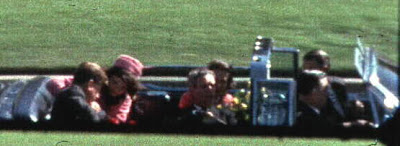
Zapruder film, about a second before the fatal head shot. Everything
has happened so fast that the driver (head turned) is just noticing that
something is wrong.
As noted above, the Zapruder film, while bearing out the testimony of Governor Connolly in regards to his movements and reactions, does not bear out the testimony of his wife. Mrs. Connolly said Kennedy reacted to the first shot by grabbing his throat, then the second shot hit her husband and he reacted. The film proves this was not the case. In the film, you can see Connolly looking to his left just seconds before the first shot, then the first shot presumably occurs and he turns very quickly to his right. As of this moment, Kennedy is still waving and has clearly not been hit yet. So the first shot would appear, in fact, to have missed. A second or two later, as Connolly is still turning to his right and apparently trying to see if Kennedy is okay, Kennedy suddenly reaches up with balled fists towards his throat. At that same instant, Connolly seems to react, and a screen shot from the Zapruder film, enhanced by modern technology, seems to show a ballooning in his shirt in the exact spot where the bullet was known to have exited Connolly’s chest. All this supports a single bullet theory.
The final destruction of the Magic Bullet theory comes when all of this is put into the computer simulation. The Magic Bullet theory was based on the belief that the trajectory could not have been right for the bullet to pass cleanly through Kennedy and into Connolly, and that some of Connolly’s wounds, therefore, must have come from a different shooter. In “JFK,” when Kevin Costner is showing all the twists and turns the bullet would have needed to take, he gets three important facts wrong.

A diagram of the Magic Bullet Theory as presented in "JFK."
First, in the movie’s reenactment, Connolly was seated directly in front of Kennedy. In fact, the jump seat Connolly was in was six inches off center from Kennedy’s seat, meaning that Connolly was six inches toward Kennedy’s left, not directly in front of him. Furthermore, the jump seat was lower than the seat Kennedy was in, so while the movie reenactment had Connolly and Kennedy sitting at the same height, Connolly was in reality three inches below Kennedy. Finally, and most importantly, the movie reenactment had Connolly facing forward with his shoulders square at the moment of impact. The Zapruder film, and Connolly’s own testimony, prove that Connolly was in fact turned to his right, not sitting with his back to Kennedy, at the time of the wounding shot.
Programming all these facts into the computer simulation allows the viewer to follow the trajectory of the bullet from gun to target. Taking into account the aim of the rifle, the distance and power of the rifle, the exact location of the car, the exact location of the men within the car, and the exact body positions of the men at the moment of impact, and programming all these things into the computer so that the event can be viewed from any angle, it becomes apparent that, in fact, a single bullet would have had a clear and straight path to cause the wounds found in Kennedy and Connolly.

Computer simulation of the second shot. Note the position
Connolly is in when the shot hits, giving a perfect trajectory,
and ruining any Magic Bullet theories.
Yes, the bullet would have passed through several layers of clothing as well as lots of skin, tissue, and bone, but a bullet fired from the kind of gun Oswald was shooting could very easily have passed through all those things. It was not a pop gun he was shooting, but a high-powered rifle, and from a relatively short distance.
With the Dictabelt recording and Magic Bullet theory adequately debunked, and adding in the ear witness accounts regarding the number and direction of gunshots, the evidence for a second gunman in Dealey Plaza that day is essentially nonexistent.
LEE HARVEY OSWALD
We have taken a long look at all the weaknesses in the various conspiracy theories and popular depictions of Kennedy’s assassination. Now it is important to look at the one figure we know was involved, and see if the evidence suggests that he might have been capable of hatching and pulling off the assassination on his own.
Oswald was born in New Orleans in 1939. According to people who knew him, including his own brother who is still alive, Oswald was a very troubled and mentally disturbed individual. His natural father died two months before he was born, and his mother was described as emotionally volatile and domineering. The family moved around a lot, and Oswald had lived in twenty-two different homes and attended twelve different schools by the time he was eighteen. He also spent over a year in an orphanage when his mother was unable to care for the kids. He was known as a loner, was described as someone who had delusions of his own immortal importance in the world, and seemed frustrated that the world did not seem to recognize his magnitude.
At fourteen, after a series of problems at a school he attended in New York City, including an incident where he threatened his stepbrother’s wife with a knife, a psychiatrist noted that he had a vivid fantasy life and tried to compensate for his own shortcomings and personal frustrations with ideas of his own omnipotence and power. He was diagnosed as being passive-aggressive and having schizoid tendencies. Further psychiatric intervention was recommended, but his mother decided around that same time to move back to New Orleans, and the counseling was never completed.
Oswald dropped out of school in the 9th grade, and by the age of sixteen had become an ardent Marxist and Socialist. Despite this, he wanted to follow in his older brother’s footsteps and join the Marine Corps – he idolized his older brother, and he likely thought the Marine Corps would be a free ticket to get out from underneath his mother’s tyrannical rule.
He joined the Marines at age seventeen and was trained as a sharpshooter. Despite the assertion in “JFK” that Oswald was only an “average” shot, this is simply not the case. Those who knew him during his tenure with the Marines described him as an excellent sharpshooter, and this is further evidenced by the existing records of his scores during target practice. Those records show that he routinely reached scores as high as 48 out of 50 and 49 out of 50 on long range rifle shooting – that is, from 200 yards. By way of comparison, the distance from his nest in the Texas School Book Depository to Kennedy’s car was less than 100 yards. Additionally, while in the Marine Corps, he qualified in separate tests first as a marksman, and then as a sharpshooter.
Despite this, his feelings of ostracism only deepened in the Marine Corps. Because of his small stature, he had a hard time garnering any respect, and his increasingly outspoken views on Socialism caused his fellow corpsmen to nickname him “Oswaldskovich.” For various offenses he was court-martialed twice, was demoted in rank, and even spent time in the brig.
In 1959, he was discharged from the Marines, went home for three days, and then immediately left the United States planning to immigrate to Russia. He had begun learning Russian while in the Marine Corps, and when he arrived in Moscow saying he wanted to denounce his citizenship in the U.S. and become a Russian, it caused somewhat of a stir, publicly. He was interviewed by Russian news outlets, and the KGB had a file on him. They initially feared he might be an American spy. After recognizing that he was mentally unstable, had a bad record, and would serve no real use to the Soviet Union, his request for citizenship was denied. Distraught at having to return to America, he made a superficial suicide attempt, but it was enough for Russian authorities to keep him around longer, under psychiatric evaluation. Eventually, although the KGB investigators advised against it, the Soviets allowed him to stay.
He was sent to Minsk, where he lived and worked for the next three years or so.

Lee Harvey Oswald as he looked during his
stay in the Soviet Union.
He married a Russian woman named Marina Prusakova, and they had a child together.

Oswald's wife, Marina.
However, he eventually grew disillusioned with life in the Soviet Union, and finally returned to the United States in the summer of 1962. This actually gained him a small amount of national attention at the time, as he was a former Marine who had defected to the Soviet Union and then returned home. His brother and mother were living in Dallas at the time, so he moved there with his Russian wife and young son.
Friends of the couple (who were mostly Russian immigrants) noted that Oswald was known to abuse his wife, and they frequently tried to talk her into leaving him. In July of 1962, about a month after returning from Russia, Oswald got a job with a welding company, but quit after three months. In October he began working for a typesetting firm. His time there was noted by conflict with other employees and marked inefficiency. He also appears to have used the company machines to produce fake identification papers for himself, using the alias “Alek James Hidell.” In April of 1963, after six months with the typesetting firm, he was terminated.
AN ASSASSINATION “TRIAL-RUN”
Just one day before his termination, the series of photographs that have become famous as the “backyard photos” were taken by Oswald’s wife in the backyard of their home.

One of the "backyard photos." Marxist newspapers
are in Oswald's hand, and the revolver he later used
to murder J.D. Tippet with is at his side.
The photographs show Oswald posing with a new rifle, which he was clearly proud to have purchased. He had bought it through a mail-order company in Chicago, using his alias, and had it mailed to his Dallas post office box.

Oswald's mail order rifle.
In some of the pictures, Oswald is seen to be holding a pair of Marxist newspapers. He is also wearing a pistol in a hip holster. On one of the photographs, the caption “Hunter of fascists – ha ha ha!!” is written on the back in Russian.
These photographs (and particularly the anti-fascist caption) are important not only because they show Oswald holding the rifle that he eventually used to assassinate Kennedy with, but also because ten days later, on April 10, 1963, Oswald appears to have made his first legitimate attempt at assassinating someone.
Edwin Walker was a former U.S. army general who had been relieved of his duties by the Kennedy administration because he was found passing out right-wing literature to his soldiers.

General Edwin Walker
He was an outspoken anti-Communist and segregationist, and had taken an active role in resistance to the integration of the University of Mississippi in 1962. He had been arrested for his role in that action, but the charges were dropped – an event that caused front page news. Walker had also run for the governor’s seat of Texas – a seat won by John Connolly. According to Oswald’s wife in the interviews with the Warren Commission, Oswald had considered Walker to be the leader of a “fascist organization.”
Seven days after Walker gave a speech wherein he called for the U.S. to “liquidate the scourge that has descended upon the island of Cuba,” Oswald purchased his mail-order rifle.
At some point in March of 1963, Oswald “staked out” Walker’s home, going so far as to take pictures of it – pictures that were later found among his belongings. These photographs, incidentally, were taken with the same camera that took the “backyard photos” of Oswald with his rifle. The Warren Commission also discovered that he left a note to his wife in Russian giving her a set of instructions to follow if he should be arrested or otherwise disappear.
Oswald carried out the attempt on April 10th, but failed. His bullet struck the window frame and was deflected, hitting Walker – who was sitting at his desk – in the arm. At the time, the attempted murder was an unsolved case and the police had no suspects. Oswald’s involvement was not discovered until after his own death later that year, when the note to his wife, and the pictures of Walker’s house, were discovered. At that time, his wife admitted that Oswald had told her about his involvement, but only after the attempt.
OSWALD IN NEW ORLEANS AND MEXICO CITY
Shortly after his failed assassination attempt on Walker, Oswald left Dallas for New Orleans, and got another job, this time as a machinery worker with a coffee maker manufacturing company. He was fired, again, from this job after only a short time, for inefficiency. While in New Orleans with his wife, and apparently incapable of being content no matter where he went, he began discussing the possibility of going back to the Soviet Union.
Around this same time, Oswald got involved with a pro-Castro organization, and set up his own New Orleans chapter – membership one. He spent time passing out literature and fliers with his alias (“A.J. Hidell”) listed as chapter president.
In August, Oswald was arrested after an altercation with an anti-Castro group who confronted him while he was passing out literature. He was arrested and spent a day in jail.

Mug shot of Oswald following his arrest in New Orleans.
The incident gained him some notoriety, however, and he was interviewed by a local journalist, and later was featured in a series of radio “debates” with some of the anti-Castro faction he had originally been arrested with.
It was during this time in New Orleans that attorney Jim Garrison of “JFK” fame later linked Oswald to Clay Shaw and several other alleged “conspirators.” However, as already illustrated, the testimonies linking Oswald with these people were inconsistent and uncorroborated, and none of the witnesses who testified to these things ever told the Warren Commission during the initial investigation.
In September of 1963, Oswald sent his wife back to Dallas, but instead of going with her, he traveled to Mexico City. According to witnesses on his bus, he openly admitted that he was hoping to travel to Cuba by way of Mexico. Once in Mexico City, he visited the Cuban embassy, asking for permission to travel to Havana, telling them he wanted to visit Cuba before returning to the Soviet Union. The Cuban embassy in Mexico City was not forthcoming, however, and Oswald went back to Dallas on October 3rd.
THE WINDS OF BLIND FATE
After getting back to Dallas, Oswald found yet another job, this time at the Texas School Book Depository, filling book orders. During this time, Oswald was living in Dallas in a rooming house, and his wife was living with friends in nearby Irving, Texas. In late October, his wife gave birth to their second child. By this time, the FBI had already begun to take notice of Oswald and his wife, and actually visited the home where his wife was staying on two separate occasions in early November of 1963.
As the winds of fate would have it, the Dallas newspaper carried a story on November 16th, 1963, saying that President Kennedy would be coming through downtown Dallas on November 22nd. On November 19th, the entire route of the president’s motorcade was mapped out in the newspaper, revealing that the motorcade would be driving right past the Texas School Book Depository.
On November 21st, Oswald asked a co-worker to give him a ride to Irving, telling the co-worker he needed to pick up some curtain rods from his wife’s home. He left $170 for his wife, along with his wedding ring, and returned with the co-worker to Dallas, toting a long paper bag. He took this paper bag with him to work on the morning of November 22nd. The last confirmed citing any co-worker had of him on that fateful day was about thirty-five minutes prior to the assassination, on the sixth floor.
After the assassination, Oswald quickly fled his nest, leaving the gun behind, and was next seen on the 2nd floor lunch area with a bottle of Coke in his hand. There, he was confronted by a police officer, but was allowed to pass because his supervisor assured the officer that he was an employee. Oswald immediately left the building, which was perhaps unfortunate for him, because he proved to be the only employee missing during a headcount a short time later. Bulletins were immediately put out around the city with his description. After leaving the building, he went back to his rooming house, where he changed clothes and left in a hurry.
He was next seen about a mile away, when he was confronted by police officer J.D. Tippit, who apparently recognized his description and pulled his squad car up to the sidewalk to question him. As Tippit got out of his car, Oswald shot and killed him with the revolver he had been wearing in the “backyard photos.” A number of people witnessed the murder. Oswald fled the scene, and ducked into a nearby movie theater, where his suspicious manner was immediately noticed. Police were called, and Oswald was arrested after a scuffle inside the theater.

Possibly the only color photo ever taken of Oswald during his
life. This was taken at police headquarters on November 23rd,
1963. Note the scratch on his head and the black eye from his
scuffle with police in the Texas Theater.

The seat Oswald was sitting in when he was arrested at the Texas Theater.
CONCLUSION
I have strayed a bit in giving details of Oswald’s actions prior to and after the assassination, but the overall picture that one gets when looking at Oswald’s life is that of a highly-disturbed neurotic with delusions of his own importance in world history. In fact, this picture fits perfectly with the common image of any assassin – someone who believes that they will gain the notoriety they deserve if they can only succeed in killing someone powerful and famous. One is reminded of John Hinckley who attempted to assassinate Ronald Reagan, believing it would impress his favorite actress (Jodie Foster) enough that she would fall in love with him.
Oswald was a troubled youth. He was diagnosed as a teenager as having schizoid tendencies. He had problems in school. He could not hold down a job and was routinely fired for poor performance and aggressive behavior. In the Marines, he lost his rank due to his emotional problems and spent time in the brig. He was known to abuse his wife physically and emotionally. He was a loner and a drifter. He was an avowed Marxist and immigrated to Russia, but then later became disillusioned with the U.S.S.R., and returned to the States. Yet within a year, he was already making plans to go back to Russia. While it is uncertain exactly when Oswald first began having ideations about assassinating someone powerful, it is clear that he had picked a target by the early part of 1963. He purchased the gun he needed to do the job, staked out the spot, and then carried out the attempt. He failed, but he had crossed a psychological line.
After more trouble with the law, and more disillusionment throughout 1963 for Oswald, the winds of fate blew the President of the United States in an open-air car right past the building where this attempted murderer and trained sharpshooter just happened to have gotten a job a month earlier. If someone – for instance, during his time in New Orleans or Mexico City – had been conspiring with Oswald to assassinate the president, they could not possibly have foreseen such a circumstance. What are the chances that Oswald and others would conspire to kill the president, and then voila, a month later, the president just happens to drive right past the place where Oswald worked in downtown Dallas? The chances against such a coincidence are astronomically low.
It seems clear that Oswald, upon learning that the president – unbelievably – was going to be driving right past his place of employment, saw the opportunity to pull off what he had failed to pull of with General Edwin Walker. After a lifetime of disappointment and disillusionment, what else was going to give him the fame and notoriety that he so clearly felt he deserved?
Oswald had the personality, the means, and the motive to assassinate Kennedy. The vast majority of ear witnesses heard three or fewer shots, and more than half of those people said the shots came solely from the Texas School Book Depository, including two employees who were on the 5th floor right beneath Oswald. Three cartridges were found in Oswald’s nest, and the gun was shown to have fired only three shots. No one on the grassy knoll heard any shots, or saw any fleeing gunmen, in that vicinity. New computer simulations prove that all the wounds suffered by the occupants of Kennedy’s car could have legitimately come from the Texas School Book Depository, effectively destroying the Magic Bullet theory. Those same models show that there was enough time in between shots for a marksman to legitimately cock and re-fire the rifle three times. Conspiracy theories tying in the Mafia, Jack Ruby, Cuba, and the KGB have no basis in fact and cannot be supported by any reliable evidence, despite years of trying. Dictabelt evidence suggesting four shots were fired has been proven unreliable and inaccurate.
Taken together with everything else, it seems abundantly clear that the original Warren Commission investigation was right all along – there was one gunman, it was Lee Harvey Oswald, he was shooting from the 6th floor of the Texas School Book Depository, he fired three shots, the first shot almost certainly missed, but likely ricocheted to cause injury to a bystander, the second shot hit Kennedy, passed through him, and hit Connolly, and the third shot hit Kennedy in the head and killed him. There is simply no other reliable evidence to suggest any other scenario.
The case, in my book, is closed.
* I have intentionally omitted references in this article because this format is not conducive to footnotes. However, to ensure that I do not step on any virtual toes, let me state that the following includes all of my sources for the information I espoused in this article:
1) My own personal knowledge of the subject, based on years of casual reading, television viewing, and studying on the topic;
2) A 2003 ABC News documentary (replayed on The History Channel) arguing for a lone gunman, and including interviews with numerous people associated with the case, as well as all the computer simulations and Dictabelt evidence that I mentioned;
3) The Warren Commission Reports, as published on www.history-matters.com; and
4) Wikipedia; I also cite by reference any of the sources cited on Wikipedia’s numerous entries on the subject.

INTRODUCTION
I have spent most of my life, and certainly all of my adulthood, believing that the Kennedy assassination was perpetrated by multiple gunmen, all acting as part of a larger conspiracy. This belief was reinforced into absolute certainty by Oliver Stone’s 1991 film “JFK,” which seemed to prove outright that Lee Harvey Oswald could not have been acting alone. Indeed, that film made such an impact on our popular culture, it would seem most people today have perspectives on the assassination colored by that movie – even those who never saw it – because the ideas presented in the film seeped into and saturated society-at-large. This is evidenced by an ABC News poll in 2004 showing that 70% of Americans still believe there was a broad conspiracy surrounding the assassination, against only 22% believing that Oswald acted alone. 68% believe there was an official government cover-up. Additionally, 51% are convinced there were multiple gunmen in the plaza that day, and – perhaps most amazing of all – 7% think Oswald was not involved at all!
But does the available evidence support these contentions? After a lifetime of casual historical interest in this subject, I have recently delved deeply into the facts of the case. As a result, I have changed my opinions entirely: I am now utterly convinced that Oswald was, in fact, acting alone.
BACKGROUND
In case anyone does not know much about the facts and theories of the Kennedy assassination, I will provide a brief overview.
Kennedy was shot on Friday, November 22nd, 1963, in Dallas, Texas. In the car that day were two secret service agents – one driving and one in the front passenger seat – Kennedy and his wife in the backseat, and Texas Governor John Connolly and his wife in two jump seats between the secret service agents and the Kennedys. Connolly was sitting right in front of Kennedy, and both were on the right side of the car. The motorcade was passing through an area of downtown Dallas called Dealey Plaza, which housed, among other things, the Texas School Book Depository. It was from the 6th floor window that Lee Harvey Oswald shot Kennedy. Oswald had been an employee at the Depository.

Dealey Plaza. The Texas School Book Depository is the large building
at the top center. The people on the sidewalk are standing at the base
of the "grassy knoll," right at the spot where Kennedy was shot.

Warren Commission photograph taken from Oswald's nest, looking
out toward where Kennedy was shot. Oswald had used the boxes in the
foreground to steady his weapon.
The Warren Commission – the government committee slated to investigate the assassination – determined that Oswald had acted alone and not part of a conspiracy, and that he had fired three shots. The first, they contended, had missed, but had likely ricocheted off a nearby curb and manhole, causing a piece of concrete to fly and wound a bystander. The second hit Kennedy in the back and passed through him to wound Connolly in the chest, wrist, and thigh. The third hit Kennedy in the head, and was the killing shot. There are a number of videos and photographs of the assassination, but the most notable is one taken from the nearby “grassy knoll” by Abraham Zapruder, which shows in close detail the moment of the assassination. The grassy knoll was situated on the right side of Kennedy’s vehicle.
Oswald was arrested only hours after the murder, and was charged not only with Kennedy’s murder, but also the murder of a Dallas policeman named J.D. Tippit who had stopped to question him on the street. He was held and interrogated for two days, and while being taken out through the basement of police headquarters for transfer to the county jail on Sunday, November 24th, he was shot and killed by a man in the crowd named Jack Ruby. Because television crews were there, his murder was broadcast live on national television.
CONSPIRACY SCENARIOS
There are a number of conspiracy theories that people have postulated in regards to Kennedy’s assassination, ranging from involvement by Lyndon Johnson, to involvement by the FBI, CIA, and the Federal Reserve. These, however, are born primarily of people’s creative imagination, and have no basis in evidence whatsoever. In my opinion, the theories that warrant legitimate investigation are the Mafia conspiracy theory, and the Soviet/Cuban/KGB conspiracy theory.
THE MAFIA CONSPIRACY
This theory suggests that the Mafia was behind Kennedy’s murder and that they used Jack Ruby – a man with known Mafia connections – to silence Lee Harvey Oswald. The Mafia’s motivation is apparent: the Kennedy administration had dramatically stepped up action against mob bosses. Prior to that time, the Mafia had managed to largely escape prosecution, but under Kennedy, all that changed. As Attorney General, Kennedy’s own brother, Robert, was given the task of ending organized crime. Under the Kennedy administration, Mafia prosecutions increased by an astounding 1200% over the Eisenhower administration that had preceded it. As Tony Soprano might have said, the Mafia had good reasons for wanting to whack JFK.
As mentioned above, a key aspect of this theory was Jack Ruby’s shocking murder of Lee Harvey Oswald two days after the assassination.
JACK RUBY
Jack Ruby was a prominent Dallas nightclub owner with known connections to the Mafia.

Jack Ruby with some of his dancers.
According to personal accounts from people who knew and worked with him, he had a vicious and violent temper – a temper that could be set off in an instant. One moment, he could be laughing with a patron, and the next he could be grabbing the guy by the collar and throwing him out the door. He was a classic Type-A personality and was widely known to carry a concealed weapon. Significantly, he was also very patriotic, absolutely loved Kennedy, and was distraught to the point of crying when the assassination occurred. In the Warren Commission interviews, Ruby broke down in tears on at least one occasion when discussing the disrespectful way Kennedy had been killed: “Here is a man that fought in every battle, went to every country, and had to come back to his own country to be shot in the back.”
In a recent interview on a Kennedy assassination documentary, one of Ruby’s former dancers testified that on the day of the assassination, Ruby was extremely upset, talking over and over again about “those poor kids” (referring to Kennedy’s children), and saying that if he got the chance, he was going to “kill the son of a bitch” who had done this to the president he loved.
Because Ruby’s nightclub was a popular spot for local Dallas cops, Ruby was quite well-known by the Dallas police, and despite his Mafia ties, he apparently had a good reputation among them. For this reason, he had easy access to police headquarters when Oswald was paraded through. Photographs show that he was present when Oswald was brought through headquarters the first time following his arrest. If Ruby were being paid by the Mafia to silence Oswald, one would have to wonder why he failed to do it right then. Otherwise he might have missed his only chance.
Ruby was evidently so distraught by the assassination that he closed his nightclub all weekend. According to friends and employees, he spent most of the weekend mourning and brooding in his house. On Sunday morning, one of his dancers called to ask if he would wire her some money so she could pay her rent. He agreed, leaving his house sometime in the late morning, and taking one of his dogs with him in the car. If you planned on heading out to whack a possible squealer in front of every police officer in Dallas, would you take your dog with you?
Ruby proceeded to the local telegraph office, where he wired $25 to his employee, recorded on a slip stamped with the time of 11:17 a.m. Conveniently, police headquarters was right around the corner.
Ruby left the telegraph office and headed over to headquarters, presumably to see what he could find out about the ongoing investigation. Oswald had been interrogated that morning and was supposed to have been transferred around 10:00 a.m. However, the interrogation lasted longer than expected (something Ruby could not possibly have known), and afterward, Oswald asked if he could go change clothes prior to being transferred by car to the county jail. For this reason, and as fate would have it, he was brought through the basement of police headquarters at 11:21 a.m., about one minute after Jack Ruby walked up to the gathering of reporters.
If you have ever seen the famous photograph of the moment of Oswald’s murder, you probably are familiar with the police detective – named Jim Leavelle – in the white suit and white Stetson who was handcuffed to Oswald’s right arm, escorting him. He is still alive and has recently been interviewed about the events of that morning.
As the pair came through the door, Leavelle said that he joked with Oswald about someone shooting him. (Paraphrasing): “If someone decides to shoot you,” Leavelle told Oswald, “I hope they’re as good a shot as you are.” The implication, of course, was that Leavelle hoped he did not accidentally get shot himself. Leavelle said that Oswald chuckled at this. It was at that very moment, while Oswald was chuckling at the joke, that Ruby first saw him.

Oswald's murder. Detective Jim Leavelle is at left.
From here, you can connect the dots of the evidence. Ruby, distraught over the murder of a beloved president, widely known to be a gun carrier, and widely known to have an explosive and violent temper, grew enraged at seeing Oswald – the murderer of the president – laughing. He, of course, could not have known why Oswald was laughing. To him it would simply have appeared that Oswald had murdered Kennedy and did not have a care in the world about it. For this reason, Ruby pulled his gun, stepped forward, and shot Oswald in a moment of blind rage.
Ruby, of course, spent the rest of his life in jail, and insisted to his dying day that he had not been paid by anyone to kill Oswald. In interviews with the Warren Commission, Ruby stated that he had seen a newspaper article on that Sunday morning suggesting that Kennedy’s wife would have to attend the trial of Oswald. This upset him, as he felt it was adding insult to injury for Mrs. Kennedy. He went on to say: “…I got so carried away…No one else requested me to do anything. I never spoke to anyone about attempting to do anything. No subversive organization gave me any idea. No underworld person made any effort to contact me. It all happened that Sunday morning.” Later in the same testimony, Ruby said: “…I just was carried away emotionally…I had the gun in my right hip pocket, and impulsively, if that is the correct word here, I saw him [Oswald], and that is all I can say. And I didn’t care what happened to me.”
Was he lying to the Commission? I will answer that question with another question: What reason could Ruby have had – incarcerated for life as he was and facing the death penalty – to stay silent, if indeed he had been paid? Even his rabbi, with whom he spoke many times in confidence, testified that Ruby insisted, even in private consultations with a trusted religious advisor, that he acted completely on his own.
With these things in mind, one must ask several other questions. If Ruby was being paid to silence Oswald, who was being paid to silence Ruby? The very idea seems ridiculous. It would create an unending series of necessary “whacks” in order to silence each successive assassin. Furthermore, if Ruby was being paid to kill Oswald, why would he do it in such a way as to ensure beyond a shadow of a doubt that he was going to get caught? If you were being paid to assassinate somebody, would you do it in the middle of police headquarters, with dozens of law enforcement officers all around you, as well as cameras and reporters? To suggest that Ruby premeditated this murder, in this fashion, would be to say that Ruby was willing to give up all his success, all his fortune, and, in fact, his entire life, in order to silence Oswald. Such a suggestion, of course, is patently ridiculous. No Mafia organization could have given him sufficient motivation to do what he did.
All things considered, it seems evident that Ruby acted in a moment of blind rage based on circumstances that could not have been predicted, and that the murder was not in any way a premeditated “hit” purchased by some larger conspiring organization. Ruby’s own brother, who is still alive, has testified to the same thing. Jack Ruby killed Oswald in a moment of fury, because he hated the man who had murdered his beloved president and he wanted to keep Mrs. Kennedy from having to endure Oswald’s trial.
THE MAFIA CONNECTION DEBUNKED
With Jack Ruby’s personal motives quite clear, the Mafia connection already begins to wilt. But the case against the Mafia goes even farther than that. In the mid-1970’s, the Kennedy assassination was investigated by a Congressional committee, due to popular demand for answers. This board ultimately determined that a second shooter was probable, and that a conspiracy seemed likely. Robert Blakey, chief counsel and staff director of the committee, testified that he personally felt the Mafia was probably involved.
This belief, however, is suspect considering that the committee’s own Mafia expert – brought in to investigate possible Mafia ties – said there was absolutely no evidence whatsoever of any Mafia connections! This expert has said in recent interviews that he investigated every known Mafia boss who was in business at the time of the assassination, and could find no evidence of any connection to any of their groups. Furthermore, this expert stated that in all the years since the assassination, with all the countless Mafioso who have been paid to turn state’s evidence and testify against their leaders for various crimes, there has never been any connection to anything relating to Kennedy’s assassination.
The conclusion is clear – there is simply no reliable evidence to suggest the Mafia had anything to do with Jack Ruby’s murder of Oswald, or with the assassination of John F. Kennedy.
THE SOVIET CONNECTION
Communism, and specifically the Communist overthrow of Cuba in 1959, was one of the Achilles’ heals of the Kennedy administration. It was widely suspected (and later known) that the CIA was attempting to infiltrate Cuba and assassinate Castro. The U.S. had secretly masterminded the failed Bay of Pigs Invasion in 1961, where Cuban insurgents had attempted to overthrow Castro, and the Cuban Missile Crisis occurred just a year later, when the Soviet Union aimed missiles in Cuba toward the United States. At one point, several months before the assassination, Castro had even been quoted as saying that anyone who would attempt to assassinate him should be fearful for his own life instead. Lyndon Johnson, Kennedy’s vice-president and the man who became president upon Kennedy’s death, apparently believed this theory himself. On a tape recording made at some point during his presidency, Johnson was heard to say: “Kennedy was trying to kill Castro. Castro got him first.”
The problem with such an argument is this: masterminding Kennedy’s assassination would have been political suicide for Castro, and despite his many failings, one positive thing that can be said of Castro is that he was a savvy and shrewd politician. It seems unlikely he would have jeopardized his power by arranging the assassination of the United States president.
But that is subjective. What evidence can be found to support a connection between Communism, Castro, and Kennedy’s death?
The answer is none.
Like the Mafia connection, there is simply no reliable evidence to suggest any involvement by Castro or the KGB. The “evidence” of Castro’s involvement is purely speculative and circumstantial. The expert slated by Congress in the 1970’s to investigate this avenue met personally with Castro, interviewed ex-KGB officers, and investigated pro-Soviet groups in Mexico City – a place where Oswald had visited just a month or two before the assassination, apparently attempting to defect to Cuba – and he found no evidence of any connection to any of these groups.
Additionally, the KGB agent who worked Oswald’s case when he immigrated to the Soviet Union in the early 1960’s is still alive and has recently been interviewed. This man, who is still, to this day, living in the U.S. under an assumed name, testified that the KGB had believed Oswald to be crazy, and would never have chosen him as an assassin. In fact, the KGB initially rejected Oswald’s request to immigrate, but only later changed its mind. The KGB, in fact, had suspected Oswald – a former Marine who had learned Russian in the Marine Corps – of working for the U.S.
Additionally, as with the Mafia connection, in the years since the fall of the Soviet Union, with the release of millions of secret documents, and with the stories and anecdotes of former KGB agents and other Soviet insiders, there has never been a single shred of evidence come to light suggesting any tie with the Soviet Union or Cuba to Kennedy’s murder.
THE HOUSE SELECT COMMITTEE ON ASSASSINATIONS
As mentioned earlier, popular demand led to the formation of a government committee to re-open the Kennedy investigation in the 1970’s. The HSCA, as it came to be known, investigated not only the assassination of Kennedy, but also Martin Luther King, Jr. They spent four years looking into all the various conspiracy theories, viewing the films, analyzing evidence, and taking interviews. In 1978, they were just a few weeks away from issuing a report that more or less vindicated the original government report by the Warren Commission suggesting that Oswald acted alone. None of their investigations found evidence of any connection to Cuba, the KGB, the Mafia, the CIA, or the FBI. However, at the last minute, a new piece of evidence came into the picture which changed their assessment of a lone gunman entirely.
THE DICTABELT RECORDING
Much less known than the various video films of Kennedy on the day of the assassination was an audio recording made by a policeman’s motorcycle Dictabelt during the assassination. The Dictabelt was simply a recording device used by police officers in the days before dashboard-mounted video cameras. The audio feed from an officer’s Dictabelt went directly to police headquarters, where it was recorded.
At the time of the HSCA’s report, new scientific analyses by prominent audiologists from the City University of New York had suggested that this little known recording proved that four shots were fired in Dealey Plaza that day, not three as the Warren Commission had stated. It is an established fact that only three cartridges were found in Oswald’s nest, and forensic tests on his rifle corroborated that it had only been fired three times. So where did this fourth shot come from? The recording in question had been triggered inadvertently by a police officer just two minutes before the murder, and according to these scientists, it provided acoustic evidence that three shots were fired from the direction of the Texas School Book Depository, and one shot was fired from the direction of the now infamous “grassy knoll” in front of Kennedy’s car. The audiologists said the probability, based on the recording, of a fourth shot from the grassy knoll was “95%.”
The key to the analysis, however, was an assertion that the recording had come from the motorcycle of Officer H.B. McClain, and that McClain had been in Dealey Plaza, turning the corner from Houston Street to Elm Street right in front of the Texas School Book Depository at the time of the shots. McClain, however, said that he had, in fact, been a block away at the time of the shots, and therefore could not have been in the right spot to make the analysis work.
Despite this, the committee was convinced by the scientific analysis of the audio recording. They changed their report, and while they ruled out any conspiracies involving the KGB, Soviet Union, organized crime, and a number of others, their report suggested that there were four shots, not three, and that the fourth shot came from the grassy knoll, but missed. They agreed, then, that Oswald’s shots alone had killed Kennedy and wounded Governor Connolly. However, the presence of a second shooter implied a conspiracy, so while they ruled out all the traditional conspiracy theories, they argued that Oswald was not working alone.
It is important to keep in mind that despite this new assertion that there had been multiple shooters, including one on the grassy knoll, 99 out of the 104 “ear witnesses” to the direction of the gunfire testified that the shots they heard all came from one spot. Over half of those witnesses marked that one spot as the Texas School Book Depository, including both Governor and Mrs. Connolly, and both secret service agents in Kennedy’s car. Only five ear witnesses testified to hearing gunshots coming from two locations, as asserted by the Dictabelt scientists.
Of the few people who were on the grassy knoll at the time of the assassination, none testified to hearing shots from that area, and none testified to seeing anyone fleeing from the area. In fact, the only three ear witnesses on the grassy knoll all agreed that the shots they heard came from the Texas School Book Depository – and they would have been in the best position to determine if a shot had come from right behind them. Abraham Zapruder and his secretary Marilyn Sitzman were standing on a retaining wall on the grassy knoll, filming the motorcade as it passed. Sitzman was one of those who testified about gunshots, and she summed it up best: “The blast of a high-powered rifle [from the grassy knoll] would have blown me off that wall.”
Finally, even though there was some discrepancy as to the direction of the shots, it was nearly universally agreed by all ear witnesses that only three shots were fired. A total of 178 people testified to hearing gunshots that day (of those, only the aforementioned 104 testified about the direction). Of the 178 ear witnesses, 132 reported exactly three shots, and another 24 reported hearing only one or two shots. That means 88% of the ear witnesses agreed that no more than three shots were fired. Of the remaining 22 testimonies, nearly half could not identify how many shots they heard. Only 6 of the 178 ear witnesses – less than 4% – claimed to have heard four shots.
THE DICTABELT RECORDING DEBUNKED
In recent years, new analyses of the recording, as well as a complete computer simulation of the assassination, has satisfactorily put to rest the evidence from the Dictabelt recording.
A review by the National Academy of Sciences in 1982 was the first analysis to cast doubt on the HSCA’s findings. Their conclusion was based on the fact that the words “Hold everything secure” can be heard on the tape right at the same time that the supposed gunshots were being fired. Those words, however, were known to have been uttered by Dallas Sheriff Bill Decker over 2-way radio about a minute after the assassination had occurred. Thus, the sounds that the audiologists interpreted as gunshots could not have been gunshots because they occurred a minute too late.
Later analyses by various groups have found that the methods used by the HSCA’s scientists were fundamentally flawed for a variety of technical reasons, relating mostly to impulse patterns.
Finally, new computer simulations show that H.B. McClain was, in fact, not at the corner of Houston and Elm, as the HSCA’s experts said. Dale Myers, a computer animator, spent over ten years analyzing the various videos and photographs of the assassination, and programming his findings, frame-by-frame, into a complete computer simulation. This simulation allows the viewer to see the assassination, all of Dealey Plaza, and all of the people and vehicles that were in Dealey Plaza that day, from any angle. His work was broadcast on a 2003 ABC News documentary on the assassination, which he later won an Emmy for.
Using this simulation, H.B. McClain’s position at the moment of the assassination can be accurately determined. As such, the simulation shows McClain to be exactly where he testified he had been – one block away from the Texas School Book Depository, at the intersection of Houston Street and Main Street. This means that he was not in the area where the HSCA’s experts said he needed to be for the analysis to be accurate.

Dealey Plaza, annotated. McClain was at the corner of Houston and Main
when the shots were fired, too far away for his Dictabelt to have recorded
the sounds.
During the 1978 investigation, Mark Weiss – one of the committee’s audiologists – was asked if the location of McClain’s vehicle was vital to the analysis. He responded as follows: “It is an essential component of it because if you do not put the motorcycle in the place that it is…you do not get a good, tight pattern that compares very well with the observed impulses on the police tape recording.”
The conclusion seems clear: the one piece of evidence given by the HSCA to support a theory of multiple gunmen has been proven unreliable. In the end, it is most likely that the Dictabelt recording, in fact, originated from a police officer who was not even in Dealey Plaza, and the “impulse” patterns heard on the recording were not gunshots at all.
“JFK” AND THE MAGIC BULLET
If the HSCA’s multiple gunmen conclusion in 1978 was not enough to encourage conspiracy theorists, Oliver Stone’s 1991 movie “JFK” certainly worked wonders on fueling their theories surrounding Kennedy’s murder. Stone admitted to using “dramatic license” in the film, but upon investigation, this seems a dreadful understatement.
First, the characterization is misleading. The main character, played by Kevin Costner, is based on a New Orleans district attorney named Jim Garrison, who decided on his own to investigate the assassination in the late 1960’s. He eventually arresting a local businessman named Clay Shaw and charging him with conspiracy to assassinate Kennedy. Shaw was played by Tommy Lee Jones in the film.
In the movie, Jim Garrison is depicted as a hero. He is the great American lawyer refusing to bow to an obvious government cover-up, and he is a loveable, warm family man, intent on bringing the truth to light.
Unfortunately, the reality was apparently quite different. Co-workers and acquaintances knew Jim Garrison as controlling, manipulative, obsessive, cruel, and narrow-minded. Garrison had been relieved of active duty in the National Guard in the 1950’s with one doctor stating that he had “severe and disabling psychoneuroses” and was considered totally incapacitated for military service and “moderately incapacitated in civilian adaptability.” Additionally, he had a reputation for arresting people first and asking questions later; critics pointed to the fact that suspects he arrested frequently had their charges dropped and were later released. He also had a tendency to make public statements against groups of people (the state legislature, for instance) without any supporting evidence. He was unanimously censured by the state legislature of Louisiana in the 1960’s for suggesting they were all taking bribes. He also suggested the state parole board was taking bribes, and once arrested nine police officers for police brutality, but was forced to release them two weeks later with practically no evidence. He was personally charged and convicted of misdemeanor criminal defamation in 1963 when he falsely accused a panel of judges of racketeering and conspiring against him after a dispute over his budget.
This paints a picture of an obsessively paranoid lawyer with delusions of his own power; a man who was not afraid to step far outside the boundaries of the law to make a case. This could not have been more strongly illustrated in his arrest of Clay Shaw. Shaw was a businessman in New Orleans, and Garrison found a witness – a man with a checkered past who was a known drug user – who claimed to have seen Shaw in a meeting with Oswald and several others, discussing killing Kennedy. The man’s story was not consistent, however, and this inconsistent story from an unreliable witness was practically the only evidence Garrison had against Shaw. It took the jury exactly 54 minutes to acquit him.
Other lies abound in the movie, most notably the famous argument about the “Magic Bullet.” This theory, pushed into the public consciousness by the movie, argues that for Kennedy and Connolly to have been struck by the same bullet – as the Warren Commission and the lone gunman theorists suggest – the bullet would have needed to change direction several times in midair. The famous scene has Kevin Costner showing how the bullet would have veered to the left, then to the right, then downward, then upward, etc.

Kevin Costner as Jim Garrison explaining the Magic
Bullet theory.
The point of this argument was that Connolly and Kennedy were wounded by separate bullets, coming from two different directions – thus, two gunmen.
The Magic Bullet theory seemed so well-argued in the movie that most people accepted it outright. It was made even more amenable by the fact that Connolly himself, along with his wife, had insisted that the bullet that struck him was different than the bullets that struck Kennedy. The Connolly’s agreed that only three shots were fired, and that Oswald was acting alone, but they insisted that the first shot hit Kennedy, the second hit Connolly, and the third hit Kennedy again. An Associated Press photographer, Ike Altgens, who captured the moment of Kennedy’s first wound in a famous still image, claimed that he snapped his picture at the moment he heard the first shot. He claimed, however, to have heard only two shots, with the second shot being the one that hit Kennedy in the head. It would seem clear to me that he simply did not hear the actual first shot.

Altgens' photograph, which he says was taken just after the first shot,
but before any subsequent shots. Note that the crowd has no idea anything
has happened yet. Kennedy is behind the rear-view mirror, clutching his
throat, with Jaqueline's white-gloved hand on his arm. Connolly (turned
sideways) is also already reacting to being hit. The man in the front
passenger seat is glancing in the rear-view mirror. Note the motorcycle
officer looking over his shoulder, having clearly heard the shots.
Regardless, the Emmy-winning computer simulation mentioned earlier proves that not only is the Magic Bullet theory a lot of hocus pocus, but that the Connollys’ and Altgens' recollection of events is simply not accurate.
THE MAGIC BULLET THEORY DEBUNKED
A careful, frame-by-frame viewing of the Zapruder film shows that Connolly and Kennedy both reacted in almost the same instant to being shot.

Zapruder Film, the instant after the second shot was fired. Note that
Connolly has already reacted to being hit, clearly by the same bullet
that struck Kennedy.

A moment later. This frame from the Zapruder film was
made at approximately the same instant that the Altgens
photograph, shown above, was snapped. Notice that Mrs.
Kennedy's face is not yet revealing any surprise or fear,
but Govenor Connolly is already reacting in pain to the
gunshot wound.
Connolly testified that he heard the first shot, and recognized it immediately as a shot from a high-powered rifle (many other ear witnesses mistook the first shot for a firecracker). He testified that he was looking to his left when he heard the first shot, then immediately turned to his right, to the direction from where he heard the shot originate. He believed Kennedy had been hit by this shot, though he admitted that he could not see Kennedy at this point. As he turned to his right, he heard the second shot, and immediately realized he was hit. His wife testified that she heard the first shot, saw Kennedy react, then heard the second shot and saw her husband react, at which point she pulled him into her lap and did not look back at Kennedy again.

Zapruder film, about a second before the fatal head shot. Everything
has happened so fast that the driver (head turned) is just noticing that
something is wrong.
As noted above, the Zapruder film, while bearing out the testimony of Governor Connolly in regards to his movements and reactions, does not bear out the testimony of his wife. Mrs. Connolly said Kennedy reacted to the first shot by grabbing his throat, then the second shot hit her husband and he reacted. The film proves this was not the case. In the film, you can see Connolly looking to his left just seconds before the first shot, then the first shot presumably occurs and he turns very quickly to his right. As of this moment, Kennedy is still waving and has clearly not been hit yet. So the first shot would appear, in fact, to have missed. A second or two later, as Connolly is still turning to his right and apparently trying to see if Kennedy is okay, Kennedy suddenly reaches up with balled fists towards his throat. At that same instant, Connolly seems to react, and a screen shot from the Zapruder film, enhanced by modern technology, seems to show a ballooning in his shirt in the exact spot where the bullet was known to have exited Connolly’s chest. All this supports a single bullet theory.
The final destruction of the Magic Bullet theory comes when all of this is put into the computer simulation. The Magic Bullet theory was based on the belief that the trajectory could not have been right for the bullet to pass cleanly through Kennedy and into Connolly, and that some of Connolly’s wounds, therefore, must have come from a different shooter. In “JFK,” when Kevin Costner is showing all the twists and turns the bullet would have needed to take, he gets three important facts wrong.

A diagram of the Magic Bullet Theory as presented in "JFK."
First, in the movie’s reenactment, Connolly was seated directly in front of Kennedy. In fact, the jump seat Connolly was in was six inches off center from Kennedy’s seat, meaning that Connolly was six inches toward Kennedy’s left, not directly in front of him. Furthermore, the jump seat was lower than the seat Kennedy was in, so while the movie reenactment had Connolly and Kennedy sitting at the same height, Connolly was in reality three inches below Kennedy. Finally, and most importantly, the movie reenactment had Connolly facing forward with his shoulders square at the moment of impact. The Zapruder film, and Connolly’s own testimony, prove that Connolly was in fact turned to his right, not sitting with his back to Kennedy, at the time of the wounding shot.
Programming all these facts into the computer simulation allows the viewer to follow the trajectory of the bullet from gun to target. Taking into account the aim of the rifle, the distance and power of the rifle, the exact location of the car, the exact location of the men within the car, and the exact body positions of the men at the moment of impact, and programming all these things into the computer so that the event can be viewed from any angle, it becomes apparent that, in fact, a single bullet would have had a clear and straight path to cause the wounds found in Kennedy and Connolly.

Computer simulation of the second shot. Note the position
Connolly is in when the shot hits, giving a perfect trajectory,
and ruining any Magic Bullet theories.
Yes, the bullet would have passed through several layers of clothing as well as lots of skin, tissue, and bone, but a bullet fired from the kind of gun Oswald was shooting could very easily have passed through all those things. It was not a pop gun he was shooting, but a high-powered rifle, and from a relatively short distance.
With the Dictabelt recording and Magic Bullet theory adequately debunked, and adding in the ear witness accounts regarding the number and direction of gunshots, the evidence for a second gunman in Dealey Plaza that day is essentially nonexistent.
LEE HARVEY OSWALD
We have taken a long look at all the weaknesses in the various conspiracy theories and popular depictions of Kennedy’s assassination. Now it is important to look at the one figure we know was involved, and see if the evidence suggests that he might have been capable of hatching and pulling off the assassination on his own.
Oswald was born in New Orleans in 1939. According to people who knew him, including his own brother who is still alive, Oswald was a very troubled and mentally disturbed individual. His natural father died two months before he was born, and his mother was described as emotionally volatile and domineering. The family moved around a lot, and Oswald had lived in twenty-two different homes and attended twelve different schools by the time he was eighteen. He also spent over a year in an orphanage when his mother was unable to care for the kids. He was known as a loner, was described as someone who had delusions of his own immortal importance in the world, and seemed frustrated that the world did not seem to recognize his magnitude.
At fourteen, after a series of problems at a school he attended in New York City, including an incident where he threatened his stepbrother’s wife with a knife, a psychiatrist noted that he had a vivid fantasy life and tried to compensate for his own shortcomings and personal frustrations with ideas of his own omnipotence and power. He was diagnosed as being passive-aggressive and having schizoid tendencies. Further psychiatric intervention was recommended, but his mother decided around that same time to move back to New Orleans, and the counseling was never completed.
Oswald dropped out of school in the 9th grade, and by the age of sixteen had become an ardent Marxist and Socialist. Despite this, he wanted to follow in his older brother’s footsteps and join the Marine Corps – he idolized his older brother, and he likely thought the Marine Corps would be a free ticket to get out from underneath his mother’s tyrannical rule.
He joined the Marines at age seventeen and was trained as a sharpshooter. Despite the assertion in “JFK” that Oswald was only an “average” shot, this is simply not the case. Those who knew him during his tenure with the Marines described him as an excellent sharpshooter, and this is further evidenced by the existing records of his scores during target practice. Those records show that he routinely reached scores as high as 48 out of 50 and 49 out of 50 on long range rifle shooting – that is, from 200 yards. By way of comparison, the distance from his nest in the Texas School Book Depository to Kennedy’s car was less than 100 yards. Additionally, while in the Marine Corps, he qualified in separate tests first as a marksman, and then as a sharpshooter.
Despite this, his feelings of ostracism only deepened in the Marine Corps. Because of his small stature, he had a hard time garnering any respect, and his increasingly outspoken views on Socialism caused his fellow corpsmen to nickname him “Oswaldskovich.” For various offenses he was court-martialed twice, was demoted in rank, and even spent time in the brig.
In 1959, he was discharged from the Marines, went home for three days, and then immediately left the United States planning to immigrate to Russia. He had begun learning Russian while in the Marine Corps, and when he arrived in Moscow saying he wanted to denounce his citizenship in the U.S. and become a Russian, it caused somewhat of a stir, publicly. He was interviewed by Russian news outlets, and the KGB had a file on him. They initially feared he might be an American spy. After recognizing that he was mentally unstable, had a bad record, and would serve no real use to the Soviet Union, his request for citizenship was denied. Distraught at having to return to America, he made a superficial suicide attempt, but it was enough for Russian authorities to keep him around longer, under psychiatric evaluation. Eventually, although the KGB investigators advised against it, the Soviets allowed him to stay.
He was sent to Minsk, where he lived and worked for the next three years or so.

Lee Harvey Oswald as he looked during his
stay in the Soviet Union.
He married a Russian woman named Marina Prusakova, and they had a child together.

Oswald's wife, Marina.
However, he eventually grew disillusioned with life in the Soviet Union, and finally returned to the United States in the summer of 1962. This actually gained him a small amount of national attention at the time, as he was a former Marine who had defected to the Soviet Union and then returned home. His brother and mother were living in Dallas at the time, so he moved there with his Russian wife and young son.
Friends of the couple (who were mostly Russian immigrants) noted that Oswald was known to abuse his wife, and they frequently tried to talk her into leaving him. In July of 1962, about a month after returning from Russia, Oswald got a job with a welding company, but quit after three months. In October he began working for a typesetting firm. His time there was noted by conflict with other employees and marked inefficiency. He also appears to have used the company machines to produce fake identification papers for himself, using the alias “Alek James Hidell.” In April of 1963, after six months with the typesetting firm, he was terminated.
AN ASSASSINATION “TRIAL-RUN”
Just one day before his termination, the series of photographs that have become famous as the “backyard photos” were taken by Oswald’s wife in the backyard of their home.

One of the "backyard photos." Marxist newspapers
are in Oswald's hand, and the revolver he later used
to murder J.D. Tippet with is at his side.
The photographs show Oswald posing with a new rifle, which he was clearly proud to have purchased. He had bought it through a mail-order company in Chicago, using his alias, and had it mailed to his Dallas post office box.

Oswald's mail order rifle.
In some of the pictures, Oswald is seen to be holding a pair of Marxist newspapers. He is also wearing a pistol in a hip holster. On one of the photographs, the caption “Hunter of fascists – ha ha ha!!” is written on the back in Russian.
These photographs (and particularly the anti-fascist caption) are important not only because they show Oswald holding the rifle that he eventually used to assassinate Kennedy with, but also because ten days later, on April 10, 1963, Oswald appears to have made his first legitimate attempt at assassinating someone.
Edwin Walker was a former U.S. army general who had been relieved of his duties by the Kennedy administration because he was found passing out right-wing literature to his soldiers.

General Edwin Walker
He was an outspoken anti-Communist and segregationist, and had taken an active role in resistance to the integration of the University of Mississippi in 1962. He had been arrested for his role in that action, but the charges were dropped – an event that caused front page news. Walker had also run for the governor’s seat of Texas – a seat won by John Connolly. According to Oswald’s wife in the interviews with the Warren Commission, Oswald had considered Walker to be the leader of a “fascist organization.”
Seven days after Walker gave a speech wherein he called for the U.S. to “liquidate the scourge that has descended upon the island of Cuba,” Oswald purchased his mail-order rifle.
At some point in March of 1963, Oswald “staked out” Walker’s home, going so far as to take pictures of it – pictures that were later found among his belongings. These photographs, incidentally, were taken with the same camera that took the “backyard photos” of Oswald with his rifle. The Warren Commission also discovered that he left a note to his wife in Russian giving her a set of instructions to follow if he should be arrested or otherwise disappear.
Oswald carried out the attempt on April 10th, but failed. His bullet struck the window frame and was deflected, hitting Walker – who was sitting at his desk – in the arm. At the time, the attempted murder was an unsolved case and the police had no suspects. Oswald’s involvement was not discovered until after his own death later that year, when the note to his wife, and the pictures of Walker’s house, were discovered. At that time, his wife admitted that Oswald had told her about his involvement, but only after the attempt.
OSWALD IN NEW ORLEANS AND MEXICO CITY
Shortly after his failed assassination attempt on Walker, Oswald left Dallas for New Orleans, and got another job, this time as a machinery worker with a coffee maker manufacturing company. He was fired, again, from this job after only a short time, for inefficiency. While in New Orleans with his wife, and apparently incapable of being content no matter where he went, he began discussing the possibility of going back to the Soviet Union.
Around this same time, Oswald got involved with a pro-Castro organization, and set up his own New Orleans chapter – membership one. He spent time passing out literature and fliers with his alias (“A.J. Hidell”) listed as chapter president.
In August, Oswald was arrested after an altercation with an anti-Castro group who confronted him while he was passing out literature. He was arrested and spent a day in jail.

Mug shot of Oswald following his arrest in New Orleans.
The incident gained him some notoriety, however, and he was interviewed by a local journalist, and later was featured in a series of radio “debates” with some of the anti-Castro faction he had originally been arrested with.
It was during this time in New Orleans that attorney Jim Garrison of “JFK” fame later linked Oswald to Clay Shaw and several other alleged “conspirators.” However, as already illustrated, the testimonies linking Oswald with these people were inconsistent and uncorroborated, and none of the witnesses who testified to these things ever told the Warren Commission during the initial investigation.
In September of 1963, Oswald sent his wife back to Dallas, but instead of going with her, he traveled to Mexico City. According to witnesses on his bus, he openly admitted that he was hoping to travel to Cuba by way of Mexico. Once in Mexico City, he visited the Cuban embassy, asking for permission to travel to Havana, telling them he wanted to visit Cuba before returning to the Soviet Union. The Cuban embassy in Mexico City was not forthcoming, however, and Oswald went back to Dallas on October 3rd.
THE WINDS OF BLIND FATE
After getting back to Dallas, Oswald found yet another job, this time at the Texas School Book Depository, filling book orders. During this time, Oswald was living in Dallas in a rooming house, and his wife was living with friends in nearby Irving, Texas. In late October, his wife gave birth to their second child. By this time, the FBI had already begun to take notice of Oswald and his wife, and actually visited the home where his wife was staying on two separate occasions in early November of 1963.
As the winds of fate would have it, the Dallas newspaper carried a story on November 16th, 1963, saying that President Kennedy would be coming through downtown Dallas on November 22nd. On November 19th, the entire route of the president’s motorcade was mapped out in the newspaper, revealing that the motorcade would be driving right past the Texas School Book Depository.
On November 21st, Oswald asked a co-worker to give him a ride to Irving, telling the co-worker he needed to pick up some curtain rods from his wife’s home. He left $170 for his wife, along with his wedding ring, and returned with the co-worker to Dallas, toting a long paper bag. He took this paper bag with him to work on the morning of November 22nd. The last confirmed citing any co-worker had of him on that fateful day was about thirty-five minutes prior to the assassination, on the sixth floor.
After the assassination, Oswald quickly fled his nest, leaving the gun behind, and was next seen on the 2nd floor lunch area with a bottle of Coke in his hand. There, he was confronted by a police officer, but was allowed to pass because his supervisor assured the officer that he was an employee. Oswald immediately left the building, which was perhaps unfortunate for him, because he proved to be the only employee missing during a headcount a short time later. Bulletins were immediately put out around the city with his description. After leaving the building, he went back to his rooming house, where he changed clothes and left in a hurry.
He was next seen about a mile away, when he was confronted by police officer J.D. Tippit, who apparently recognized his description and pulled his squad car up to the sidewalk to question him. As Tippit got out of his car, Oswald shot and killed him with the revolver he had been wearing in the “backyard photos.” A number of people witnessed the murder. Oswald fled the scene, and ducked into a nearby movie theater, where his suspicious manner was immediately noticed. Police were called, and Oswald was arrested after a scuffle inside the theater.

Possibly the only color photo ever taken of Oswald during his
life. This was taken at police headquarters on November 23rd,
1963. Note the scratch on his head and the black eye from his
scuffle with police in the Texas Theater.

The seat Oswald was sitting in when he was arrested at the Texas Theater.
CONCLUSION
I have strayed a bit in giving details of Oswald’s actions prior to and after the assassination, but the overall picture that one gets when looking at Oswald’s life is that of a highly-disturbed neurotic with delusions of his own importance in world history. In fact, this picture fits perfectly with the common image of any assassin – someone who believes that they will gain the notoriety they deserve if they can only succeed in killing someone powerful and famous. One is reminded of John Hinckley who attempted to assassinate Ronald Reagan, believing it would impress his favorite actress (Jodie Foster) enough that she would fall in love with him.
Oswald was a troubled youth. He was diagnosed as a teenager as having schizoid tendencies. He had problems in school. He could not hold down a job and was routinely fired for poor performance and aggressive behavior. In the Marines, he lost his rank due to his emotional problems and spent time in the brig. He was known to abuse his wife physically and emotionally. He was a loner and a drifter. He was an avowed Marxist and immigrated to Russia, but then later became disillusioned with the U.S.S.R., and returned to the States. Yet within a year, he was already making plans to go back to Russia. While it is uncertain exactly when Oswald first began having ideations about assassinating someone powerful, it is clear that he had picked a target by the early part of 1963. He purchased the gun he needed to do the job, staked out the spot, and then carried out the attempt. He failed, but he had crossed a psychological line.
After more trouble with the law, and more disillusionment throughout 1963 for Oswald, the winds of fate blew the President of the United States in an open-air car right past the building where this attempted murderer and trained sharpshooter just happened to have gotten a job a month earlier. If someone – for instance, during his time in New Orleans or Mexico City – had been conspiring with Oswald to assassinate the president, they could not possibly have foreseen such a circumstance. What are the chances that Oswald and others would conspire to kill the president, and then voila, a month later, the president just happens to drive right past the place where Oswald worked in downtown Dallas? The chances against such a coincidence are astronomically low.
It seems clear that Oswald, upon learning that the president – unbelievably – was going to be driving right past his place of employment, saw the opportunity to pull off what he had failed to pull of with General Edwin Walker. After a lifetime of disappointment and disillusionment, what else was going to give him the fame and notoriety that he so clearly felt he deserved?
Oswald had the personality, the means, and the motive to assassinate Kennedy. The vast majority of ear witnesses heard three or fewer shots, and more than half of those people said the shots came solely from the Texas School Book Depository, including two employees who were on the 5th floor right beneath Oswald. Three cartridges were found in Oswald’s nest, and the gun was shown to have fired only three shots. No one on the grassy knoll heard any shots, or saw any fleeing gunmen, in that vicinity. New computer simulations prove that all the wounds suffered by the occupants of Kennedy’s car could have legitimately come from the Texas School Book Depository, effectively destroying the Magic Bullet theory. Those same models show that there was enough time in between shots for a marksman to legitimately cock and re-fire the rifle three times. Conspiracy theories tying in the Mafia, Jack Ruby, Cuba, and the KGB have no basis in fact and cannot be supported by any reliable evidence, despite years of trying. Dictabelt evidence suggesting four shots were fired has been proven unreliable and inaccurate.
Taken together with everything else, it seems abundantly clear that the original Warren Commission investigation was right all along – there was one gunman, it was Lee Harvey Oswald, he was shooting from the 6th floor of the Texas School Book Depository, he fired three shots, the first shot almost certainly missed, but likely ricocheted to cause injury to a bystander, the second shot hit Kennedy, passed through him, and hit Connolly, and the third shot hit Kennedy in the head and killed him. There is simply no other reliable evidence to suggest any other scenario.
The case, in my book, is closed.
* I have intentionally omitted references in this article because this format is not conducive to footnotes. However, to ensure that I do not step on any virtual toes, let me state that the following includes all of my sources for the information I espoused in this article:
1) My own personal knowledge of the subject, based on years of casual reading, television viewing, and studying on the topic;
2) A 2003 ABC News documentary (replayed on The History Channel) arguing for a lone gunman, and including interviews with numerous people associated with the case, as well as all the computer simulations and Dictabelt evidence that I mentioned;
3) The Warren Commission Reports, as published on www.history-matters.com; and
4) Wikipedia; I also cite by reference any of the sources cited on Wikipedia’s numerous entries on the subject.
Subscribe to:
Posts (Atom)