Tuesday, June 28, 2011

Jesus' Occupation: Was Jesus a Carpenter?

Jesus was a carpenter, right?  It’s one of the most widely known “facts” about Jesus’ life prior to his ministry.  In many ways, it is the only “fact” we know about Jesus’ life before his baptism by John the Baptist. 
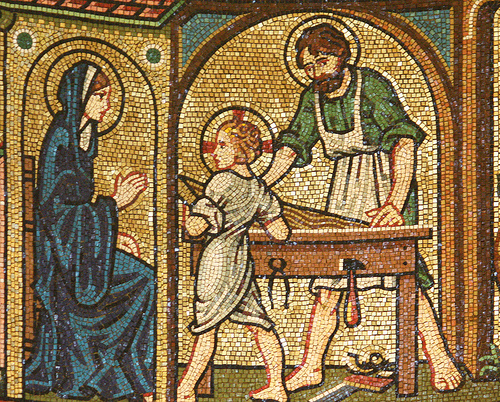


Surprisingly, no text of the New Testament tells us that Jesus was a carpenter.

In only one Gospel is there any hint as to what Jesus’ occupation was prior to the start of his ministry.  This comes from the Gospel of Mark, where he notes that Jesus was a tekton – that is, a builder or craftsman.  In the Greek version of the Old Testament, this same word (tekton) is used to translate the Hebrew word charash, which means the same thing – artisan, craftsman, engraver, etc.

The only other time the word tekton appears in the New Testament is in the Gospel of Matthew, where the writer tells us that Jesus was the son of a tekton.  Perhaps Matthew was implying that Jesus followed in his father’s footsteps, but in any case, the only explicit reference in the New Testament comes from Mark.

Tekton, as stated above, is a word meaning “builder” or “craftsman.”  Literally, it means “someone who creates.”  It certainly can refer to something like a carpenter – that is, a woodworker.  But, like our own word “builder,” it does not exclusively refer to the profession of carpentry.  Unfortunately, there is no context in Mark’s passage (or Matthew’s, for that matter) to imply exactly what sort of tekton Jesus was. 

The tradition that tekton, in the Gospels, referred specifically to carpentry seems to be an early one.  Justin Martyr, writing in the mid-2nd century (only about 80 years after the first Gospel), states that Jesus was a carpenter who built yokes and plows like his father before him.  Justin tells us that Jesus used his woodworking trade to teach “the symbols of righteousness” to his followers and to encourage them to be productive. 

Sometime later, around 200 C.E., another Church father – this time the prolific writer Origen – denies that Jesus was a carpenter and notes explicitly that the Gospels do not, in fact, tell us this widely known “fact” (clearly Origen understood that “tekton” was not a specific reference to carpentry). 

We are left them with a problem: the word used in the New Testament is vague, and the debate about what, exactly, this word referred to is as old as Christianity itself.  How can we possibly hope to clear up the confusion?  Our only option is to look at other available evidence, both textual and historical, and when we do, it seems likely that Jesus was not, in fact, a carpenter.

One of the ways that scholars attempt to better understand the so-called “lost years” of Jesus’ life is by looking at the content of his parables.  What sorts of things did Jesus talk about?  What images and metaphors did he like to use in teaching?  In his parables, we never find references to anything having to do with woodworking – nothing about boat building, for instance, or fashioning plows or yokes (as per Justin Martyr), etc.  What we do find there, however, are parables about stone-working – consider, for instance, the parable of the foolish builders, where Jesus brings up the image of a man digging into solid ground to build a firm (i.e. “stone”) foundation for his house; or consider when Jesus quotes a passage from the Old Testament dealing with “the stone the builders rejected” and how it would become “the cornerstone.”  Think also of when Jesus nicknamed his closest companion, Simon.  Simon did not become “the Hammer.”  No, he became “the Rock” – the foundation on which Jesus’ movement would be built.   

In fact, Jesus brings up images of stone-working quite frequently in his sayings.  The parable of the wise and foolish builders, in particular, seems to imply a fairly intimate understanding of stone building practices in general. 

In addition to these clues, consider also the historical context.  It is known that there was very little in Galilee during Jesus’ lifetime that was made of wood.  Wood, in fact, was a scarce commodity in 1st century Galilee.  Houses, for instance, were made of stone or mud-brick, typically with thatched roofs.  Carpentry would not have been a very common trade.  Masonry, on the other hand, would have been a major industry, employing hundreds, if not thousands, throughout Jesus’ homeland. 

During the “lost years” of Jesus’ life, the major Galilean town of Sepphoris was rebuilt.  Sepphoris had been destroyed in the wake of the death of Herod the Great, and his successor, Herod Antipas, wanted to rebuild it to honor his Roman overlords.  Sepphoris, as it happens, was about 4 miles away from Nazareth – literally a new, shining white city on the hill visible from the valley in which the village of Nazareth set.  If Jesus and his family members had anything at all to do with the building industry, it is a virtual certainty that they would have spent a significant amount of time working in Sepphoris.  The buildings in Sepphoris were not made of wood.  They were made of stone.

Might Jesus have lain these stones inside a ritual Jewish bathing pool in Sepphoris?
It's not outside the realm of possibilities.

Considering these textual and historical clues, it seems probable that Jesus was, in fact, someone who worked with stone rather than wood.  Given his background and the historical context, it is likely that he was simply a laborer who helped haul stones and put them in place, rather than actually carving the stones himself.  He was probably not, in other words, an actual stone mason.  Of course, we can never know for certain.  But then again, we can rarely know anything in ancient history “for certain.”  The best we can do is collect evidence and piece together the resulting puzzle.  And in this case, the puzzle puts a rock in the hands of Jesus, not a hammer and nails.  

Friday, June 24, 2011

My Attempt at Vlogging

Okay, so if you don't know what vlogging is, it's basically blogging by video. For those poor saps who either can't write well or are too lazy, vlogging allows you to post thoughts and commentaries about things by just talking about it.

I have no intention of becoming a vlogger. But I've recently purchased a webcam, so I thought I'd make a video. This is really, really embarrassing. Do I really look and act like this when I'm talking about something? I'd make a terrible TV personality. This is why I write.  This is also why women think I'm a creeper.

Thursday, June 23, 2011

New Testament Authors, Part II: The Third and Fourth Gospels and Acts

Read Part I


The Gospel of Luke
Date: 90 C.E.
The Acts of the Apostles
Date: 95 C.E.
Textual Claim: Anonymous
Church Tradition: Luke, a Gentile physician and companion of Paul

The Third Gospel is the only text of the New Testament traditionally attributed to a Gentile – that is, a non-Jewish – author.  This is based on the tradition that its writer was Luke, a companion of the apostle Paul who seems to be called a Gentile in one of Paul’s letters.  The book of Acts is a virtual “second volume” to the Gospel of Luke, and it is widely recognized, understood, and agreed that whoever wrote Luke also wrote Acts.  The writing style and theology is the same, and the author himself – though he does not provide his own identity – does state, at the start of Acts, that he is writing a second volume to continue where the story of the Gospel of Luke left off.  He also addresses both books to the same person – someone named Theophilus. 

Perhaps the best place to start here is over the issue of whether Luke was, in fact, a Gentile.  Many who are familiar with this very widespread notion may be surprised to discover that there is virtually no evidence to suggest Luke was a Gentile, other than a somewhat vague statement in the New Testament letter of Colossians.  There, Paul lists the names of three of his companions, stating that they are the only Jews who work with him.  He then goes on to list several others, including Luke.  This, then, appears to be evidence that Luke was a Gentile. 

There are two problems here.  The first problem is that Paul doesn’t actually use the word “Jew” in the passage.  Instead, he refers to that first group of people as “those of the circumcision group.”  In other places, Paul uses this colloquialism as a way of referring not necessarily to people who are Jewish by ethnicity or even by religion, but to Christians who believe one must follow the Law of Moses in order to be a Christian.  This group, then, could be made up of either ethnic Jews or ethnic Gentiles.  As a group, they are usually referred to by historians as “Jewish Christians,” but there would certainly have been plenty of ethnic Gentiles among them. 

As a result, those people – including Luke – who are not, according to Paul, “part of the circumcision group,” are not necessarily Gentiles.  They could be Jews who, like Paul, have stopped following the Law of Moses. 

That’s the first problem.  The second problem involves the authorship of Colossians itself.  Since I will be talking later about Colossians, I’ll simply note that many scholars doubt that Paul actually wrote Colossians.  If, in fact, Colossians is a forgery in Paul’s name, then any biographical detail – like the names and ethnicities and religious persuasions of his personal companions – is historically unreliable anyway.  It is important to note here, as an aside, that Colossians is our only source for Luke’s profession as well – that he was a doctor.  If Colossians is a forgery, then there may be no reason to suppose Luke was a physician either. 

The writer of Luke/Acts shows a remarkably high level of understanding of Jewish culture, traditions, history, geography, and scriptures.  Coupled with the fact that there is virtually no reliable evidence suggesting the writer was a Gentile anyway, the most likely conclusion, in my mind, is that the writer was a Jew.

With that established, we turn now to the author himself – Luke the companion of Paul.  Regardless of whether he was Jewish or Gentile, what is the evidence that he is the author of the texts that bear his name? 

Our oldest evidence for the tradition dates to the late 2nd century.  Around 180 C.E., Iranaeus, Bishop of Lyons, refers numerous times to the texts in question, and states that they were written by Luke, without making any indication that there might be some doubt as to the author’s identity.  Clearly the tradition of Lukan authorship was well-entrenched by this time.

Unfortunately, Iranaeus was writing nearly 100 years after the texts themselves were composed, and we don’t have much evidence for the tradition of Lukan authorship prior to Iranaeus.  At best, scholars can trace the tradition to about 150 C.E.  As such, it becomes necessary to look at the internal evidence of the texts themselves. 

Within the Gospel of Luke, there is very little to go by.  However, in his second volume, Acts, there are in fact some internal clues that might help us answer the question of whether Luke was the writer.

The most famous pieces of evidence are the so-called “we” passages of Acts.  In these passages, the author suddenly switches the narrative from third-person into first-person – that is, he begins using “we” and “us” – as though he was there in the story himself.  These passages occur during the missionary travels of Paul.  This has led a lot of scholars and armchair enthusiasts to conclude that the tradition of Lukan authorship may have a basis in fact.  Early tradition tells us it was Luke, Acts has first-person passages, so Luke must be the author.

Other scholars, however, have noted several alternate theories.  First, the “we” passages might, in fact, indicate that the writer was an eyewitness to these events, but that does not necessarily mean that the author was actually Luke.  Maybe it was some other eyewitness.  Second, the “we” passages might be the result of what textual experts call “redaction.”  That is, the writer was using another text as source material for these passages, and simply retained the first-person perspective.  And finally, some scholars have noted that in Greek travel literature of the time, it was common for writers to use the first-person when describing sea voyages.  Since the “we” passages in Acts all correspond to sea voyages taken by Paul, perhaps the writer was simply employing a common stylistic convention.

All of these alternative theories cast doubt on the significance of the “we” passages.  They might indicate an eyewitness, and that eyewitness might have been Luke, but the passages don’t really represent the evidential “homerun” that they might appear to represent at first glance.

Perhaps the biggest argument against Lukan authorship is the fact that he seems to get so many things wrong about Paul.  We know this, of course, because we have a number of Paul’s own writings in the New Testament.  In many cases, scholars can compare what Luke says about an event in Paul’s life with what Paul himself says about the same event.  More often than not, Luke’s version of the story differs dramatically from Paul’s version.  For the sake of space, I won’t detail all these scenes, but will simply note that they are there, and the contradictions are plain for any reader to see.  If the Gospel of Luke and the book of Acts were written by one of Paul’s companions, why would he get so much vital information so dramatically wrong? 

In the end, I think Luke is the most difficult attribution to nail down.  Scholars apparently feel the same way, because the field is fairly well divided, with many good scholars arguing for Lukan authorship, and many other good scholars arguing against it.  Ultimately, the jury is still out, because the evidence is not conclusive in either direction. 

If you're interested in a bit more on this subject, I've written about it more fully in a previous blog post, from last February.  

The Gospel of John
Date: 95-100 C.E.
Textual Claim: “The disciple whom Jesus loved”  
Church Tradition: John, son of Zebedee, a disciple of Jesus

Even though it was the last Gospel written, the Fourth Gospel has perhaps had the most impact on Christian theology through the ages.  Traditionally it is attributed to John, one of Jesus’ most prominent and beloved disciples. 

Scholars across the theological spectrum agree that the disciple John almost certainly did not write this text.  In fact, there are very few reputable scholars out there today who still argue for Johannine authorship.  There are numerous reasons for this. 

To begin with, we know John from the Gospels as an uneducated fisherman from the backwoods of Galilee who spoke Aramaic.  That he might later have learned not only to speak, but to write in highly literate Greek is extremely improbable.

Second, our earliest sources for this tradition are, themselves, vague and contradictory.  Iranaeus, for instance, seems to believe there were two Johns among the early Christian evangelists, and it is not entirely clear which one he thinks wrote the Gospel.  Other early writers provide similarly confusing accounts. 

Third, textual scholars have identified several probable textual sources for the Gospel of John, and this begs the question of why a disciple of Jesus and eyewitness to all the events he describes would need to use other sources for information.

Fourth, textual scholars have also identified multiple layers within the Gospel where the text has been redacted – that is, changed, edited, updated, and collated with other sources – implying that the text we have today is not a single document written in a single time period by a single person, but rather a sort of community effort of several writers writing over the course of a number of years/decades. 

Fifth, since most scholars agree that the text was written near the end of the 1st century, the likelihood that John was still alive and able to write coherently (in another language, no less) is very, very low.

Sixth, much of the Gospel’s content differs dramatically from the stories in the other three Gospels, leading even many early Christian writers to admit that the author had a more spiritual purpose than historical purpose, which would seem odd if it was written by an eyewitness who actually knew the accurate historical situation.

This list could go on and on.  Simply put, there is virtually no evidence to support Johannine authorship, while there is overwhelming evidence to doubt Johannine authorship.  Put together, this is the reason why virtually every reputable scholar on the planet agrees that the Fourth Gospel was the work of a community, rather than any single person, and certainly not John, son of Zebedee.  It may well be that the community in question was a community founded by John, or otherwise devoted to John – that, in fact, is a very common conclusion among scholars – but there can be little doubt that John, himself, did not author this text. 

Sunday, June 19, 2011

Happy Father's Day

My father: Byron


My Father-in-Law: Gerald


My Paternal Grandfather: Arthur


My Maternal Grandfather: Oscar


My Maternal Great-Grandfather: Joe


My Paternal Great-Grandfather: Luke


My Paternal Great-Great-Grandfather: John


My Paternal Great-Great-Great Grandfather: Andrew

Saturday, June 18, 2011

New Testament Authors, Part I: The First and Second Gospels

INTRODUCTION

I’m often amazed at how disinterested most Christians seem to be on the question of who wrote the Bible.  This perplexes me because it seems, to my mind anyway, that it should matter where the texts came from, who wrote them, when, and why.  Yet these questions don’t seem to concern many Christians that I know. 

Just to test this theory out, I ran it by some of my Christian family members.  None of them cared.

Be that as it may, the authorship of the Bible is an important issue, and some folks may be surprised to discover just how little we really know about who wrote these texts and where they came from.  The history of how we got the Bible is complex and can fill volumes.  Here, I intend simply to provide, in a continuing “series,” an overview of the authorship for each of the 27 books of the New Testament, briefly discussing the various perspectives.  My hope is to keep these discussions brief and accessible, while still detailing the pertinent information. 

THE GOSPELS

Any discussion of the New Testament usually starts with the four Gospels.  These are the books that tell us intimate details about the life of Jesus, from his birth up through his baptism, ministry, and death in Jerusalem.  Almost as interesting as the content of these texts is the discussion about who, exactly, wrote them.  In what follows, it is important to keep in mind that the Gospels, themselves, are anonymous.  They did not come with titles, and nothing in the text tells us who the writer is.  The authors of these Gospels clearly figured their audience would know who they were. 

The Gospel of Mark
Date: 70 C.E.
Textual Claim: Anonymous
Church Tradition: John Mark, a companion of Peter and Paul

Mark is not the first Gospel in our Bibles, but it was the first Gospel to be written, composed somewhere around 70 C.E., about the time that Jerusalem was falling to the Roman legions and the Jewish people were being dispersed throughout the Mediterranean world.  Because it was traditionally believed to have been the second gospel written, it is typically referred to as the Second Gospel.  I put it first simply because scholars now know that it was, in fact, the first to be written.   

Church tradition has attributed this Gospel to a man named John Mark, said to have been a companion of Paul and later a secretary to Peter.  This view goes back quite a long way, all the way back to the first part of the 2nd century, with a writer named Papias, who, we are told, was the leader of the church in Heirapolis, in modern day Turkey. 

Scholars tend to date Papias’ work to roughly 115 C.E.  As far as post-New Testament authors go, Papias is one of the very earliest that we know about.

None of Papias’ writings have survived for scholars to read.  We know of him and his work only because he was quoted by Christian writers who came after him.  As such, we have a few statements from Papias, but no complete works.

One of his quoted pieces deals with the authorship of Mark.  He states: “Mark having become the interpreter of Peter, wrote down accurately whatsoever he remembered.” 

This isn’t much, of course, but it’s enough to establish that by the first part of the 2nd century, Christians were attributing some text or another to Mark, a companion of Peter.  Whether Papias understood this to be the same Mark who had previously been a companion of Paul (and who, according to Acts, parted ways early on with Paul) is unclear.  It is also not clear exactly what text Papias is talking about.  Is he referring to our Gospel of Mark?  Or some other text purportedly written by Peter’s companion?  There is nothing in our Gospel of Mark to suggest that it was written by a companion of Peter (one might expect, for instance, that it would be heavily “pro-Peter” if it was written by one of his followers, but it is not). 

There are other reasons to suspect that Papias may have been talking about a different text.  To begin with, Papias quotes several stories that are not found in any of the four Gospels of the New Testament.  He gives, for instance, an account of the death of Judas that is completely different from the ones found in Matthew and Luke.  Additionally, he quotes a parable of Jesus that is not found in any other source, either inside or outside the New Testament.  Could these stories have come from the text that Papias believed was authored by Mark?  If so, then he certainly was not referring to the text we know as the Gospel of Mark. 

In addition to the general doubts about what text Papias was talking about, there is also the issue of who, exactly, John Mark was.  We know from the letters of Paul that he had a companion by this name, though Paul simply calls him “Mark.”  “John Mark” is how he is referred to in the book of Acts.  In Acts, Mark and Paul have a falling out, and Mark abandons him, never to return to the story.  In the book of 1 Peter, ostensibly written by the apostle Peter, Mark is also referenced as sending his greetings to the recipients of the letter.  Is this, perhaps, where the tradition comes from that Mark, after abandoning Paul, became the secretary of Peter?  Perhaps, but there is nothing in the text itself to indicate that this is the same Mark.  In Acts, for instance, when Mark leaves Paul, he doesn’t go to Peter, but instead sets out with Barnabas.

In the end, it seems likely that the text we know as the Gospel of Mark was probably not written by anyone who was a companion of Peter or Paul, or even by anyone named Mark.  The attribution to Mark, the secretary of Peter/companion of Paul, seems to be a “best guess” by early Church fathers attempting to assimilate the available data and add authority to those texts considered pure and orthodox by the emerging Church.     

The Gospel of Matthew
Date: 80-85 C.E.
Textual Claim: Anonymous
Church Tradition: Matthew the tax collector, also called Levi, a disciple of Jesus

Matthew is typically called the First Gospel, even though it is now known to have been the second gospel written.  When it comes to this text, the waters become even murkier than with the Gospel of Mark.  Perhaps the best place to start is with the identity of the person we call Matthew.

In Church tradition, Matthew was also known as Levi, and he was a tax collector.  In Mark’s Gospel, this connection is not explicit.  There is a story about Jesus calling a man named Levi, who is a tax collector, but later – when Mark provides a list of the 12 disciples – Levi is absent.  A man named Matthew is named as one of the disciples, but there is no suggestion by Mark that this is the same person as Levi the tax collector.  In the Gospel of Matthew, the conundrum is cleared up.  When this author re-tells Mark’s story about Levi the tax collector, he doesn’t call him Levi at all, but instead calls him Matthew.  Luke does not tell the story of the tax collector, but does mention that one of the disciples was named Matthew.

We also have a reference to a disciple named Matthew in the Gospel of Thomas, though no biographical information is provided.  Additionally, there is a reference in the Gospel of Peter to a disciple named Levi, but again there is no biographical information.

Clearly, the author of the Gospel of Matthew believed that Levi the tax collector and the disciple Matthew were one and the same.  This, in and of itself, causes one to wonder if that does not explain where the tradition of Matthean authorship comes from – the assumption being that the author of this text knew Matthew and Levi were the same person quite simply because the author was, in fact, Matthew himself.

Whether that is the source for the tradition of Matthean authorship or not, our earliest reference to this tradition again comes from the aforementioned Papias.  Papias says: “Matthew put together the oracles [sayings of Jesus] in the Hebrew language, and each one interpreted them as best he could.” 

We are faced again with the same problem we saw with Mark.  Is Papias talking about the same text we know as the Gospel of Matthew?  Here, the doubt is even greater, because as anyone familiar with the Gospel of Matthew knows, it is not simply a list of sayings (“oracles”) of Jesus, but an entire “gospel” detailing Jesus’s life from birth to death.  Papias’ description actually sounds more like the Gospel of Thomas than the text we know as the Gospel of Matthew.  Furthermore, the Gospel of Matthew was written in Greek, not Hebrew.  Before you wonder if it might have originally been written in Hebrew, and simply translated later into Greek, there is no evidence to suggest this.  I am certainly no ancient Greek scholar, but those folks who are scholars of ancient Greek have ways of determining if a Greek text is an original Greek composition or a translation from some other language.  From what I understand, it is widely agreed that this text is an original Greek composition. 

There is one more point to be made about Papias’ identification: recall from the discussion of Mark that Papias gives an account of the death of Judas which is different than the account found in Matthew and Luke.  If the text Papias knew as Matthew was the same text we know as Matthew, why would Papias give an account of Judas’ death that differs from what is found in Matthew? 

It seems likely to me that whatever text Papias was talking about, it was not the Gospel we know as Matthew. 

Again, we are in a position similar to the one we faced with Mark: the disciple Matthew almost certainly didn’t write the text we know as the Gospel of Matthew, and even the disciple Matthew’s very identity is in question. 

In Part II, we will look at the authorship of the Third and Fourth Gospels, Luke and John. 

Sunday, June 05, 2011

Notes from the Cave

Yikes, it's been way too long since I posted on my blog.  Sorry for the absenteeism.  Very busy, as usual.

Work has really taken off in the last few weeks.  It seems like every shift I work now is really busy, and I'm still working at least some overtime every week.  From here forward, I'll be working third shift on my weekends.  We rotate weekends so that we basically work every third weekend, with two weekends off in between.  I like the occasional third shift, so this is a good thing, but it's really difficult to switch back and forth, and my schedule will generally only give me one day off in between.  So, for instance, I will work third on Saturday and Sunday, then have Monday off (which is mostly spent sleeping), then have to be right back at 8 a.m. (or earlier) on Tuesday morning.  When I've done this in the past, even when I've gotten enough sleep the night before, I am always dragging that next day.  It's just hard on the body to switch back and forth like that.  I'm actually facing that scenario right now - worked third shift last night, and have to be at work tomorrow morning at 7 a.m.

I finished Swan Song by Robert McCammon last week - I think I mentioned this book in my last update.  As a counterpart to Stephen King's more famous book, The Stand, there is virtually no comparison.  Swan Song was significantly better.  I had expected this to be the case, since I had read Robert McCammon before and considered his books to be much more readable and enjoyable than Stephen King.  I highly recommend Swan Song.  I've now moved on to book three in the saga of Henry II by Sharon Kay Penman.  I've also started a new non-fiction book called Forged, by biblical scholar Bart Ehrman.  It discusses the authorship of various books within and outside of the New Testament.

I really wish I had more to talk about, but this is about all I've got.  It's hot and dry, after a wet and cool spring, and the grass needs to be mowed, but I failed to do it today.  I did feed the horses for a few minutes though.  There were a bunch out there today, including some that, judging by the looks of them, must have been race horses of some kind.

Sunday, May 15, 2011

Notes from the Cave

Let me go ahead and start off with the obligatory "I don't have much to say tonight."

I've been working quite a bit for the last few weeks; I've even managed to get some overtime, which is not always easy to come by in this day and age.  I was off last weekend and am off this weekend, which is nice.  I think last weekend was only the second full weekend I've had off all year.  It's frustrating to be working so much and so hard, and to still feel like you are living paycheck to paycheck.  But I guess that's just life in 21st century America.

We went to the lake last weekend with the whole clan - my wife's parents and her sister's family of 7.  We were able to get out on the boat on Saturday morning and do a bit of fishing with the kids.  As per the norm, my brother-in-law caught a fish, and I caught jack shit.

My wife and I always enjoy watching 48 Hours Mystery on Saturday nights and 10 pm, and we watched a new one tonight that has kind of got me creeped out.  I normally don't get that way, but this one was just particularly unnerving.  The murderer is apparently a serial killer - off the streets now and awaiting trial - but he has killed at least four women, the earliest being when he and his victim were just teenagers.  The disturbing thing about this guy is that he doesn't appear to have been motivated by sex or rape or theft or even something like revenge.  His victims have apparently shown no signs of sexual assault, and money and credit cards have never been stolen.  Instead, he apparently just likes stalking, then murdering and mutilating women with a knife, Jack the Ripper style.  It's a total nightmare scenario: he sneaks in through a window and starts stabbing the woman while she is asleep in bed.  One managed to fight him off, and he actually mumbled "sorry" as he fled out the door.  It was after that botched attack in 2008 that he was finally arrested.

In any case, I've been a little paranoid since watching that episode tonight.  Earlier, I went upstairs to do something, and as I came around the corner in the stairwell, there was a shadow thrown against the wall because the light was on upstairs and the door into the Cave was partially opened.  At first glance, I thought it was a person standing there, and my heart rate went from about 80 to 150 in roughly 0.6 seconds.

Just finished the second installment of Sharon Kay Penman's 12th century historical trilogy about Henry II and his queen, Eleanor of Aquitaine.  This book was centered on Henry's friendship, and ultimate falling out, with Thomas Becket, who was originally Henry's chancellor, and later became the Archbishop of Canterbury (even though he hadn't even been a priest prior to his elevation to that most powerful Church position).  Becket was eventually murdered right near the altar in Canterbury Cathedral by knights loyal to Henry, having come ostensibly to arrest Becket.  This is one of the most famous stories of Medieval England, and I find it utterly fascinating.

Before I read the last book in the trilogy - which will center on the last years of Henry's life, and the rebellion against him by his sons - I am reading a book I recently bought called Swan Song.  This is by a writer named Robert McCammon, who isn't widely known, but who has apparently written quite a few novels, some of which have been New York Times bestsellers.  I read one book by him several years back, on the advice of my sister, and it was absolutely one of the best books I've ever read.  It was called The Wolf's Hour, and I highly recommend it.  In a nutshell, it's about a werewolf who works as a spy for England in World War II.  I know, I know - it sounds bizarre.  I thought the same thing when my sister first lent me the book, and it sat on my bookshelf for probably two years, until I finally started it one night when I had nothing else to read.  It was absolutely fabulous.  Definitely a "read again" kind of book.

In any case, this new book I'm starting is called Swan Song and it's an absolute monster.  I haven't actually looked to see how many pages it is, but it must be well in excess of 1000.  It was originally published in 1987, so it's not a new book, but it has apparently just been re-released.  It's in the same genre with Stephen King's popular book The Stand.  It's one of those "terrifying visions of a post-apocalypse world," where a nuclear World War III occurs and more or less wipes out civilization as we know it.  This is already occurring right in the first chapter, and the book itself will be about what happens afterward.  I read The Stand last year and thought it was decent - I rarely ever think Stephen King books are anything other than "decent" - so I'm curious how this one will compare.  If it's anything like The Wolf's Hour, it should blow The Stand completely out of the water.

Not much else to report.  We've been seeing a lot of horses in our backyard lately.  I think I've probably mentioned around here before that our new house backs right up into a horse farm, and our house is actually the only one on the street with an unobstructed view into the fields - all the other houses are blocked by trees.  For some reason, there is a big gap in the tree line right behind our house, so the horses literally come right up to the fence in our backyard.  We've been feeding them grass and apples and carrots out of our hands, although I wonder if the owners wouldn't be irritated with us for doing that.  Two of the horses are some kind of really large breed - Clydesdales maybe?  I don't know much about horse breeds, but these two horses are all white and must be the biggest horses I've ever seen.  They make the "normal" horses seem rather small.    


Tuesday, May 03, 2011

Congressman Geoff Davis

This fellow is the U.S. congressman for my district in Kentucky.  He's not anyone you've ever heard of, of course, but most congress people are not prominent enough to get national media attention, unless they commit a crime.

From everything I know about him, he's a pretty strong conservative, and if you know anything about me, you'll know I'm a lifelong Democrat.  Be that as it may, I get his weekly email newsletter to keep up with what he's doing in office.

The thing that strikes me every week about this newsletter is that it is unashamedly partisan.  The newsletter is sent out under the guise of "informing" constituents about what's going on in Washington, but the entire thing is just a set of Republican talking points and criticisms of the Obama administration.  Now this, by itself, isn't so surprising.  I'm sure Democratic congressmen have similar newsletters, probably just as unashamedly biased.

What really bugs me, though, is that every couple of weeks, he will include a link to a "survey" that he has "put together" to "find out what his constituents think" about a given topic.  These surveys always make for a good laugh.  Take this week's survey for instance.  The first question is this: "How have you been affected by rising gas prices?"  It then lists several answers, and you can click as many as are applicable to you.  Okay, fair enough.

The second question is this: What do you think of the Obama Administration's energy policy?

Here, there are only two answers possible, and you have to choose one or the other (there are also "unsure" and "other," but I'm not counting those).

The first answer is this: I agree with the current policy.  Increasing regulation and taxes on energy companies will protect the environment and fight global warming, which is necessary even if it raises gas prices.

The second answer is this: America needs a new energy policy that will encourage more domestic production of energy to lower the cost of fuel and create more American jobs.

Hmmmmmm.  Which answer do you think is going to get the vast majority of votes?  It's a tough one, I know, but it's answer number two.  Who, after all, is going to say they want "regulation" and "higher taxes" and will gladly suffer through "higher gas prices"?  With the obligatory reference to to the divisive issue of global warming, the entire answer is worded in such a way as to ensure that no self-respecting Republican, and very few Democrats, are going to choose it.

The second answer, on the other hand, is spun out to sound totally reasonable, with its reference to "America" and "new energy policy" and "domestic" and "lower fuel costs" and "American jobs."

In other words, Obama is all about taxes and regulation and evil global warming and high gas, while the valiant Republicans are all about America and domestic prosperity and low fuel costs and more jobs.

Why does ANYONE take this shit seriously?   I didn't even respond to the survey because it was such an obvious sham.  Geoff Davis does not have one iota of interest in what his "constituents" actually think.

But that's how this game works.  Will it surprise anyone when Geoff Davis gets up on the floor of the House, or gets on an  interview with a reporter, and says that his constituents have "told him" that they want "a new energy policy" and that they disagree with Obama's policy?   And he can just conveniently point to his little survey to "prove" that.

What a sham.  And what a sham for a politician Geoff Davis is.

Thursday, April 28, 2011

Jack the Ripper: Case Solved

Well, maybe.

I recently DVR'd a show on the National Geographic Channel called Finding Jack the Ripper, where a retired British police detective investigates the case and attempts to see if he can discover anything new.  His name was Trevor Marriott, and apparently this show was actually based on a book he published in 2005 outlining his theories.

I didn't expect to be particularly impressed - it was just a reality docudrama, after all.  As it turns out, he made an incredibly well-reasoned and convincing argument for a suspect that - as far as I know - has never been involved in any Jack the Ripper investigations in the past.

BACKGROUND


Most people, of course, are at least vaguely familiar with the story of Jack the Ripper.  To give a brief overview, the story begins on balmy London night in late August, 1888, when a prostitute named Mary Ann Nichols was brutally murdered with a knife.  A week later, another prostitute - Annie Chapman - was killed, and her uterus was removed by the murderer.  

About three weeks after that, by now the end of September, two more prostitutes were killed on the same night - Elizabeth Stride and Catharine Eddowes.  Virtually since the night it happened, there has been disagreement as to whether Elizabeth Stride was actually murdered by Jack the Ripper.  Unlike his other victims, she had no mutilations to her body - only her throat was cut.  Those who believe she was indeed Jack the Ripper's victim argue that he was interrupted as he went about his deed, and therefore had to find another victim - Catharine Eddowes - whom he killed about 45 minutes later.  Others, however, doubt that the murderer could have pulled both murders off in the period of time necessary.  Together with the lack of mutilation or other telltale Ripper signs, this leads them to the conclusion that Stride, in fact, was the victim of some other person.

Jack the Ripper's murder spree ended about a month after the double murder of Stride and Eddowes.  In the first week of November, 1888, a fifth prostitute - Mary Kelly - was murdered, and her body was mutilated to such a degree as to be hardly recognizable as human.  The black and white photograph of her body is, to say the least, highly disturbing.

Following the murder of Mary Kelly, Jack the Ripper disappeared, apparently never to be heard from again.  Theories have abounded as to why the murders suddenly stopped, with the most obvious being that the Ripper himself died before he was able to kill again (the Whitechapel district of London, where the murders took place, was NOT a place you wanted to be in the late 1800's - people died there every day from murders and fights and all manner of violent causes).

Over the years, there have been literally hundreds of suspects identified, mostly by amateur enthusiasts and the occasional independent investigator.  None has ever garnered widespread support, and I doubt this latest suspect will either.  But the argument is an interesting one.    

THE NEW THEORY

Trevor Marriott, the police detective who has put forth this new suspect, has always believed that Jack the Ripper was most likely a merchant seaman - that is, someone who was frequently coming and going from the nearby shipyards.  This would help explain the sudden start to the crimes, the periods of time between murders, and the subsequent abrupt ending to the killing spree.  It is also true that many of Whitechapel's prostitutes made their living largely by serving sailors who were temporarily in port.  It's not a stretch to imagine that the murderer might have been a sailor, and this has been a popular theory almost since the time of the original investigation.   

Starting from this point, Marriott began investigating possible suspects.  He eventually centered on a German sailor named Carl Feigenbaum.     

Who is Carl Feigenbaum?  

Well, nobody, really.  He was executed in 1896 for murdering a woman in New York City, and while his lawyer claimed in an interview on the day of the execution that he believed Feigenbaum was Jack the Ripper, no one took him seriously and Feigenbaum was more or less forgotten as a suspect.  Until Trevor Marriott came along, anyway.

Marriott discovered that Feigenbaum had, in fact, worked for a German merchant shipping company in the 1880's, ending his stint there in the early 1890's before settling in the U.S.A.  

Combing through the records of this shipping company, Marriott was able to determine the exact dates in which Feigenbaum had been employed - and the dates included the late summer and early autumn of 1888.  

He was further able to comb the shipping records of the port in London where he believes the Ripper would have been based.  His first goal was to find out if any one ship - of any nationality - was in port on each of the days the Ripper struck.  He found only one ship that met this criteria, but it was only in port on 3 of the 4 murder days (recall that two murders took place on the same day, resulting in 5 victims killed on 4 different days).  

This ship, as it turns out, was a ship owned and operated by the company Feigenbaum was employed by, and it was a ship that he was known to have worked on.  

Furthermore, on the 4th day in question - the day in which the first ship was not in port - there was ANOTHER ship of the same company that was in port.  

This means that the shipping company which Feigenbaum worked for in late 1888 had ships in port on each of the days of the Ripper murders.  Furthermore, there were other Ripper-like murders around Europe and North America in the few years following the Whitechapel murders, and in each of those cases, Marriott was able to confirm that a ship of this German merchant company had been in port at the time.  Ultimately, he identified something like 20 different Ripper-like murders (including the 5 in London) that occurred in large cities around the world, beginning in 1888 with the Ripper murders and going up through 1892, in which ships of this German shipping line were in dock at the time of the murder.  

I don't know about you, but that's a pretty amazing discovery, particularly considering that it seems to be exactly this period - about 1888 to 1892 - that Feigenbaum was working for the shipping company in question. 

Marriott's next step was to see if he could actually confirm that Feigenbaum was on these ships when they were in port.  Finding those records could conceivably prove beyond any reasonable doubt that Feigenbaum was, in fact, Jack the Ripper.  The coincidence would be too great.

Fortunately, the company in question kept very detailed records of the men who worked on their London-bound ships.  However, the company's records from the three months in which the Ripper murders took place in London were mysteriously absent from the archives.  This was true despite the fact that, apparently, the records before and after that stretch were relatively complete.  Marriott has theorized that perhaps Feigenbaum's lawyer got possession of them, although that's purely speculation.  What is not speculation is that the records which could conclusively confirm or deny whether Feigenbaum was in London on the days of the murders have been lost.  

After Feigenbaum's stint as a merchant seaman, he seems to have settled in the U.S. and worked as a florist in Wisconsin before ultimately moving, about 1894, to New York City.  It was there that he eventually murdered a woman and was sentenced to death for it.  The murder was very much "Ripper style," with a long-bladed knife used to slit the woman's throat with a double slash.  The long-bladed knife and the double slash throat cut are two of the hallmarks of the Ripper murders.  The woman's body was not mutilated, but that could be because Feigenbaum was caught in the act by her son and forced to run.  He was later caught by police.  

As noted above, Feigenbaum's lawyers told newspapers on the day of Feigenbaum's execution that he believed Feigenbaum could be connected to Jack the Ripper.  He went on to say that he would "stake [his] professional reputation" that a proper investigation would tie Feigenbaum to London and Whitechapel in late 1888. 

He also told the press that Feigenbaum had confided to him that he had "suffered for years" from an "all absorbing passion" that caused him to want to brutally murder and mutilate women.  When this "passion" came on him, Feigenbaum apparently said, he was "unable to control" himself.  

This, of course, is perfectly consistent with what criminal psychologists would now recognize as the hallmark of a serial killer - the uncontrollable urge to kill.

Feigenbaum's lawyer went on to say that he had looked up some of the dates of the Ripper murders, and then asked Feigenbaum about where he was on those dates, without telling him why he wanted to know.  Feigenbaum, said his lawyer, confirmed that he was in London on the days in question.

This story apparently made a minor sensation at the time, and was reported in many newspapers around the country, but the theory never caught on, and within a few years, Carl Feigenbaum had basically passed out of the consciousness of Ripper investigators and enthusiasts.  

CONCLUSION

Marriott finalized his theory by asserting that the Ripper-like murders which had been taking place in various places around the world during the late 1880's and early 1890's pretty much ended after the arrest and execution of Carl Feigenbaum.  As a final piece to the puzzle, that certainly seems to seal the deal.

However, as one can imagine, many experts are still not convinced.  I found a website devoted to the case where the author analyzed Marriott's conclusions extensively and ultimately stated that he thought Marriott was wrong.  

Without those all important records that actually show Feigenbaum's name as part of the crew of a ship that was actually in port during these various murders, it is difficult to say that the "case is closed."  

I personally have always found it odd that so many Ripper enthusiasts seem to assume that the murderer must have moved on to some other place and kept on murdering.  Invariably, this "other place" always ends up being America, and it's not an accident that the enthusiasts who tend to support these theories are American.  The case is so fascinating to so many people that it almost seems as though American enthusiasts resent that the murders happened in London and want desperately to be able to claim Jack the Ripper as their own.

In all likelihood, Jack the Ripper was some tramp who lived on the streets of Whitechapel, snapped one day and started murdering, then ended up dead himself in a bar fight or a mugging, or was perhaps arrested and put in jail for some other unrelated crime, and thus passed out of history without anyone ever knowing any better.  That's the simplest answer, anyway, and the simplest answer is usually the right one.  

Still, this newest theory about Carl Feigenbaum is noteworthy simply because it seems, on the surface anyway, to have some solid evidence behind it, even if that evidence is only circumstantial.  


Friday, April 22, 2011

Notes from the Cave

After working 9 days straight, I finally had a day off today.  But I'm right back tomorrow for a ten hour shift, followed by a 12-hour third shift on Saturday night.  Working a lot of days in a row is bad enough, but the switching back and forth between 1st and 3rd shift really, really sucks.  In short, I'm too old for this shit.

On Sunday afternoon (after I got up from sleeping after working all night), I got all my stuff together to mow the lawn for the first time this year.  As many of you know, we sold our last house in June of 2009, and had been in an apartment since then, up until February of this year.  So this was not only the first mow of the year for me, but also the first in about two years.  The lawn equipment had been in storage all that time.

I went out and got new gas cans (the old ones were gone - probably thrown away when we moved), filled them up with gas, then mixed oil into the second container (the weed eater requires a gasoline/oil mix).  Got my mowing outfit on and got prepared to set about mowing for the first time the largest yard that I've ever owned.  I started on the weed eater, and it fired up like normal and all was good.

Then I put the gasoline into the lawn mower.

Almost immediately I saw liquid begin to drip from the filter.  I kept pouring for a few more seconds before I realized that the gasoline was leaking back out.  My first thought was that it was a bad fuel line - maybe dry rot from sitting idle for two years.  But upon closer investigation, I saw that it was actually leaking out of an iron tube connecting from the filter to the engine itself.  Obviously some O-ring or gasket inside the engine has broken and is leaking gasoline.  So not only did I not get my lawn mowed - which was badly in need of it - but I also have to get the damn mower fixed - and it's a relatively new mower.  I think I bought it in 2008, which means I only used it for one season and maybe two months of another.  And, of course, this is the busy season for lawn mower repair.  My father-in-law has his in the shop right now and they told him it would be three weeks.

Tonight I borrowed a neighbor's mower and mowed the front, but the back is still basically a jungle.

Earlier this week, I began working out a new idea for a collection of short fiction.  It's been a while since I've written any fiction, and I've always tended to struggle somewhat with short stories because in many ways they are harder to write than long fiction.  But my idea is based on all the genealogical research I have done on ancestry.com.  There are so many interesting vignettes about ancestors and their life events that they fairly beg to be fictionalized.   So I am going to start a series of short stories - maybe 12 to 16 total - and put them into a collection, yet to be titled, about real people and events from American history.  Rather than writing about famous people and events - which is what informs most historical fiction - these stories will be about average, every day Americans from across 400 years of American history.  Of course I will include a lot of stories about my own ancestors, but I don't want it to be top-heavy with my own family, so I have asked a number of friends and co-workers if I can research their families on ancestry.com to find interesting tidbits to write stories about.  Already I have found several stories from among my friends' family lines that would make for good short stories.  Ultimately, it will be interesting to see if this pans out or if it fizzles into that nebulous world of artistic plans and ideas that never come to fruition.

On the reading front, I finished James Rollins' Altar of Eden - it was typical pop thriller fare, predictable and formulaic as all get out, but entertaining enough for a week's read.  I've now moved on to the second book of Sharon Kay Penman's 12th century trilogy, called Time and Chance.  It picks up pretty much where the first book left off, in the mid 1150's, a few years into the reign of Henry II and his queen Eleanor of Aquitaine.  It will apparently focus mostly on Henry's relationship, and ultimate falling out, with his chancellor and later Archbishop of Canterbury, Thomas Becket.  (Click that link for a short 2006 post I made about Becket's murder.)

I've simultaneously started reading a very thick collection of short stories by Rudyard Kipling.  For those who don't know, Kipling is one of England's most famous writers, easily the most famous British writer of the late 19th and early 20th centuries.  He was born and lived much of his life in British-controlled India, and as such became a prominent voice for the waning days of British imperialism there.  He only wrote a few novels, focusing instead on short stories and poetry - of which he wrote literally hundreds of each.  His most famous collection of short stories, in America anyway, is The Jungle Book.

The very first story in this collection I'm reading is a story from 1885 called The Dream of Duncan Parrenness, and in it is a quote that immediately stood out to me as one of those "great quotes" from literature.  It immediately struck a chord with my own experiences, and I must have read it over five or six times:
Yet there be certain times in a young man's life, when, through great sorrow or sin, all the boy in him is burnt and seared away so that he passes at one step to the more sorrowful state of manhood.
It sort of gives me chills even reading it now again.  He managed, in this one sentence from a relatively obscure story from his early life, to sum up beautifully the universal experience of men reaching adulthood.  It doesn't necessarily happen when you turn 18, or 21, or 25.  But it happens, and once it does, there's no going back.

Have any of you heard of this New York Times bestseller called Heaven is for Real?  I've read about it recently. I guess this kid had a near-death experience at age 4, and now he and his parents (and no doubt a ghost writer) have written a book to give people encouragement about what awaits them after death.  Not surprisingly, the boy's father is an evangelical minister, and the boy's trip to heaven included visits from Jesus and John the Baptist.

What I want to know is this: How come people who have near death experiences always have them within the bounds of their own spiritual heritage?  In other words, how come Christians don't ever experience Muslim or Buddhist heaven, and vice versa, and how come Hindus never see Jesus during their near death experiences?  I might be inclined to believe a near-death experience if it happened to a Christian, but they saw Mohammed, or it happened to a Buddhist, but they saw Jesus, or it happened to a Jew, but they saw Osiris, and then converted to the new religion on the spot.  THAT would be impressive.  A Christian seeing John the Baptist, or a Buddhist seeing Buddha, however, is not so interesting.

Of course, I suppose the reason this book is such a hit is because it happened to this 4-year old who wouldn't have had the same sort of religious knowledge that the rest of us have.  Yet magically he saw Jesus and John the Baptist - figures he undoubtedly would have heard talked about by his minister father and in Sunday School.  Isn't it amazing that he didn't run into Shiva or Mohammed or Zoroaster or Zeus - figures he almost certainly had never heard of?  Again, had this 4-year-old seen Shiva, ultimately leading to the mass conversion from Christianity to Hinduism of his entire family, including his evangelical minster father, THEN I would be mightily impressed.

He also, apparently, met up with a sister he didn't know he had, learning only later that his mother had miscarried a girl (how she could have known it was a girl, so early in a pregnancy, is anyone's guess, I suppose).  Of course, even though he may not have been consciously aware, at age 4, of his mother's past miscarriage, it's a virtual certainty that he had heard his parents talk about it and had stored it away subconsciously.

But then I suppose I'm just a jaded old skeptic who likes to pee on people's parades.

Perhaps I should read the book before criticizing it - I'm sort of breaking one of my own rules here - but I simply have never seen or read anything to make me suppose that near-death experiences are likely to be anything other than a function of neural activity in a dying and oxygen-starved brain, which causes people to see familiar things.  These stories are interesting, even amazing, but I haven't ever been persuaded to suppose there is anything supernatural going on.

Thursday, April 14, 2011

Notes from the Cave

Not much to talk about this week.  I know I said something to that effect on my last Cave entry, but it's really true this time.

WORK:
We started a new schedule at work this week, and it's taking some getting used to.  I was supposed to work 6 to 2:30 today, and showed up at 8 a.m. because I'm not used to that earlier shift.  Tomorrow (which is really today, since it is past two in the morning) I work second shift.  Then I work a swing shift on Friday, followed by the night shift on Saturday.  Then I'm back to an 8 a.m. shift next Monday.  It's no wonder I got confused.

In the last few weeks, I passed my 1-year anniversary with my employer.  In the past, a 1-year anniversary would have seemed significant, but I guess as you get older and move from career to career, as I have done, it's not that big of a deal anymore.  This is particularly true since there are so many people I work with who have been with the hospital for 20 and 30 and even 40 years.  One year doesn't seem like much up against that.  And I'm still the low man on the totem pole for seniority.  I am literally dead last.

STOMACH ISSUES:
My stomach issues, which I have mentioned in the past, seem to be settling down a bit.  I hesitate to say they are "resolved," but for now, I've been doing okay for the last few weeks.  I did have to take some Advil a few days ago, but it was just that one day.

THE FREE CANDY VAN:
I had to get some work done on my car last week (my car is not REALLY a van, that's just my Twitter joke), as my check engine light had been on for almost two months.  I was worried it was going to be something major - I guess you always worry about that when you aren't sure what it is.  It turned out to just be some kind of "sensor crank" or something, and it only cost a few hundred bucks.  That's a few hundred more than I had, but at least it didn't need a whole new transmission or anything, which is what I had feared.

ROCK BAND:
My oldest daughter and I have been on one of our Rock Band II streaks this week.  We will get on streaks like this where we play every day for a week or two, then won't play for several months.  She's the drummer,, and her favorite songs to play include Eye of the Tiger, Hungry Like the Wolf, We Got the Beat, and, strangely enough, Psycho Killer by the Talking Heads.  That was a song I'd never even heard until I got Rock Band.  She also likes Round and Round, Spoonman, and Man in the Box.  I think my favorite one to play is The Middle, by Jimmy Eat World.  (They were on Conan a few weeks ago, and I loved the spot he did as a commercial that night before the show.  He said something to the effect of: "We're going to have Jimmy Eat World tonight.  Don't worry, Jimmy no really eat world.")  That probably doesn't sound as funny written out in my blog post as it did when Conan delivered it.

READING:
I finally finished the book I've been reading since January - When Christ and His Saints Slept, by Sharon Kay Penman.  It was historical fiction, set during "The Anarchy" - the 12th century English civil war between King Stephen and the Empress Maude.  If you love historical sagas set in the Middle Ages, this one is for you.  It's actually the first in a trilogy, with the second two books continuing with the reign of Henry II and his queen Eleanor of Aquitaine.  These books are right up my alley because they are set during the 12th century - my absolutely favoritest period of English history.  The second and third books are on my shelf to be read.  The only downside, of course, is that this book took me two months to read.  It's a virtual encyclopedia.  I'm now onto some lighter fare in James Rollins' most recent thriller, Altar of Eden.

I'm not sure how I feel about the category headings.  Not sure if I'll keep doing that.  In any case, that is all.

Thursday, April 07, 2011

Rush in Louisville: A Review

On Tuesday evening, I saw my 7th Rush concert since 2004, this time in Louisville, Kentucky.  This show, at the new KFC/YUM Center, marks the 6th different venue I’ve seen them in.  Seven shows in six years may seem like a lot to some, but it’s painfully few compared to the hardcore fans among which I count myself.  I know people who have seen twice that many just on this tour alone. 

I always like getting to these shows early, to avoid parking woes and to find out where my seat is without fighting enormous crowds of people.  It also allows me to find close parking, and thus get out quicker when the show is over and avoid the heavy exit traffic. 

The new KFC/YUM Center sits right on the Ohio River in downtown Louisville
I arrived about two hours before the show and was able to park for $10 in a parking garage that was across the street from the venue.  It was a nice, newer garage, with a covered walkway leading virtually right up to the arena.  Considering I passed public lots two or three blocks down that were also $10, I thought this was a pretty nice find.  Of course, being two hours early helps.

The venue itself is very nice.  The acoustics inside were fantastic, and I would highly recommend it to anyone thinking about going to a concert there.  The sound was very crisp and clear, with little to no distortion.  I think this is the reason why my ears were only ringing very mildly at show’s end – in the past, I’ve sometimes had ringing ears for several days after an indoor concert.  The area around the venue is clean and new and well-lit, and I didn’t feel uncomfortable, even walking out to my car at 11 pm.

Prior to the show, I hung around outside, and there was a cover band playing Rush and Ozzy songs in front of a bar.  Turns out, the drummer was 11, the guitarist 12, and the bassist/keyboardist a 17-year-old girl wearing fishnet stockings and blue hair.  Considering their age, they were quite good.  During their cover of Tom Sawyer, the girl played keyboards with one hand while playing bass with the other – simply “hammering” the open strings at the right time.  They did a fine rendition of The Spirit of Radio, as well as a cover of Ozzy’s Crazy Train. 

As for the real Rush show, it was excellent, as always.  I try not to be one of those fans who claims every show I go to is the “best I’ve seen yet!”, but I have to say that they did seem to be more “into it” – for lack of a better phrase – than in some other shows I’ve seen.  This was probably due to the fact that the crowd was more “into it” than most.  One of my biggest complaints about Rush concerts is that the fans usually don’t move around much – they do stand throughout the show, and certainly cheer the songs, but there is never a lot of dancing and or jumping or fist-pumping or other various gyrations that you expect to see at a rock concert.  I’ve always chalked this up to the fact that most shows are populated by older people (Rush has been around since the mid-70’s), and 50-year-old fat guys aren’t as prone to head-banging and other forms of physical expression as, say, a 20-year-old would be. 

My standard for this has always been the crowd at Rush’s performance in 2002 in Rio de Janeiro, Brazil.  This was Rush’s first trip to Brazil, and the final stop there was filmed for a DVD called Rush in Rio.  This DVD, by the way, is actually Rush’s best-selling “album” of all time, certified seven times platinum by the RIAA last September. 


In any case, on the Rush in Rio DVD, the crowd of 40,000 was absolutely unbelievable.  You can see them throughout the show cheering and whooping and yelling and dancing and jumping and raising their hands and singing along and generally acting like a Brazilian soccer crowd.  They even “sang along” to one of Rush’s instrumentals, a song called YYZ, humming in unison to the familiar melody.  At one point, during the instrumental part of the song Freewill, the crowd spontaneously started bowing in rhythm with hands outstretched, like subjects making obeisance to a god (in this case, three gods). 

Compared to this crowd, American crowds are dead on their feet. 

In any case, the crowd for the Louisville show on Tuesday was a lot more “into it” than I have seen in the past (maybe this is why Rush seemed more “into it” too).  Nothing like the Brazilians, of course, but not exactly zombies either.  This always makes the show more enjoyable and makes you feel more free, yourself, to whoop and cheer and jump without looking stupid (of course, it’s that self-conscious feeling, so common among Americans, that causes no one to do it in the first place). 

As always, there were humorous videos before and after the performance, as well as themed lighting and pyrotechnics.  They actually are using more pyrotechnics on this tour than I remember them using in the past.  Lots of flame cannons and explosions, and even some minor fireworks.  


One unexpected explosion, during the line “like a lucky shot in the dark” from the song Marathon, nearly gave me a heart attack.

During one song early on (unfortunately, I can’t remember which one), guitarist Alex Lifeson played a very prominent and noticeable wrong note during one of his riffs.  He made a funny face and then humorously “scolded” his left hand. 

Someone actually managed to catch a photo of this and posted it online.
Neil Peart’s drum solo was unbelievable.  It’s always unbelievable, of course.  Anyone who knows a Rush fan probably is familiar with exclamations of how incredible Neil Peart is.  If you go to a concert and watch his drum solo, you’ll know why.  And you almost have to see it, because it’s somewhat indescribable.  During one part, he plays a song on his electric marimba and accompanies himself on drums. 

The same person who took the picture above also took this one, and the next one.
 To borrow a phrase I once read from an interview with Geddy Lee, Neil’s ability for complete “limb independence” is just staggering.  Most people’s brains can’t allow them to do what Neil Peart does.  Try patting your head with one hand, rubbing circles on your stomach with another, drawing an X in the dirt with one foot, and drawing a square in the dirt with the other foot.  All at the same time.  That’s the sort of thing Neil Peart does on the drums.

As for Geddy Lee’s bass playing, he seemed to be more “in the zone” and doing a bit more improvisation than I’ve seen in the past.  


With as good as Neil Peart is on drums, sometimes Geddy and Alex get overlooked for their own superior playing.  But make no mistake, they are both among the best on their own instruments.  That’s what makes Rush so incredible – it’s three virtuosos all coming together in the same band and making music that just blows you away. 

Geddy’s voice sounded pretty good.  It’s a fact that he is nearing 60 years old, so obviously he’s not the wailer he was in his youth.  But considering his age, not to mention the mileage, he still does a remarkably good job night after night.  He seems to struggle more noticeably on the run-of-the-mill parts than on the really high, difficult sections.  I suppose that is the result of focusing.  He “relaxes” somewhat during the easy parts, so sometimes his voice quavers a bit, but he gets mentally ready for the tough parts, and manages to hit the notes squarely.  During Freewill, which includes some of his highest vocal ranges (“Each of us, a cell of awareness,” and so on), he absolutely nailed it, belting it out like he was still 30.  It was so good it gave me goose bumps, and the crowd cheered mid-song – something you don’t often hear (although it happened a lot at this show). 

They finished with a nice encore that included old favorites La Villa Strangiato and Working Man.  They played the opening of Working Man slowed down, like you might expect from an “unplugged” version of a song.  Before Geddy started singing, I wasn’t even sure what they were playing.  They played it like that for about one verse, then suddenly ripped back into the normal, chest-thumping, ear-jarring version, and it totally blew me and the rest of the crowd away.  One of the best parts of the whole concert.

When the show was over, I bolted straight for the door while the ending video played.  I could still see and hear it as I walked out, so I didn’t miss anything, and as soon as it ended I was out the arena door, into the entry hall and back outside.  This allowed me to get to my car quickly and experience not one iota of exit traffic.  I was on the Interstate within about 10 minutes of walking out of the arena, if even that. 

All in all, it was another great Rush experience, made even better by the great Louisville crowd, the nice, concert-friendly arena, the clean, safe, well-lit area of downtown Louisville where the venue sits, and, of course, the boys themselves, the Trinity, the greatest band on earth, RUSH!!