We've been having an interesting conversation on the Rush messageboard about hell. One of the more enlightened and intellectually honest Christians on the board created a thread asking about what the bible actually says about hell. He has, apparently, been struggling with the concept of an all-loving, all-merciful God who also sends the majority of human beings to eternal damnation in a lake of fire (what intellectually honest Christian wouldn't struggle with such an abominable and counter-intuitive idea?).
As a result, there has been an interesting conversation taking place. I wanted to post some of my own thoughts from the thread here on my blog, for a wider reading audience.
-----
Did you know that the word "hell" only appears 14 times in the bible? Fully half of those instances are in the book of Matthew alone, and 12 of the 14 are in the synoptic gospels (Matthew, Mark, and Luke). The other two are in James and 2 Peter.
How can something that plays such an otherwise insignificant role in the bible be such a central theme within Christianity? By way of comparison, consider the instances of these words in the bible:
Free: 186
Prison/Jail: 140
Slave: 164
Field: 301
Flower: 22
Tower: 51
Life: 589
Love: 697
Compassion/Compassionate: 88
Vomit: 13
Spit: 17
Semen: 6
I mean, for crying out loud, the word "vomit," or a variation thereof, is used as many times in the bible as the word "hell"!!! And look how many times "love" appears in the bible. Based on some of these numbers, what do you think is most important in the message of the bible? Eternal damnation for sin, or showing love and compassion to each other, and bringing the message of abundant life to the people you encounter each day?
-----
There is very little in the bible regarding hell. There are plenty of references to Satan, but not a single one of them is referenced in a passage regarding hell.
Think about that for a moment.
In the bible, Satan is characterized as the embodiment of evil, temptation, and wayward living. Hell, on the other hand, is where you end up if you are out of communion with God. Christianity, and other religions, connect these two things, but if you simply look at biblical texts, you won't find a clear connection between Satan and Hell. If you assume hell is a real place, the very first question you must ask yourself is "Is Satan there too?" The bible doesn't make this clear. For me, this is strong evidence that our modern concepts of hell and Satan are entirely manmade. If God were a supernatural entity attempting to communicate with us through the bible, he sure messed up on giving us a clear picture about hell and Satan.
The reason for the ambiguity in the bible, of course, is because hell, as a theological concept, was still in its infancy when the New Testament was being written. I've remarked elsewhere that I don't personally believe Jesus probably ever said anything about hell. I think the references Jesus makes to hell in the gospels were probably words put into his teachings by later Christian writers who were writing after the concept was beginning to be incorporated into Christian theology.
Thus, for instance, when Matthew has Jesus say, in chapter 5, verse 4, "If your right eye causes you to sin, gouge it out and throw it away. It is better for you to lose one part of your body than for your whole body to be thrown into hell" I think the part about hell was probably added to Jesus's authentic teaching. More than likely, Jesus's teaching would have been about eternal separation from God -- thus, discard your sinful ways (that is, ways that lead you out of communion with God), and begin leading God-centered lives, so that you don't end up permanently out of communion with God. When such a teaching is translated into late 1st century emerging Christian theological language, you end up with what Matthew wrote.
Whether Jesus actually used hell language or not, the issue still remains irrelevant for me. As a 1st century spiritual teacher, Jesus may well have used language and concepts that were common to the people he was teaching and to the culture in which he lived. However, since hell wasn't a concept within Jewish theology, I don't believe he ever talked about hell. Even if he did, 1st century conceptions of eternal damnation are irrelevant for 21st century theology, in my opinion, even if they are from Jesus.
To go a little deeper, let's look at another hell reference in the New Testamant. Most scholars agree that 2 Peter was probably the last NT book to be written -- written sometime in the first part of the 2nd century. There is a reference to hell in the second chapter.
"For if God did not spare angels when they sinned, but sent them to hell, putting them into gloomy dungeons to be held for judgment....."
Gloomy dungeons? That doesn't sound like a lake of fire to me. Interestingly, the Greek word for hell used in this passage was "Tartarus," which refers to a deep, dark pit or hole where the dead await judgment. This concept was drawn directly from Greek mythology, which stated that Tartarus was within Hades -- Hades being the abode of the dead. It's very closely related to the Jewish concept of Sheol.
The point, of course, is this -- this particular biblical reference to "hell" is clearly not related to the concepts of fire that you get in other biblical hell references, and certainly not in the modern evangelical concept of hell. To the Christian community that composed 2 Peter, hell was not about eternal fire and damnation, but more in line with Jewish and Greek concepts as a holding tank for the final judgment. This speaks to Jeremy's original question about whether we get a chance, after death, to accept God. It would seem, by the standards of the writer(s) of 2 Peter, that final judgment doesn't happen during life or even at death, but at the end of time -- and this was a distinctly Jewish idea, not at all like what we understand in modern Christianity.
All this leads back to the original statement -- and that is that the bible gives no clear idea of what hell is, and no clear connection at all to Satan. Hell was a concept that was in use in sporadic Christian communities during the 1st and 2nd centuries, and there was no clear agreement even among these communities about what hell was or what Satan's role was there. It was not until much later that specific ideas about hell, Satan, fire, and eternal damnation were developed. And because we now have these sorts of ideas about hell, we read those same ideas back into the bible, even though those ideas aren't actually there.
It's important to note, too, that no reference to hell ever appears in Paul's writings -- the earliest Christian writings in existence. If Jesus talked about hell, and hell was an important Christian concept, wouldn't the father of Christianity have at least mentioned it in passing? I firmly believe no Christian ever talked of "hell" until the latter part of the 1st century, long after Jesus, his followers, and the earliest missionaries were gone.
-----
Just remember....hell, as a location, is mentioned in only 5 of the 66 biblical books (that's less than 8% of the books in the bible), with a total of only 14 mentions, half of which are in one book alone. Hell is never mentioned by the New Testament's earliest writer, and the general father of Christian theology, Paul, and it is also not mentioned in other early New Testament books like the book of Hebrews. Finally, hell and Satan are never mentioned together in the bible, and there is no indication in the bible that Satan lives in hell, or that hell is place of eternal and irreversible damnation. All of those ideas were developed long after the biblical books were written, and by people and institutions that were not part of the earliest Christian communities.
-----
If you want to read further on my beliefs and feelings about hell, click here. This is a blog post from March where I talk about hell.
Wednesday, May 23, 2007


Friday, May 18, 2007
On Second Thought....
It is beginning to appear that we will be staying in Lexington, at least for the time being.
Several things needed to come together in order for us to reasonably make the move up to Cincinnati, but it seems that instead of coming together, various roadblocks keep arising instead.
Primarily, Melanie needs to get a job in the Princeton district. Unfortunately, there don’t appear to be any openings right now, and she has also been told that any openings will likely be filled internally. That leaves her Mom’s district, and maybe a handful of others, but none of those pay as well as Princeton’s district. With the raise she will be getting here next year, there would only be a difference of a couple of thousand dollars per year if she got a job at one of these other districts in Cincinnati. Since I will be spending at least a couple of thousand dollars per year driving to school, clinicals, and back, this would negate any extra that she was making.
Couple that with the fact that it seems apparent we are going to have to pay more to rent the house than we previously (or should reasonably have) expected, it just seems like too much trouble and hassle to go up there now, be no better off or possibly even worse off financially, and also have me driving to and from Lexington 3 or 4 times a week. I’ve also recently discovered that one of the clinical sites for the LMR program I’m in is actually at the prison that sits almost within site of our house. One instructor has already said that this would be a good fit for me, as the person there is a very good teacher/mentor, and that she believes I would fit well in that site. How absurd would it be for me to be driving several times per week right back to our old house for clinical sites? I could practically walk there from where we live now.
Additionally, we’ve spoken with a realtor about our house, and because we have refinanced it twice, including just a few months ago, it would only list about $10K higher than what we still owe on it. When you figure that we’ll probably have to come down at least somewhat off the asking price, as well as the potential for buyers to want us to pay closing costs, and the 6% the realtor will take from the sale price, we could come out making next to nothing on the house. At best, we might make a couple thousand dollars. At worst, we could end up owing.
If Melanie could manage to get a job in the Princeton district, and/or if we could either live for free or for very, very low rent ($200 a month, maybe), then it might be one thing. But with us looking at Melanie only have a few thousand dollars more in her salary, and us only saving $350 or so per month in rent/mortgage, as well as the likelihood of not making much on selling our house, it just suddenly doesn’t seem like the best choice.
So, at this point, unless Melanie gets an opportunity in the next few weeks for an interview in the Princeton district, or a district with a similar pay scale, or unless her aunt suddenly has a change of heart about how much she wants to charge us to live in the house, we will most likely be staying here.
Regardless, I will have to find a new job come the end of summer, because, despite what we were told when we started in this program, there are no night clinicals currently available. So starting in September, I will have to be in clinical sites for 9 hours a day, during the day, about 2 or 3 days per week. So I won’t be able to work a regular business week job like I have now. I’ll almost certainly end up waiting tables again (which is what I would also probably be doing in Cincinnati). I’m not particularly looking forward to that, but one thing I did like about waiting tables was the hours. You can work 30 hours a week and bring home 350 in cash each week, and you don’t have to get up early.
Several things needed to come together in order for us to reasonably make the move up to Cincinnati, but it seems that instead of coming together, various roadblocks keep arising instead.
Primarily, Melanie needs to get a job in the Princeton district. Unfortunately, there don’t appear to be any openings right now, and she has also been told that any openings will likely be filled internally. That leaves her Mom’s district, and maybe a handful of others, but none of those pay as well as Princeton’s district. With the raise she will be getting here next year, there would only be a difference of a couple of thousand dollars per year if she got a job at one of these other districts in Cincinnati. Since I will be spending at least a couple of thousand dollars per year driving to school, clinicals, and back, this would negate any extra that she was making.
Couple that with the fact that it seems apparent we are going to have to pay more to rent the house than we previously (or should reasonably have) expected, it just seems like too much trouble and hassle to go up there now, be no better off or possibly even worse off financially, and also have me driving to and from Lexington 3 or 4 times a week. I’ve also recently discovered that one of the clinical sites for the LMR program I’m in is actually at the prison that sits almost within site of our house. One instructor has already said that this would be a good fit for me, as the person there is a very good teacher/mentor, and that she believes I would fit well in that site. How absurd would it be for me to be driving several times per week right back to our old house for clinical sites? I could practically walk there from where we live now.
Additionally, we’ve spoken with a realtor about our house, and because we have refinanced it twice, including just a few months ago, it would only list about $10K higher than what we still owe on it. When you figure that we’ll probably have to come down at least somewhat off the asking price, as well as the potential for buyers to want us to pay closing costs, and the 6% the realtor will take from the sale price, we could come out making next to nothing on the house. At best, we might make a couple thousand dollars. At worst, we could end up owing.
If Melanie could manage to get a job in the Princeton district, and/or if we could either live for free or for very, very low rent ($200 a month, maybe), then it might be one thing. But with us looking at Melanie only have a few thousand dollars more in her salary, and us only saving $350 or so per month in rent/mortgage, as well as the likelihood of not making much on selling our house, it just suddenly doesn’t seem like the best choice.
So, at this point, unless Melanie gets an opportunity in the next few weeks for an interview in the Princeton district, or a district with a similar pay scale, or unless her aunt suddenly has a change of heart about how much she wants to charge us to live in the house, we will most likely be staying here.
Regardless, I will have to find a new job come the end of summer, because, despite what we were told when we started in this program, there are no night clinicals currently available. So starting in September, I will have to be in clinical sites for 9 hours a day, during the day, about 2 or 3 days per week. So I won’t be able to work a regular business week job like I have now. I’ll almost certainly end up waiting tables again (which is what I would also probably be doing in Cincinnati). I’m not particularly looking forward to that, but one thing I did like about waiting tables was the hours. You can work 30 hours a week and bring home 350 in cash each week, and you don’t have to get up early.
Tuesday, May 15, 2007
Satan's Got a New Golfing Buddy in Hell
Well, in case you hadn’t heard, let the joyous news be spread, the wicked old witch at last is dead.

Of course, my initial feeling upon hearing of Jerry Falwell’s untimely passing (untimely because it didn’t happen 30 years ago) was happiness. It’s not often that I feel that way upon finding out that someone has died. I can feel compassion for his family, particularly for any grandchildren he had who didn’t know him as the monster he was, but rather simply as Granddad (although I feel more compassion for the fact that they had to have him as a grandfather). But when someone has dedicated their life’s work to spreading hate, intolerance, and bigotry, any compassion for their passing is forfeited.
Jerry Falwell dedicated his life to pushing our society, and indeed our world, back toward the Dark Ages, and we are all now the beneficiaries of the evil he spread in this world.
A USAToday article I read said the following:
Falwell is at least partly responsible for the influx of the religious right in our current political situation, mass media, and public consciousness. When Christian fundamentalism was dying in the 1960’s and 1970’s, it was Falwell who helped to resurrect it in the 1980’s, not only as a dominant religious force, but a dominant political one too. Falwell has, single-handedly, done more to damage this country, and our world, than just about any single figure in the last 30 years.
Here are a few gems right from the horse’s mouth:
“AIDS is not just God's punishment for homosexuals; it is God's punishment for the society that tolerates homosexuals.”
“Any sex outside of the marriage bond between a man and a woman is violating God's law.”
“Billy Graham is the chief servant of Satan in America.”
“Christians, like slaves and soldiers, ask no questions.”
“God himself preserved the Bible, and brought it down through the ages.”
“I am such a strong admirer and supporter of George W. Bush that if he suggested eliminating the income tax or doubling it, I would vote yes on first blush.”
“I believe that global warming is a myth. And so, therefore, I have no conscience problems at all and I'm going to buy a Suburban next time.”
“If you're not a born-again Christian, you're a failure as a human being.”
And, of course, the penultimate statement, on the 700 Club, right after 9/11:
“I really believe that the pagans, and the abortionists, and the feminists, and the gays and the lesbians who are actively trying to make that an alternative lifestyle, the ACLU, People For the American Way, all of them who have tried to secularize America. I point the finger in their face and say ‘you helped this happen.’”
As a person who attempts, in my every day life, to live a Godly life, centered around the teachings of Jesus of Nazareth – teachings that stressed love, forgiveness, compassion, and abundance of life – I am trying very hard to find someway to be compassionate about this person. The best I can do is state that if God exists as a supernatural being the way that most religions define God, I would hope that this God would somehow find a way to offer mercy, compassion, and forgiveness even to someone like Jerry Falwell. Maybe such a God is capable of that.
But whether God is merciful to Jerry Falwell or not, those of us still living on earth are left with his legacy, and must clean up the messy repercussions of the prominent life he used for evil, hate, and diabolical anti-intellectualism. What a shame that a Christian with such ambition and such gifts of oratory and leadership couldn’t have used them to further the Christ-centered message of love, acceptance, abundant life, and personal growth. Instead, he used his gifts to destroy those things.
May God have mercy on this monster’s soul.

Of course, my initial feeling upon hearing of Jerry Falwell’s untimely passing (untimely because it didn’t happen 30 years ago) was happiness. It’s not often that I feel that way upon finding out that someone has died. I can feel compassion for his family, particularly for any grandchildren he had who didn’t know him as the monster he was, but rather simply as Granddad (although I feel more compassion for the fact that they had to have him as a grandfather). But when someone has dedicated their life’s work to spreading hate, intolerance, and bigotry, any compassion for their passing is forfeited.
Jerry Falwell dedicated his life to pushing our society, and indeed our world, back toward the Dark Ages, and we are all now the beneficiaries of the evil he spread in this world.
A USAToday article I read said the following:
...the controversial Southern Baptist minister from Lynchburg, Va., launched a political force that would help elect two presidents and install a Republican-controlled Congress.
“He will be remembered as one of the originators of the movement of conservative Christians, especially evangelical Protestants, to bring traditional values back into public policy by means of politics,” said John Green, a political scientist at the University of Akron.
“He was at the genesis of the religious right,” said Marshall Wittmann, legislative director of the Christian Coalition from 1993 to 1995 and now a veteran Capitol Hill aide.
Falwell is at least partly responsible for the influx of the religious right in our current political situation, mass media, and public consciousness. When Christian fundamentalism was dying in the 1960’s and 1970’s, it was Falwell who helped to resurrect it in the 1980’s, not only as a dominant religious force, but a dominant political one too. Falwell has, single-handedly, done more to damage this country, and our world, than just about any single figure in the last 30 years.
Here are a few gems right from the horse’s mouth:
“AIDS is not just God's punishment for homosexuals; it is God's punishment for the society that tolerates homosexuals.”
“Any sex outside of the marriage bond between a man and a woman is violating God's law.”
“Billy Graham is the chief servant of Satan in America.”
“Christians, like slaves and soldiers, ask no questions.”
“God himself preserved the Bible, and brought it down through the ages.”
“I am such a strong admirer and supporter of George W. Bush that if he suggested eliminating the income tax or doubling it, I would vote yes on first blush.”
“I believe that global warming is a myth. And so, therefore, I have no conscience problems at all and I'm going to buy a Suburban next time.”
“If you're not a born-again Christian, you're a failure as a human being.”
And, of course, the penultimate statement, on the 700 Club, right after 9/11:
“I really believe that the pagans, and the abortionists, and the feminists, and the gays and the lesbians who are actively trying to make that an alternative lifestyle, the ACLU, People For the American Way, all of them who have tried to secularize America. I point the finger in their face and say ‘you helped this happen.’”
As a person who attempts, in my every day life, to live a Godly life, centered around the teachings of Jesus of Nazareth – teachings that stressed love, forgiveness, compassion, and abundance of life – I am trying very hard to find someway to be compassionate about this person. The best I can do is state that if God exists as a supernatural being the way that most religions define God, I would hope that this God would somehow find a way to offer mercy, compassion, and forgiveness even to someone like Jerry Falwell. Maybe such a God is capable of that.
But whether God is merciful to Jerry Falwell or not, those of us still living on earth are left with his legacy, and must clean up the messy repercussions of the prominent life he used for evil, hate, and diabolical anti-intellectualism. What a shame that a Christian with such ambition and such gifts of oratory and leadership couldn’t have used them to further the Christ-centered message of love, acceptance, abundant life, and personal growth. Instead, he used his gifts to destroy those things.
May God have mercy on this monster’s soul.
Monday, May 14, 2007
Ode to My Mother
My mother was born in rural western Kentucky, the daughter of a coal miner and a housewife who never learned to drive a car. She grew up in a house that had a grocery store and gas station in the front room, and she proudly wore a high school letterman’s jacket that displayed her prowess as a cymbal player in the marching band.
Shipped off to college in the late ‘60’s to get her MRS degree, she met and married my father a few weeks prior to her 20th birthday. My father had just graduated and was slated to go to Germany as part of his ROTC obligation. They boarded a plane a few weeks after they were married. It was the summer of 1970.
They spent 4 years in Europe, traveling throughout the continent, and bringing my sister into the world in 1972. They returned in 1974 when my father’s obligation to Uncle Sam was finished. They moved into a house in Lexington, Kentucky and my father started graduate school. I was born in February of 1975.
My earliest specific memory of my mother is hard to categorize. I have a number of snapshot memories from that old house in Lexington, but it’s hard to separate real ones from pictures or stories I have seen or heard. We moved from that house in 1978 to Louisville, when I was 3, and when I think of memories from that first Louisville house, it’s hard for me to categorize a timeline of when certain events/memories took place. Suffice it to say, my earliest memories of my mother are centered around feelings of warmth, comfort, safety, and an overabundance of love. Funny thing is, when I think of my Mom now, it’s still that way.
Next to holidays, I think my favorite early memories of my mother are centered around trips to the mall on quiet weekdays when all the big kids (including my sister) were in school, and I had my Mom all to myself. She’d get me a sugar cookie at the store in the mall, and if I was really lucky an Orange Julius. I remember being fascinated by the trees that grew out of the mall floor. I loved those trips to the mall with her.
As I grew older, my mother never seemed to fall out of touch. She was always there for me, was always the consummate “cool” Mom. She let me skip school, she gave me money to go out with my friends, she rarely nagged (except about leaving my shoes or my coat lying around), and she always tried to be interested in the things I was interested in.
My mother is kind, personable, selfless, self-disciplined, hard working, and generous. She comes from simple roots, but has never used that as an excuse for intellectual stagnation. She is intelligent, worldly, and urban, but she is also simple, laid back, and easy going. She is a world traveler, a successful nurse and medical center administrator, and she is well-liked and respected by her peers. She’s also extremely humble, which may be one of her more endearing qualities.
My mother has a seemingly boundless capacity for love. This is the most important thing she has taught me. Generosity, compassion, kindness, good humor – those are all hallmarks of who my mother is. It’s not a platitude when I say that I have the quintessential mother – the perfect mom.
So since it is too frequently deserved and far too rarely spoken, I wanted to take this opportunity to tell my mother that she is wonderful, intelligent, inspiring, caring, loving, generous, and, most of all, the best mom in the world. I would not be who I am, and I damn sure wouldn’t be where I am, if it were not for my mother.
I love you, Mom.
Shipped off to college in the late ‘60’s to get her MRS degree, she met and married my father a few weeks prior to her 20th birthday. My father had just graduated and was slated to go to Germany as part of his ROTC obligation. They boarded a plane a few weeks after they were married. It was the summer of 1970.
They spent 4 years in Europe, traveling throughout the continent, and bringing my sister into the world in 1972. They returned in 1974 when my father’s obligation to Uncle Sam was finished. They moved into a house in Lexington, Kentucky and my father started graduate school. I was born in February of 1975.
My earliest specific memory of my mother is hard to categorize. I have a number of snapshot memories from that old house in Lexington, but it’s hard to separate real ones from pictures or stories I have seen or heard. We moved from that house in 1978 to Louisville, when I was 3, and when I think of memories from that first Louisville house, it’s hard for me to categorize a timeline of when certain events/memories took place. Suffice it to say, my earliest memories of my mother are centered around feelings of warmth, comfort, safety, and an overabundance of love. Funny thing is, when I think of my Mom now, it’s still that way.
Next to holidays, I think my favorite early memories of my mother are centered around trips to the mall on quiet weekdays when all the big kids (including my sister) were in school, and I had my Mom all to myself. She’d get me a sugar cookie at the store in the mall, and if I was really lucky an Orange Julius. I remember being fascinated by the trees that grew out of the mall floor. I loved those trips to the mall with her.
As I grew older, my mother never seemed to fall out of touch. She was always there for me, was always the consummate “cool” Mom. She let me skip school, she gave me money to go out with my friends, she rarely nagged (except about leaving my shoes or my coat lying around), and she always tried to be interested in the things I was interested in.
My mother is kind, personable, selfless, self-disciplined, hard working, and generous. She comes from simple roots, but has never used that as an excuse for intellectual stagnation. She is intelligent, worldly, and urban, but she is also simple, laid back, and easy going. She is a world traveler, a successful nurse and medical center administrator, and she is well-liked and respected by her peers. She’s also extremely humble, which may be one of her more endearing qualities.
My mother has a seemingly boundless capacity for love. This is the most important thing she has taught me. Generosity, compassion, kindness, good humor – those are all hallmarks of who my mother is. It’s not a platitude when I say that I have the quintessential mother – the perfect mom.
So since it is too frequently deserved and far too rarely spoken, I wanted to take this opportunity to tell my mother that she is wonderful, intelligent, inspiring, caring, loving, generous, and, most of all, the best mom in the world. I would not be who I am, and I damn sure wouldn’t be where I am, if it were not for my mother.
I love you, Mom.
Thursday, May 10, 2007
The Flight of Rudolf Hess
Sixty-six years ago today – May 10, 1941 – Nazi Party Deputy Führer Rudolf Hess parachuted into Scotland, apparently in the hopes of negotiating peace with the British in light of the coming war with the Soviet Union.

Hess had been born to German parents in Alexandria, Egypt, but returned to the Fatherland as a young teenager. He wanted to be an astronomer, but his business-minded father insisted that he attend school in Switzerland at a business college. Already 20 at the outbreak of World War I, Hess took the opportunity to escape the rule of his tyrannical father and joined the infantry. He served at the battle of Ypres in 1915, and later in Romania. He was wounded twice, earning an Iron Cross 2nd Class. He later transferred to the air service and flew Fokker D.VII’s for JG 35 in the last few weeks of the war, though he was not credited with any kills.
After the war, Hess, like so many other embittered German veterans, joined the Freikorps, a right wing paramilitary outfit that sprang up in post-war Germany, fighting, among other things, to put down Communist uprisings. He was also reputed to be a member of the Thule Society, an anti-Jew and anti-Communist occult group that later gave Hitler the basis for such Nazi ideas as the primacy of the Aryan race, the use of the swastika as a party symbol, and Jewish extermination.
Hess first met Adolph Hitler in 1920, after hearing Hitler speak. He soon joined Hitler’s budding organization, officially as the 16th member. He took part in the Bier Hall Putsch of 1923, and served 7 and a half months in prison as a result. About this same time, he began serving as Hitler’s secretary, and was the primary editor for Hitler’s book Mein Kampf. He very quickly rose to become Deputy Führer of the Nazi Party and third in command after Hitler and Hermann Göring. Göring, of course, was another former World War I aviator.
Although he maintained his high position in Hitler’s inner circle, he grew increasingly disenfranchised during the 1930’s as others began to grow more powerful within the Nazi hierarchy.
Be that as it may, by May of 1941, Hess was still a right hand man to Hitler and a devoted Nazi to the core.

Hitler and Hess
To this day, the exact circumstances surrounding Hess’s flight on May 10th of that year are unknown. Ostensibly, Hess decided, on his own, to solve the problem of the coming 2-front war for Germany by flying to England to negotiate peace. This, he apparently believed, would help to restore his influence within the Nazi hierarchy. His plan was to meet with the Duke of Hamilton and Brandon, who was an influential commander in the Royal Air Force (he was in charge of the air defense of Scotland), but was suspected, by the Germans anyway, of being a Nazi sympathizer. The Duke had visited Germany a number of times during the 1930’s and had rubbed shoulders with many of the Nazi leadership, including Hitler and Göring. Göring, in fact, had given him a personal invitation to inspect the newly formed Luftwaffe only several years prior to the outbreak of war.
So, presumably acting completely on his own, Hess took off on the evening of May 10, 1941, bound for Scotland. Knowing he would have nowhere to safely land, he parachuted from his plane over southern Scotland, landing on a farm in Eaglesham, just south of Glasgow.

The wreckage of Hess's Messerschmitt in Scotland
Apparently believing he was at or near Dungavel House – the summer estate of the Duke, which was in the same area – Hess limped on a broken ankle to the door of the workman’s cottage nearby and asked to be taken to the Duke, providing the name “Albert Horn” to the dumbstruck farmer.
Instead of taking him to the Duke, the farmer, a man named David McLean, transported him to a local hospital, promising to summon the Duke for him. When Hamilton arrived, Hess admitted to him who he was and told him why he had come. He outlined a plan of peace with England that included returning all European lands to their original nationality, but keeping German police located throughout. Germany would agree to pay to rebuild these countries, but England would have to support the German war against the Soviet Union. Hamilton, realizing that Hess did not, apparently, represent the official German government, and realizing that Hess appeared to be mentally unstable, immediately contacted Winston Churchill. Hess was taken into custody of the British, where he remained a prisoner of war until 1945.
Shortly after his imprisonment, Hitler publicly announced that Hess had not been on any sort of official mission, and that he had gone insane. He arrested and imprisoned most of Hess’s staff and replaced Hess with Martin Bormann – who would later become another influential Nazi figure. Upon hearing of these things, Hess told his interrogators that Hitler’s statements and actions were part of a pre-arranged plan in case the mission failed, in order to save face for the Nazi party. Hess was seen throughout his time in England by a British psychiatrist who determined that he was not, in fact, insane, but was mentally ill and was severely depressed.
Tried with other Nazi criminals at Nüremberg, Hess appeared to go in and out of lucidity, though many believed it was an act. At one point he claimed to have amnesia. During one particularly lucid moment, Hess proudly proclaimed his devotion to the Nazi party, assuring the court that, if he could do it all over, he would not change a thing. His behavior was so disconcerting that Hermann Göring asked for a seat away from him. This request was denied.

The Nüremberg trial, Hess seated 2nd from left, next to Göring
Hess was found guilty of crimes against peace, as well as conspiracy, and sentenced to life in prison at Spandau Prison, in West Berlin. He was found not guilty of war crimes and crimes against humanity.

Spandau Prison
Hess lived well into the 1980’s, spending the last 10 years or so of his life as the jail’s only prisoner, before finally committing suicide at the age of 93, in 1987.
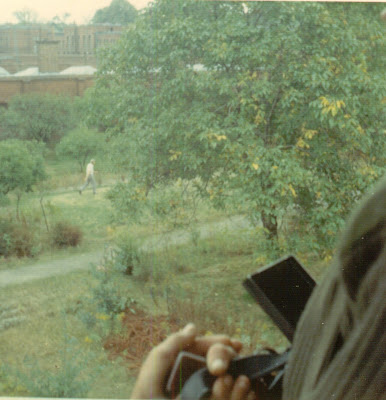
A rare photo of Hess at Spandau on one of his daily walks
Even his death is shrouded in mystery, as many, including his son, believe the British secret service actually assassinated him. For many years, there had been talk of pardoning him, due to his mental illness and old age. Even Winston Churchill and other prominent British leaders expressed publicly that they felt his lifetime incarceration was unjust. By 1987, such a pardon seemed imminent. It is believed by many – though not supported by any hard evidence – that the British killed him to ensure that no embarrassing secrets were revealed upon his release. Many believe the British were, in fact, involved in peace talks with Germany during that period of 1941, and many believe that the British, in fact, had known that Hess was coming, but later balked at making peace with Germany, instead plunging England into another 4 years of war.
After Hess’s death, Spandau Prison was demolished, to keep it from becoming a neo-nazi shrine.
As a postscript, Greg Illes’ excellent novel Spandau Phoenix (Barnes & Noble Link) is centered around the Hess conspiracy, and follows one theory that has suggested the prisoner in Spandau all those years was not Hess at all, but a double. I highly recommend it to anyone who likes thriller novels centered around World War II intrigue.

Hess had been born to German parents in Alexandria, Egypt, but returned to the Fatherland as a young teenager. He wanted to be an astronomer, but his business-minded father insisted that he attend school in Switzerland at a business college. Already 20 at the outbreak of World War I, Hess took the opportunity to escape the rule of his tyrannical father and joined the infantry. He served at the battle of Ypres in 1915, and later in Romania. He was wounded twice, earning an Iron Cross 2nd Class. He later transferred to the air service and flew Fokker D.VII’s for JG 35 in the last few weeks of the war, though he was not credited with any kills.
After the war, Hess, like so many other embittered German veterans, joined the Freikorps, a right wing paramilitary outfit that sprang up in post-war Germany, fighting, among other things, to put down Communist uprisings. He was also reputed to be a member of the Thule Society, an anti-Jew and anti-Communist occult group that later gave Hitler the basis for such Nazi ideas as the primacy of the Aryan race, the use of the swastika as a party symbol, and Jewish extermination.
Hess first met Adolph Hitler in 1920, after hearing Hitler speak. He soon joined Hitler’s budding organization, officially as the 16th member. He took part in the Bier Hall Putsch of 1923, and served 7 and a half months in prison as a result. About this same time, he began serving as Hitler’s secretary, and was the primary editor for Hitler’s book Mein Kampf. He very quickly rose to become Deputy Führer of the Nazi Party and third in command after Hitler and Hermann Göring. Göring, of course, was another former World War I aviator.
Although he maintained his high position in Hitler’s inner circle, he grew increasingly disenfranchised during the 1930’s as others began to grow more powerful within the Nazi hierarchy.
Be that as it may, by May of 1941, Hess was still a right hand man to Hitler and a devoted Nazi to the core.

Hitler and Hess
To this day, the exact circumstances surrounding Hess’s flight on May 10th of that year are unknown. Ostensibly, Hess decided, on his own, to solve the problem of the coming 2-front war for Germany by flying to England to negotiate peace. This, he apparently believed, would help to restore his influence within the Nazi hierarchy. His plan was to meet with the Duke of Hamilton and Brandon, who was an influential commander in the Royal Air Force (he was in charge of the air defense of Scotland), but was suspected, by the Germans anyway, of being a Nazi sympathizer. The Duke had visited Germany a number of times during the 1930’s and had rubbed shoulders with many of the Nazi leadership, including Hitler and Göring. Göring, in fact, had given him a personal invitation to inspect the newly formed Luftwaffe only several years prior to the outbreak of war.
So, presumably acting completely on his own, Hess took off on the evening of May 10, 1941, bound for Scotland. Knowing he would have nowhere to safely land, he parachuted from his plane over southern Scotland, landing on a farm in Eaglesham, just south of Glasgow.

The wreckage of Hess's Messerschmitt in Scotland
Apparently believing he was at or near Dungavel House – the summer estate of the Duke, which was in the same area – Hess limped on a broken ankle to the door of the workman’s cottage nearby and asked to be taken to the Duke, providing the name “Albert Horn” to the dumbstruck farmer.
Instead of taking him to the Duke, the farmer, a man named David McLean, transported him to a local hospital, promising to summon the Duke for him. When Hamilton arrived, Hess admitted to him who he was and told him why he had come. He outlined a plan of peace with England that included returning all European lands to their original nationality, but keeping German police located throughout. Germany would agree to pay to rebuild these countries, but England would have to support the German war against the Soviet Union. Hamilton, realizing that Hess did not, apparently, represent the official German government, and realizing that Hess appeared to be mentally unstable, immediately contacted Winston Churchill. Hess was taken into custody of the British, where he remained a prisoner of war until 1945.
Shortly after his imprisonment, Hitler publicly announced that Hess had not been on any sort of official mission, and that he had gone insane. He arrested and imprisoned most of Hess’s staff and replaced Hess with Martin Bormann – who would later become another influential Nazi figure. Upon hearing of these things, Hess told his interrogators that Hitler’s statements and actions were part of a pre-arranged plan in case the mission failed, in order to save face for the Nazi party. Hess was seen throughout his time in England by a British psychiatrist who determined that he was not, in fact, insane, but was mentally ill and was severely depressed.
Tried with other Nazi criminals at Nüremberg, Hess appeared to go in and out of lucidity, though many believed it was an act. At one point he claimed to have amnesia. During one particularly lucid moment, Hess proudly proclaimed his devotion to the Nazi party, assuring the court that, if he could do it all over, he would not change a thing. His behavior was so disconcerting that Hermann Göring asked for a seat away from him. This request was denied.

The Nüremberg trial, Hess seated 2nd from left, next to Göring
Hess was found guilty of crimes against peace, as well as conspiracy, and sentenced to life in prison at Spandau Prison, in West Berlin. He was found not guilty of war crimes and crimes against humanity.

Spandau Prison
Hess lived well into the 1980’s, spending the last 10 years or so of his life as the jail’s only prisoner, before finally committing suicide at the age of 93, in 1987.

A rare photo of Hess at Spandau on one of his daily walks
Even his death is shrouded in mystery, as many, including his son, believe the British secret service actually assassinated him. For many years, there had been talk of pardoning him, due to his mental illness and old age. Even Winston Churchill and other prominent British leaders expressed publicly that they felt his lifetime incarceration was unjust. By 1987, such a pardon seemed imminent. It is believed by many – though not supported by any hard evidence – that the British killed him to ensure that no embarrassing secrets were revealed upon his release. Many believe the British were, in fact, involved in peace talks with Germany during that period of 1941, and many believe that the British, in fact, had known that Hess was coming, but later balked at making peace with Germany, instead plunging England into another 4 years of war.
After Hess’s death, Spandau Prison was demolished, to keep it from becoming a neo-nazi shrine.
As a postscript, Greg Illes’ excellent novel Spandau Phoenix (Barnes & Noble Link) is centered around the Hess conspiracy, and follows one theory that has suggested the prisoner in Spandau all those years was not Hess at all, but a double. I highly recommend it to anyone who likes thriller novels centered around World War II intrigue.
Wednesday, May 09, 2007
Random Thoughts Born from Boredom
Well, I’m bored at work, don’t feel like working, and thought I would sit down to blog. Unfortunately, I discovered that I have nothing to blog about. So I decided I would blog about nothing; or, at least, about whatever came to mind.
I saw in the news today that they have uncovered King Herod’s tomb in Jerusalem. Yes, the same King Herod who is portrayed as a paranoid, jealous, baby-killer in the Gospel of Matthew. It’s interesting that no other Gospel or New Testament book mentions this singular event. Similarly, it cannot be verified through any known outside archaeological or historical source. Considering the writer of Matthew was writing to a Jewish audience, attempting to show them that Jesus was the prophesied Jewish Messiah, and attempting to show why Jesus was the one the Jews should be following as opposed to the established Jewish hierarchy, it is not hard to imagine that the writer of Matthew might have been exaggerating the truth to make this Jewish king look bad.
Herod, of course, was no saint, and I’m not here to suggest that he was. Secular records of the time showed that he did, indeed, frequently give death sentences to people he viewed as threats. One story says that on his deathbed, Herod ordered the execution of numerous Jewish dignitaries, to ensure that a sincere period of mourning followed his own death. Perhaps it was this sort of reputation, combined with Matthew’s agenda to show his Jewish audience why Jesus was the Messiah, that helped birth Matthew’s story of the massacre of the Jewish infants. Remember, also, that Jerusalem had fallen 10-15 years before Matthew’s gospel was written, and Herod and his descendents were a good target of blame for angry Jews.
On a different note, we had what was definitely our hardest test/comp of the year last night in my Rad 200 class. It was on the pelvis and upper limb. Not only was the comp very difficult, due to a lot of tube angles, convoluted positioning, and a large quantity of methods to learn, but the written test was difficult and convoluted as well. I came out of it unsure whether or not I got an A – which, as most of you know, means that I found it very, very hard.
As part of our written exam each week, we also have to critique various films, labeling landmarks, anatomy, and such. Our bonus film had one question: “What is the object on this film?” The film was an AP pelvis, showing all of the pelvic girdle and upper thighs. In the center of the pelvis, just above the pubic bone, was a long, narrow, white object that extended halfway up the sacrum. On its tip was a smaller projection that seemed to be broken off. At its base was a ring of some sort.
It was a rotating, vibrating dildo.
With a condom on it.
Stuck in someone's asshole.
Now, I don’t have a problem with the crazy stuff people like to do to get off. If a dildo in the rear is your thing, then great. But why would you stick it so far up that it got stuck? And why in the hell would you put a condom on it!? If someone else had just used it and you wanted to be safe – wash the fucking thing!
If you pay attention to my “Currently Reading” panel on the left side of the screen, you’ll know I’ve been reading the first couple of books of the Harry Potter series. I have had these books for 4 or 5 years, but was never that interested in reading them. I always figured I’d get around to it eventually. Well, I’ve gotten around to it, and I am totally hooked. I think these first two books are absolutely sublime. They are so comforting and warm and cozy. I love it!
Don’t worry, I won’t be turning up at Barnes & Noble at midnight in a cape, pointy hat, and funny glasses to buy the next one. But I am excited about reading the series now.
Melanie and I are 99.9% decided on moving to Cincinnati. We have been offered an opportunity to live in her grandparents’ house, which has been empty since last year, for a very low rent (renting from her Mom and aunt). I will have to commute to school, but Melanie will make a lot more money teaching up there, I can work part-time bartending or waiting tables, and we will have a lot of family close by to help with the kids. We’ve weighed all the pro’s and con’s, and it just seems like a no-brainer to go up there. We will only live in the house while I’m in school. After that, we may stay in Cincinnati, or we may come back this way. But right now, we’re just at the end of our rope with the kids and not having any close help, and we are financially strained like we have never been before. I have always been opposed to moving back up to Cincinnati, but because of the present circumstances, I am really excited about this, and I think it will be a good move for us. And who knows, maybe I’ll find that Cincinnati is not so bad after all.
I saw in the news today that they have uncovered King Herod’s tomb in Jerusalem. Yes, the same King Herod who is portrayed as a paranoid, jealous, baby-killer in the Gospel of Matthew. It’s interesting that no other Gospel or New Testament book mentions this singular event. Similarly, it cannot be verified through any known outside archaeological or historical source. Considering the writer of Matthew was writing to a Jewish audience, attempting to show them that Jesus was the prophesied Jewish Messiah, and attempting to show why Jesus was the one the Jews should be following as opposed to the established Jewish hierarchy, it is not hard to imagine that the writer of Matthew might have been exaggerating the truth to make this Jewish king look bad.
Herod, of course, was no saint, and I’m not here to suggest that he was. Secular records of the time showed that he did, indeed, frequently give death sentences to people he viewed as threats. One story says that on his deathbed, Herod ordered the execution of numerous Jewish dignitaries, to ensure that a sincere period of mourning followed his own death. Perhaps it was this sort of reputation, combined with Matthew’s agenda to show his Jewish audience why Jesus was the Messiah, that helped birth Matthew’s story of the massacre of the Jewish infants. Remember, also, that Jerusalem had fallen 10-15 years before Matthew’s gospel was written, and Herod and his descendents were a good target of blame for angry Jews.
On a different note, we had what was definitely our hardest test/comp of the year last night in my Rad 200 class. It was on the pelvis and upper limb. Not only was the comp very difficult, due to a lot of tube angles, convoluted positioning, and a large quantity of methods to learn, but the written test was difficult and convoluted as well. I came out of it unsure whether or not I got an A – which, as most of you know, means that I found it very, very hard.
As part of our written exam each week, we also have to critique various films, labeling landmarks, anatomy, and such. Our bonus film had one question: “What is the object on this film?” The film was an AP pelvis, showing all of the pelvic girdle and upper thighs. In the center of the pelvis, just above the pubic bone, was a long, narrow, white object that extended halfway up the sacrum. On its tip was a smaller projection that seemed to be broken off. At its base was a ring of some sort.
It was a rotating, vibrating dildo.
With a condom on it.
Stuck in someone's asshole.
Now, I don’t have a problem with the crazy stuff people like to do to get off. If a dildo in the rear is your thing, then great. But why would you stick it so far up that it got stuck? And why in the hell would you put a condom on it!? If someone else had just used it and you wanted to be safe – wash the fucking thing!
If you pay attention to my “Currently Reading” panel on the left side of the screen, you’ll know I’ve been reading the first couple of books of the Harry Potter series. I have had these books for 4 or 5 years, but was never that interested in reading them. I always figured I’d get around to it eventually. Well, I’ve gotten around to it, and I am totally hooked. I think these first two books are absolutely sublime. They are so comforting and warm and cozy. I love it!
Don’t worry, I won’t be turning up at Barnes & Noble at midnight in a cape, pointy hat, and funny glasses to buy the next one. But I am excited about reading the series now.
Melanie and I are 99.9% decided on moving to Cincinnati. We have been offered an opportunity to live in her grandparents’ house, which has been empty since last year, for a very low rent (renting from her Mom and aunt). I will have to commute to school, but Melanie will make a lot more money teaching up there, I can work part-time bartending or waiting tables, and we will have a lot of family close by to help with the kids. We’ve weighed all the pro’s and con’s, and it just seems like a no-brainer to go up there. We will only live in the house while I’m in school. After that, we may stay in Cincinnati, or we may come back this way. But right now, we’re just at the end of our rope with the kids and not having any close help, and we are financially strained like we have never been before. I have always been opposed to moving back up to Cincinnati, but because of the present circumstances, I am really excited about this, and I think it will be a good move for us. And who knows, maybe I’ll find that Cincinnati is not so bad after all.
Tuesday, May 08, 2007
Snakes & Arrows
On May 1, 2007, Rush’s 19th studio album, Snakes & Arrows, was released to stores in the United States. In anticipation of this event, I took the day off so that I could buy the album and listen to it to my heart’s content. I also got a 2-hour massage while I was at it. If the massage was sublime (and it was), then the album was splendid, marvelous, and utterly refreshing.
Because I only became a devoted Rush fan in the last few years, Snakes & Arrows has been my first real experience with a brand new, studio-made album of new Rush material. It has been billed as a work dealing largely with issues of faith, religion, and spirituality – topics that, most of you know, are very close to my heart. The very title, Snakes & Arrows, is a reference to an ancient Hindu game detailing the ups and downs of spiritual and material life. Needless to say, I anticipated the release of this album for quite some time.
So far, it has not disappointed. I think it may be Rush’s best album in 20 years. There are also several songs/moments on the album that come pretty darn close to being downright bluesy – something I’ve never heard in a Rush song before.
The first song on the album, Far Cry, was released to radio and the Internet back in March, and is probably the most radio-friendly song on the album. It has an upbeat sound with the alternating time signature stop-beats that Rush is so famous for. It also has a chord in one of the primary riffs that is clearly a reference to an old epic song of Rush’s, the 18-minute masterpiece Hemispheres, from 1979. The lyrics of Far Cry lament the state of the world today. “It’s a far cry from the world we thought we’d inherit.” Later in the song: “Whirlwind life of faith and betrayal/rise in anger/fall back and repeat.”
Track two, Armor and Sword, is a more relaxed song with several moments of solo acoustic guitar and voice, mixed in with a driving verse. It discusses the way that our emotional refuges frequently serve to hurt, rather than help. “What should have been our armor becomes a sharp and angry sword,” and, “No one gets to their heaven without a fight.”
Workin’ Them Angels, track three, is a set of lyrics first written in Neil Peart’s book “Traveling Music,” which details a week-long car trip that Neil took, and the music he listened to along the way (Neil is Rush’s drummer, and also their lyricist). If I recall correctly, the title was taken from a conversation he overheard in some out-of-the-way town where one person told another that they had been “workin’ them angels.” “All of my life I’ve been workin’ them angels, riding and driving and living so close to the edge. Workin’ them angels overtime.”
The Larger Bowl is subtitled “a pantoum,” and I admit I had to look the word up. A pantoum is a Malay poetic form in which the second and fourth verses of a quatrain (a four-verse stanza) are repeated as the first and third verses of the next quatrain. At this early stage, The Larger Bowl is one of my favorite songs on the album. It is relaxed and laid back, largely acoustic, and the lyrics, because of their repetitious nature, have a gentle, lilting feel. There's also a timely and well-crafted guitar solo toward the end. “The golden one, or scarred from birth/some things can never be changed/such a lot of pain on this earth/it’s somehow so badly arranged.”
Spindrift is the fifth track on the album, and although the meaning of this word is evident after you read the lyrics, I looked it up as well. It refers to ocean spray that gets blown into misty circles by a strong wind. This is probably the darkest song on the album, musically, and perhaps even lyrically.
“As the waves crash in
On the Western shore
It makes me feel uneasy
The spray that’s torn away
Is an image of the way I feel.”
Track six is the first of three instrumentals on the album. Titled The Main Monkey Business, it is a 6-minute song with a nice groove that displays, like all their songs, Rush's instrumental virtuosity.
Track seven, The Way the Wind Blows, has probably the most straightforward, no punches pulled lyrics on the whole album. It’s also an early contender for my favorite song:
“Now it’s come to this
It’s like we’re back in the Dark Ages
From the Middle East to the Middle West
It’s a world of superstition.”
“Wide-eyed armies of the faithful
Pray, and pass the ammunition.”
“Hallow speeches of mass deception
Like crusaders in an unholy alliance
It’s a plague that resists all science.”
“It seems to leave them partly blind
And they leave no child behind
While evil spirits haunt their sleep
While shepherds bless and count their sheep.”
Need I say more about this song? This is why I love this band. The music to this one is great, too, and the opening riff is so bluesy it could have been taken straight off a Stevie Ray Vaughan album.
The eighth song on the album is a solo acoustic guitar instrumental called Hope. It is a great example of Alex Lifeson’s virtuosity and feel for the guitar. The liner notes to the song state that Alex wrote it “all by his own self.”
Track nine, Faithless, is another song with strong, straightforward lyrics. This is the song that many traditionally believing Rush fans will bristle at. “I don’t have faith in faith/I don’t believe in belief/you can call me faithless/but I still cling to hope.” “Like a flower in the desert/that only blooms at night/I will quietly resist.”
Bravest Face is probably the only song on the album that, at this point, I would call “average.” It’s a fine song, but there is just nothing in it that strikes a chord, emotionally, with me. It’s got a nice chorus, however, and I do like the lyrical refrain, “Though we may have precious little, it’s still precious.”
Track eleven, Good News First, is another blues-inspired song that almost has a ghostly, underwater feel to it. Geddy sings the verses with an unusual warble that sounds a little odd at first, but grows on you with time. “Some would say they never fear a thing/well I do/and I’m afraid enough for both of us/me and you.”
Track twelve is the third and final instrumental on the album, and, in my opinion, the best. Titled Malignant Narcissism, it has a funky, hard rocking beat with a lot of great drum and bass work. Probably their best instrumental since 1981’s YYZ.
The final song, We Hold On, carries on the Rush tradition of closing albums with a very good song. After twelve previous songs that are often dark, pessimistic, and angry, this song is upbeat and ends the album on a positive note. The lyrics are also disturbingly relevant to my life and experiences:
“How many times
Do we chafe against the repetition
Straining against a fate
measured out in coffee breaks?”
“How many times
Do we swallow our ambitions
Long to give up the same old way
Find another road to take?”
“Keep holding on so long
‘Cause there’s a chance
That we might not be so wrong
We could be down and gone
But we hold on.”
Definitely a set of lyrics I need to hear right now, and definitely an important message for anyone struggling (like the Hindu game the album is named after) with the ups and downs of spiritual and material life.
I think there is a little in this album for everyone. The lyrics are powerful and relevant, the music is varied and drawn from a wide variety of musical styles, Geddy’s voice sounds great, and the playing is, as always, superb, tight, and virtuosic.
I highly recommend it.
Because I only became a devoted Rush fan in the last few years, Snakes & Arrows has been my first real experience with a brand new, studio-made album of new Rush material. It has been billed as a work dealing largely with issues of faith, religion, and spirituality – topics that, most of you know, are very close to my heart. The very title, Snakes & Arrows, is a reference to an ancient Hindu game detailing the ups and downs of spiritual and material life. Needless to say, I anticipated the release of this album for quite some time.
So far, it has not disappointed. I think it may be Rush’s best album in 20 years. There are also several songs/moments on the album that come pretty darn close to being downright bluesy – something I’ve never heard in a Rush song before.
The first song on the album, Far Cry, was released to radio and the Internet back in March, and is probably the most radio-friendly song on the album. It has an upbeat sound with the alternating time signature stop-beats that Rush is so famous for. It also has a chord in one of the primary riffs that is clearly a reference to an old epic song of Rush’s, the 18-minute masterpiece Hemispheres, from 1979. The lyrics of Far Cry lament the state of the world today. “It’s a far cry from the world we thought we’d inherit.” Later in the song: “Whirlwind life of faith and betrayal/rise in anger/fall back and repeat.”
Track two, Armor and Sword, is a more relaxed song with several moments of solo acoustic guitar and voice, mixed in with a driving verse. It discusses the way that our emotional refuges frequently serve to hurt, rather than help. “What should have been our armor becomes a sharp and angry sword,” and, “No one gets to their heaven without a fight.”
Workin’ Them Angels, track three, is a set of lyrics first written in Neil Peart’s book “Traveling Music,” which details a week-long car trip that Neil took, and the music he listened to along the way (Neil is Rush’s drummer, and also their lyricist). If I recall correctly, the title was taken from a conversation he overheard in some out-of-the-way town where one person told another that they had been “workin’ them angels.” “All of my life I’ve been workin’ them angels, riding and driving and living so close to the edge. Workin’ them angels overtime.”
The Larger Bowl is subtitled “a pantoum,” and I admit I had to look the word up. A pantoum is a Malay poetic form in which the second and fourth verses of a quatrain (a four-verse stanza) are repeated as the first and third verses of the next quatrain. At this early stage, The Larger Bowl is one of my favorite songs on the album. It is relaxed and laid back, largely acoustic, and the lyrics, because of their repetitious nature, have a gentle, lilting feel. There's also a timely and well-crafted guitar solo toward the end. “The golden one, or scarred from birth/some things can never be changed/such a lot of pain on this earth/it’s somehow so badly arranged.”
Spindrift is the fifth track on the album, and although the meaning of this word is evident after you read the lyrics, I looked it up as well. It refers to ocean spray that gets blown into misty circles by a strong wind. This is probably the darkest song on the album, musically, and perhaps even lyrically.
“As the waves crash in
On the Western shore
It makes me feel uneasy
The spray that’s torn away
Is an image of the way I feel.”
Track six is the first of three instrumentals on the album. Titled The Main Monkey Business, it is a 6-minute song with a nice groove that displays, like all their songs, Rush's instrumental virtuosity.
Track seven, The Way the Wind Blows, has probably the most straightforward, no punches pulled lyrics on the whole album. It’s also an early contender for my favorite song:
“Now it’s come to this
It’s like we’re back in the Dark Ages
From the Middle East to the Middle West
It’s a world of superstition.”
“Wide-eyed armies of the faithful
Pray, and pass the ammunition.”
“Hallow speeches of mass deception
Like crusaders in an unholy alliance
It’s a plague that resists all science.”
“It seems to leave them partly blind
And they leave no child behind
While evil spirits haunt their sleep
While shepherds bless and count their sheep.”
Need I say more about this song? This is why I love this band. The music to this one is great, too, and the opening riff is so bluesy it could have been taken straight off a Stevie Ray Vaughan album.
The eighth song on the album is a solo acoustic guitar instrumental called Hope. It is a great example of Alex Lifeson’s virtuosity and feel for the guitar. The liner notes to the song state that Alex wrote it “all by his own self.”
Track nine, Faithless, is another song with strong, straightforward lyrics. This is the song that many traditionally believing Rush fans will bristle at. “I don’t have faith in faith/I don’t believe in belief/you can call me faithless/but I still cling to hope.” “Like a flower in the desert/that only blooms at night/I will quietly resist.”
Bravest Face is probably the only song on the album that, at this point, I would call “average.” It’s a fine song, but there is just nothing in it that strikes a chord, emotionally, with me. It’s got a nice chorus, however, and I do like the lyrical refrain, “Though we may have precious little, it’s still precious.”
Track eleven, Good News First, is another blues-inspired song that almost has a ghostly, underwater feel to it. Geddy sings the verses with an unusual warble that sounds a little odd at first, but grows on you with time. “Some would say they never fear a thing/well I do/and I’m afraid enough for both of us/me and you.”
Track twelve is the third and final instrumental on the album, and, in my opinion, the best. Titled Malignant Narcissism, it has a funky, hard rocking beat with a lot of great drum and bass work. Probably their best instrumental since 1981’s YYZ.
The final song, We Hold On, carries on the Rush tradition of closing albums with a very good song. After twelve previous songs that are often dark, pessimistic, and angry, this song is upbeat and ends the album on a positive note. The lyrics are also disturbingly relevant to my life and experiences:
“How many times
Do we chafe against the repetition
Straining against a fate
measured out in coffee breaks?”
“How many times
Do we swallow our ambitions
Long to give up the same old way
Find another road to take?”
“Keep holding on so long
‘Cause there’s a chance
That we might not be so wrong
We could be down and gone
But we hold on.”
Definitely a set of lyrics I need to hear right now, and definitely an important message for anyone struggling (like the Hindu game the album is named after) with the ups and downs of spiritual and material life.
I think there is a little in this album for everyone. The lyrics are powerful and relevant, the music is varied and drawn from a wide variety of musical styles, Geddy’s voice sounds great, and the playing is, as always, superb, tight, and virtuosic.
I highly recommend it.
Monday, April 30, 2007
The Heavenly Messenger of 1006
1001 years ago tonight...
The evening of April 30, 1006, would have started like any other spring evening in north-central Egypt. As the sun set, the mid-80 degree temperatures would have sluiced off like water down a drain, dropping quickly into the low- to mid-60’s. The setting sun would have illuminated the western sides of the Pyramids at Giza, casting them in a golden orange glow until the disc of the sun dropped below the horizon. The purple-blue sky would have quickly descended into a vast, moonless black. The moon’s last quarter had begun on April 23rd, and April 30th marked the night of the new moon. The stars that night would have shown like grains of sand on a beach, the stellar light added to only by cooking fires spread across the Muslim village of Cairo.
Abu’l Hasan Ali ibn Ridwan Al-Misri was roughly 10 or 11 years old on that moonless Egyptian night. Born near Giza, he was an exceptionally bright child, fascinated by the heavens, devoted to Allah, and interested in the workings of the human body. He would one day become a prominent physician and astronomer, writing commentaries on ancient Greek medical practices and engaging in lively polemics against a rival physician and thinker across the deserts in Baghdad.
But on this night, the night of April 30, 1006, Ali ibn Ridwan, as he was more commonly known, was still a curious and eager child, with the world at his doorstep. He must have stepped out of that doorstep on that fateful evening, perhaps to engage in a nightly routine of stargazing, or perhaps to perform some mundane household task. Whatever the reason, what he saw in the sky that night would remain in his mind forever.
As he gazed into the heavens on that dark, moonless night, he saw what astronomers now know was the brightest and most intense supernova ever witnessed and recorded by human beings.
Later in life, Ali ibn Ridwan would write that it was about three times the size and intensity of Venus (which was, and is, a very bright, prominent body in the night sky), and that the overall intensity was about one-quarter the brightness of a full moon. Indeed, it was so bright, it cast shadows on the ground, much like the moon can do on a clear night. A modern astronomer commenting on the event stated that it was probably so bright, one could likely have read a text or manuscript by its light.
Egyptians weren’t the only ones who witnessed this timeless stellar event. Benedictine monks in Switzerland wrote of the supernova, “in a wonderful manner this was sometimes contracted, sometimes diffused, and moreover sometimes extinguished.”
According to Chinese astrologers, who left the most detailed report of the event, the supernova was east of the constellation of Lupus, south of Di, and one degree west of Centaurus. These same astrologers claimed its brightness equaled half the intensity of the full moon.
The supernova remained visible in varying degrees of intensity throughout the summer, before disappearing in the fall. As the earth rotated, it became visible again in December, and appeared off and on for at least the next year and a half. A recently discovered Native American petroglyph from roughly the same era is believed to also record the event (see this CNN article.)
In 1965, astronomers verified the factuality of the various ancient texts when they first detected radio waves and X-rays emitting from the remnant of the explosion. It was long believed, based on the eyewitness reports, that the supernova of 1006 was a Type Ia explosion, meaning, among other things, that it lacked hydrogen. A Type Ia explosion had been suspected primarily based on the reports from the Swiss monks of the star’s tendency to change in intensity, diffuse, and disappear. Type Ia supernovae do not collapse into neutron stars or form black holes, and, verifying the initial suspicions about the nature of the 1006 supernova, no neutron star or black hole has ever been detected in the remnant.
The next time you casually step outside on a clear night and stare up into the sky, remember Ali ibn Ridwan, and marvel at the vastness and timeless beauty of the universe.

A Type Ia supernova just outside the border of galaxy NGC 4526.
The evening of April 30, 1006, would have started like any other spring evening in north-central Egypt. As the sun set, the mid-80 degree temperatures would have sluiced off like water down a drain, dropping quickly into the low- to mid-60’s. The setting sun would have illuminated the western sides of the Pyramids at Giza, casting them in a golden orange glow until the disc of the sun dropped below the horizon. The purple-blue sky would have quickly descended into a vast, moonless black. The moon’s last quarter had begun on April 23rd, and April 30th marked the night of the new moon. The stars that night would have shown like grains of sand on a beach, the stellar light added to only by cooking fires spread across the Muslim village of Cairo.
Abu’l Hasan Ali ibn Ridwan Al-Misri was roughly 10 or 11 years old on that moonless Egyptian night. Born near Giza, he was an exceptionally bright child, fascinated by the heavens, devoted to Allah, and interested in the workings of the human body. He would one day become a prominent physician and astronomer, writing commentaries on ancient Greek medical practices and engaging in lively polemics against a rival physician and thinker across the deserts in Baghdad.
But on this night, the night of April 30, 1006, Ali ibn Ridwan, as he was more commonly known, was still a curious and eager child, with the world at his doorstep. He must have stepped out of that doorstep on that fateful evening, perhaps to engage in a nightly routine of stargazing, or perhaps to perform some mundane household task. Whatever the reason, what he saw in the sky that night would remain in his mind forever.
As he gazed into the heavens on that dark, moonless night, he saw what astronomers now know was the brightest and most intense supernova ever witnessed and recorded by human beings.
Later in life, Ali ibn Ridwan would write that it was about three times the size and intensity of Venus (which was, and is, a very bright, prominent body in the night sky), and that the overall intensity was about one-quarter the brightness of a full moon. Indeed, it was so bright, it cast shadows on the ground, much like the moon can do on a clear night. A modern astronomer commenting on the event stated that it was probably so bright, one could likely have read a text or manuscript by its light.
Egyptians weren’t the only ones who witnessed this timeless stellar event. Benedictine monks in Switzerland wrote of the supernova, “in a wonderful manner this was sometimes contracted, sometimes diffused, and moreover sometimes extinguished.”
According to Chinese astrologers, who left the most detailed report of the event, the supernova was east of the constellation of Lupus, south of Di, and one degree west of Centaurus. These same astrologers claimed its brightness equaled half the intensity of the full moon.
The supernova remained visible in varying degrees of intensity throughout the summer, before disappearing in the fall. As the earth rotated, it became visible again in December, and appeared off and on for at least the next year and a half. A recently discovered Native American petroglyph from roughly the same era is believed to also record the event (see this CNN article.)
In 1965, astronomers verified the factuality of the various ancient texts when they first detected radio waves and X-rays emitting from the remnant of the explosion. It was long believed, based on the eyewitness reports, that the supernova of 1006 was a Type Ia explosion, meaning, among other things, that it lacked hydrogen. A Type Ia explosion had been suspected primarily based on the reports from the Swiss monks of the star’s tendency to change in intensity, diffuse, and disappear. Type Ia supernovae do not collapse into neutron stars or form black holes, and, verifying the initial suspicions about the nature of the 1006 supernova, no neutron star or black hole has ever been detected in the remnant.
The next time you casually step outside on a clear night and stare up into the sky, remember Ali ibn Ridwan, and marvel at the vastness and timeless beauty of the universe.

A Type Ia supernova just outside the border of galaxy NGC 4526.
Friday, April 27, 2007
RUSH RUSH RUSH RUSH
FIFTEENTH FUCKING ROW IN CINCINNATI, BITCHES!!!!!
FIFTEENTH FUCKING ROW IN CINCINNATI, BITCHES!!!!!
FIFTEENTH FUCKING ROW IN CINCINNATI, BITCHES!!!!!
FIFTEENTH FUCKING ROW IN CINCINNATI, BITCHES!!!!!
FIFTEENTH FUCKING ROW IN CINCINNATI, BITCHES!!!!!
FIFTEENTH FUCKING ROW IN CINCINNATI, BITCHES!!!!!
FIFTEENTH FUCKING ROW IN CINCINNATI, BITCHES!!!!!
FIFTEENTH FUCKING ROW IN CINCINNATI, BITCHES!!!!!
FIFTEENTH FUCKING ROW IN CINCINNATI, BITCHES!!!!!
FIFTEENTH FUCKING ROW IN CINCINNATI, BITCHES!!!!!
FIFTEENTH FUCKING ROW IN CINCINNATI, BITCHES!!!!!
FIFTEENTH FUCKING ROW IN CINCINNATI, BITCHES!!!!!
FIFTEENTH FUCKING ROW IN CINCINNATI, BITCHES!!!!!
FIFTEENTH FUCKING ROW IN CINCINNATI, BITCHES!!!!!
FIFTEENTH FUCKING ROW IN CINCINNATI, BITCHES!!!!!
That's right. SUCK ON IT!!
Come on September 1st!!!!!!!
FIFTEENTH FUCKING ROW IN CINCINNATI, BITCHES!!!!!
FIFTEENTH FUCKING ROW IN CINCINNATI, BITCHES!!!!!
FIFTEENTH FUCKING ROW IN CINCINNATI, BITCHES!!!!!
FIFTEENTH FUCKING ROW IN CINCINNATI, BITCHES!!!!!
FIFTEENTH FUCKING ROW IN CINCINNATI, BITCHES!!!!!
FIFTEENTH FUCKING ROW IN CINCINNATI, BITCHES!!!!!
FIFTEENTH FUCKING ROW IN CINCINNATI, BITCHES!!!!!
FIFTEENTH FUCKING ROW IN CINCINNATI, BITCHES!!!!!
FIFTEENTH FUCKING ROW IN CINCINNATI, BITCHES!!!!!
FIFTEENTH FUCKING ROW IN CINCINNATI, BITCHES!!!!!
FIFTEENTH FUCKING ROW IN CINCINNATI, BITCHES!!!!!
FIFTEENTH FUCKING ROW IN CINCINNATI, BITCHES!!!!!
FIFTEENTH FUCKING ROW IN CINCINNATI, BITCHES!!!!!
FIFTEENTH FUCKING ROW IN CINCINNATI, BITCHES!!!!!
That's right. SUCK ON IT!!
Come on September 1st!!!!!!!
Monday, April 23, 2007
Thunder Over Louisville
Saturday, April 21st, 2007, dawned crisp and clear, with a pristine blue sky stretching unmarred from horizon to horizon. I had been looking forward to this day since March, when my best friend Russell first suggested that we go to Thunder Over Louisville together.
Thunder is a relatively new annual tradition in Louisville, first begun in 1990 as a way to kick off the traditional Kentucky Derby festivities. It takes place two Saturdays before the Derby itself, and it inaugurates fourteen days of citywide entertainment, culminating with the fastest two minutes in sports. It consists of the country’s 5th largest air show, which takes place all afternoon and into the early evening, and ends with the largest annual fireworks show in the United States.
According to the official estimates, as many as 1 million people turn out for Thunder Over Louisville. Roughly 700,000 on the Kentucky side, and another 300,000 on the Indiana side. Considering there is only about 1.2 or 1.3 million in the Greater Louisville area, these figures show how many out-of-towners converge on the city on this day. A 2001 estimate stated that the 1-day show brings in about 31 million dollars for the local economy, and I suspect it is probably a lot higher than that by now.
Russell and I arrived in downtown Louisville at about 2:00 on Saturday. The capitalist parking lot owners were out in full force, with some lots charging as much as $45 for parking. We passed those lots by and found a “cheaper” lot a few blocks farther on where we paid a measly (!!!) $20 for parking. The lot belonged to a funeral home, and the director was in the parking lot taking cash and directing us into the appropriate slot, which was probably not too terribly unfamiliar to him, what with sliding bodies out of morgue trays and all. He offered to let us use the bathroom inside if need be, which I thought was kind of him, even if we had just paid him twenty dollars to park our car on his pavement. No death calls today, please! I’m making more money committing anal rape in my parking lot!
As is his tradition, Russell had brought along a bottle of Jim Beam to help liven things up a bit, but there were too many people around to safely carry it with us, so we decided to leave it in the car and come back for it later. We began the 25-minute walk to the main festival area, which was situated on the river right in front of the Louisville Bats baseball stadium. Even as far out as the stadium, a number of people had blankets and chairs set up, not feeling the need to get any closer to the mass of humanity that was slowly converging on the riverfront. Police were everywhere, and a line of ambulances sat idling along the street, ready to whisk away the inevitable heat stroke, heart attack, and broken bone victims that must surely appear when so many people are in one spot.
We entered the festival area, which was situated underneath and around the JFK Memorial Bridge. Rows and rows of food stands lined the main drag, consisting of everything from the typical fairground hotdogs and corn dogs, to Greek gyros, barbecue, and sirloin tips. Even this early in the afternoon, it was already quite crowded. To our right, nearer the river, the various branches of the military each had interactive displays, complete with a rope ladder to test your climbing skills for the Navy, a pull-up bar to test your upper body strength with the Marines, and some kind of obstacle course to run for the Army.
Naturally, Russell and I directed our attention directly at the Chow Wagon. This was an enclosed area near the center of the festival grounds where alcohol (as well as more food) was sold. You had to purchase a 3-dollar Pegasus pin to get in, and then you had to show your ID and get a green bracelet to show that you were 21. None of the food stands or beer stands in the Chow Wagon take cash; instead, you had to purchase food tickets or alcohol tickets: 50 cents for a food ticket, and a dollar for a beer ticket. A 20-ounce beer cost 6 tickets and your basic Oscar Mayer wiener, grilled black, would set you back 4 tickets. A gyro sandwich cost a whopping 12 tickets. Once you got your Pegasus pin from the vendor outside, passed through the turnstiles showing your pin to the guard, obtained your green bracelet from the ID booth, and purchased your tickets from the ticket booth, you then took your tickets to your food/beer stand of choice and bought your food and/or drinks.
Russell and I went through this highly convoluted and complicated process (which is clearly meant to weed out any drinkers with less than a Ph.D in Physics, although somehow the white trash still managed to get through), and finally got 2 frosty Bud Lights, which we summarily downed with gusto.

Inside the Chow Wagon
There was a cover band with a female singer playing Country Hits of Your Grandparents’ Generation and throwing in an occasional Electric Slide just for shits and giggles. Honestly, they weren’t that bad, but I could have done with a band playing more upbeat music from the last 20 years or so, as opposed to 1960’s and 70’s hits of Patsy Cline and Linda Ronstadt. When they mentioned that they would be playing a set following the fireworks show, Russell and I gave it some serious consideration, but then decided to go insert fishhooks into our eyeballs instead.
At 3:00, the air show started. It was hard not to realize when it began, because it started with a double afterburner F-22 Raptor streaking across the sky, followed by a roar that made the eardrums buzz. The F-22 was followed by a series of other deafening jets, before some more serene propeller planes took over, flying in formation and performing various tricks.


After standing in the sun for while, draining two more beers, taking some pictures of the planes, and then walking around the waterfront for half an hour or so, we decided to head back to the car to crack open the Beam. It was in the upper 70’s outside, and not a cloud in the sky, so we were losing a lot of fluid to sweat, and replacing it not with water, but with beer. So even with only a few beers apiece, we were both feeling pretty good. I’m not much on bourbon, especially after I’ve already had beer, but Russell loves it, so I decided to be a trooper. For his sake.
We hiked back to the car and were disappointed to find that there were still some funeral home personnel lingering around the parking lot. So we sat in the car for a few minutes, finished the pack of cigarettes we had started earlier, and then, all stealthy-like, poured a bunch of bourbon into the Cokes we had purchased before walking out of the festival area. There was no reliable way to carry the bottle with us without getting caught, so we decided to leave it permanently in the car. For this reason, we made what would be our only mixed drink quite strong. Bourbon with a splash or two of Coke, really.
As the day wore on, the crowds began to swell. By the time we returned with our illicit drinks, the mass of humanity seemed to have doubled. Where the Chow Wagon had been a slight reprieve from the heavy crowds outside earlier in the day, by 5:30 it was as crowded as any other area we had been in. Unfortunately, after walking back inside, the guards made us pour out our drinks, which we had only half finished. It wasn’t because he knew there was liquor in it; apparently you simply aren’t allowed to bring beverages in from outside, even if they were bought at a festival stand. We were too buzzed by this time to realize we could have just walked back outside and finished the drinks before entering the Chow Wagon, so instead we dumped them unceremoniously into the garbage.
Since we were now without beverage, like two newborns without pacifiers, we immediately went to buy more beer, but had to stand in a line stretching to Memphis to buy tickets. When we had finally rescued the Bud Light from the keg and had it safely in our hands, we returned to the place we had been standing earlier, against a wall right in front of a small waterfall that provided a nice cool breeze.

I sat for a while, having been drained of energy by the bourbon, while Russell stood and presumably tried not to look drunk.
I finally stood back up right about the time an older black man, with a few missing teeth, curly hair tied into a very short bun/ponytail behind his head, and wearing a slick green suit with a yellow turtleneck, leather shoes, and no socks, walked up, complaining that someone had stolen his cigarettes. He had stood up, he said, to dance a little to the music, and when he turned around, his cigarettes were gone. He wasn’t mad, though, because that’s just the way life goes sometimes. I offered him some of ours, but he declined, assuring me that the lady next to him had just sold him five cigarettes for a dollar – an act which he found to be immensely kind and generous, apparently forgetting that you can get 20 for about $2.50 at any corner gas station.
He and I began chatting. I learned that his last name was Cooper, and I won’t make any attempt to recreate his first name, as it was nothing I had ever heard before and sounded either tribal African or otherwise made up. He was not an evangelist, he told me, but he was simply called to show God’s love. God, he said, was allowing him to have a few beers because he had just graduated from culinary school. That very day. It was a gift, he assured me, and it was not something he would do again, because he didn’t want to take advantage of that gift. He’s not a crack cocaine user, he doesn’t do all that yellow rock. That’s the past. God has transformed his life. How has God transformed his life? Well, he went from a double-barreled shotgun pointed at his mouth to the man you see today dressed in these fine clothes. You see, it happened back in 1998. He found out that his wife was “sucking dicks” for money. His kids told him. He’d come home and his son would say, “Daddy, Mama had those men over again today.” She was sucking dicks for cash. He was so distraught, and so high on that yellow rock, that he decided he couldn’t live anymore. He came home, put a round into a double-barreled shotgun, chambered it and cocked it, and then stuck it in his mouth. But before he pulled the trigger, he prayed. Suddenly a bright light glowed around him, so bright he had to shield his eyes. It was coming from behind him, and he turned to look. He heard a voice that told him everything was going to be okay. This was, apparently, God, not the yellow rock talking. He felt a sudden peace in his heart (as opposed to the piece that had been in his mouth). He put the gun down, lay back, and slept better than he had ever slept in his life, waking up the next morning feeling like a new man. Ever since then, he’s been working to overcome his drug and alcohol addiction (hadn’t had a drink in two years, he said, until God gave him the gift of beer that day as a reward for graduating from culinary school), and he was working at the YMCA as a cook, with his new degree. He was currently in “transitional living,” which was his phrase for “living in a homeless shelter,” working at the YMCA and the Salvation Army. The Salvation Army, he admitted, was where he had gotten his nice suit, because “you know, I gotta get mine, too.”
While this 45-minute conversation of testimony and the Divine Reward of Beer was going on, Russell, I found out later, was sneaking puffs on a joint from a girl standing next to him who had gladly produced it. By the time Mr. Cooper finally left (he was going home because he couldn’t get drunk on God’s Reward that night – he had bible study and church on Sunday), the joint was gone, and the girl walked away about the same time. Damn my luck.
We stood around for a while longer, until Russell accidentally spilled his beer down the wall in front of the waterfall. We decided it was time to head toward the main lawn area, which is the best viewing area for the fireworks. It was about 8:15.
The main lawn area was like Woodstock, without the mud. Just a sea of bodies, lawn chairs, blankets, and coolers, stretching for as far as the eye could see. It probably took us half an hour just to get through the crush of bodies and find a 5-foot area of grass where we could stand.

Thunder Over Woodstock
It was at this point that all the Obligatory Patriotic Bullshit started. Since I went to Thunder Over Louisville with Russell back in 2004 or 2005, I had known this was coming, but I had been dreading it all the same. It started with two helicopters flying in the dusk sky, spotlights illuminating the fluttering Stars and Stripes hanging down from their landing skids. A deep, heavy voice – the kind of voice you hear at those overly dramatic EPCOT exhibits: rich and deep, penetrating, dripping with the weight of historical importance – began giving a soliloquy on American history. “From a farmer-turned-general who would lead This Great Nation through its Revolution against the Forces of Tyranny, to the Kentucky-born president who would Emancipate the Slaves, and to the selfless actions of the Greatest Generation in the War to End All Wars, America the Beautiful has stood as One Nation Under God, never faltering in the Face of Adversity, but always Standing Up For Freedom...” blah, blah-blah, blah-blah. This, naturally, was followed by a rousing rendition of God Bless America, followed, as could only be expected, by an equally rousing rendition of Your Favorite Song and Mine, Proud to Be An American. Because hey, at least I know I’m free.
There was a group of teenage girls not far from where we were standing. They weren’t the slutty teenage type, but looked, instead, like a group of girls from a church youth group. During God Bless America, they were doing sign language to the lyrics (I mean, does anything scream CHURCH more than sign language to a patriotic song?), and for the word “bless” they made a cross with their fingers. Now, I don’t know sign language, but I was betting that motion wasn’t the word for “bless.” I looked it up today, and sure enough, “bless” is done by placing both fists on the chin, thumbs back, and then moving the hands downward, palms open and toward the floor. So these kids had learned sign language to God Bless America, but had learned “bless” as two crossed index fingers.
I’m not sure what was worse – listening to the soliloquy and the songs, or watching all the shirtless, sunburned white trash saluting, waving miniature flags, singing, and slow-dancing with their trashy girlfriends with expressions of deep meditation on the Greatness of Our Country and the Sacrifice of Our Troops.
Thankfully, God herself finally intervened and made the fireworks start, thereby ending the Orwellian fervor of Patriotic Bliss that was happening all around me.
Fireworks are, well, fireworks. You can see the pictures, although it doesn’t do them justice.

Opening salvo.


Atom with nucleus.

Burning bridge.


The heart.


Final blast.
There were two areas of fireworks, with the main one spread right out in front of us, covering the majority of the sky. They were being shot from the bridges and from barges on the river. You could feel the concussions in your chest, and sometimes the sky was so bright it was like stadium lights had been turned on. The show lasted about half an hour, ending first with a faux climax, and then starting up again in an utter blitzkrieg of colored fire in the sky.
When the show was finally over, Russell and I made a quick exit, hoping to beat some of the mass of humanity back toward Main Street. Once there, we made our way to Stevie Ray's, which is a blues bar dedicated to the memory of Stevie Ray Vaughan, a great rock n’ roll blues guitarist. We went there after our Thunder experience in 2004 or 2005, and we had had a great time. Turns out, the same band was there, a local blues powerhouse called The Predators. I can say, without any question, that this is the best local band I have ever heard anywhere in any city at any event. The lead singer has an amazing voice, the band as a whole is tight and accurate, they perform without the slightest sense of tension or urgency, and the lead guitarist is hands down the best electric guitarist I have ever seen perform live, with the exception of Alex Lifeson of Rush. He seems to be as good as Stevie Ray himself, and the tone and timbre of his guitar is identical to Stevie Ray’s. They played, naturally, a lot of Stevie Ray’s music, but also played a lot of other songs, ranging from 1960’s Motown hits to modern rock songs. The last time we went, they even played Prince’s “Sexy Motherfucker,” which is hardly a blues-style song, but which they performed flawlessly.
The place was pretty crowded, but we were able to find seats at a table on the patio. The crowd swelled very quickly, and soon a group of very attractive 20-something couples were sitting all around us. You know the type: guys and girls who look like they just stepped out of an Abercrombie ad. They were all pretty drunk, and kept hitting the table and knocking their drinks over. Two beer bottles were spilled on the table, a third bottle crashed to the ground and shattered, and a vodka and cranberry was dropped to the floor, splashing my legs. That all happened in about 30 minutes’ time.
It was so crowded that we were unable to get another round from the waitress, so after about an hour, we went inside, ordered another round from the bar, and found an empty table near the stage that someone had just vacated. By now it was well after midnight, and I was pretty tired and drained. All day outside in the heat and sun, nothing to drink but alcohol, nothing to eat but a $4 burnt Oscar Mayer wiener, and about a pack and a half of cigarettes. I didn’t even finish the second beer, but left it about two-thirds full on the table. We paid our tab and left.
On the way home, naturally, we stopped at Taco Bell and bought about 4 pounds of food. We got home and binged it right on down, chased with a glass of water and, for Russell, a couple of hits on the bowl (that’s slang for “he smoked pot”). His brother Chad came over for a little while, but we were already so tired and half asleep that I don’t remember much after he showed up. I know he had beers with him, but Russell and I both declined. I’m not sure when he left.
I actually wasn’t that drunk by this time. Following my last Chow Wagon beer, which I finished about 8:00, I only had the 1.4 bottles of beer at Stevie Ray’s, and that wasn’t until between 10:30 and 12:30. But, as I stated earlier, I was simply drained from a day in the sun and a day of drinking, and, especially, from all those damn cigarettes. I woke up several times during the night with a pounding headache and racing heart – the typical Night of Drinking effects that I always get – but felt pretty good the next morning and was not hungover.
And that’s the long and short of my weekend adventure.
Who wants to join us next year?
Thunder is a relatively new annual tradition in Louisville, first begun in 1990 as a way to kick off the traditional Kentucky Derby festivities. It takes place two Saturdays before the Derby itself, and it inaugurates fourteen days of citywide entertainment, culminating with the fastest two minutes in sports. It consists of the country’s 5th largest air show, which takes place all afternoon and into the early evening, and ends with the largest annual fireworks show in the United States.
According to the official estimates, as many as 1 million people turn out for Thunder Over Louisville. Roughly 700,000 on the Kentucky side, and another 300,000 on the Indiana side. Considering there is only about 1.2 or 1.3 million in the Greater Louisville area, these figures show how many out-of-towners converge on the city on this day. A 2001 estimate stated that the 1-day show brings in about 31 million dollars for the local economy, and I suspect it is probably a lot higher than that by now.
Russell and I arrived in downtown Louisville at about 2:00 on Saturday. The capitalist parking lot owners were out in full force, with some lots charging as much as $45 for parking. We passed those lots by and found a “cheaper” lot a few blocks farther on where we paid a measly (!!!) $20 for parking. The lot belonged to a funeral home, and the director was in the parking lot taking cash and directing us into the appropriate slot, which was probably not too terribly unfamiliar to him, what with sliding bodies out of morgue trays and all. He offered to let us use the bathroom inside if need be, which I thought was kind of him, even if we had just paid him twenty dollars to park our car on his pavement. No death calls today, please! I’m making more money committing anal rape in my parking lot!
As is his tradition, Russell had brought along a bottle of Jim Beam to help liven things up a bit, but there were too many people around to safely carry it with us, so we decided to leave it in the car and come back for it later. We began the 25-minute walk to the main festival area, which was situated on the river right in front of the Louisville Bats baseball stadium. Even as far out as the stadium, a number of people had blankets and chairs set up, not feeling the need to get any closer to the mass of humanity that was slowly converging on the riverfront. Police were everywhere, and a line of ambulances sat idling along the street, ready to whisk away the inevitable heat stroke, heart attack, and broken bone victims that must surely appear when so many people are in one spot.
We entered the festival area, which was situated underneath and around the JFK Memorial Bridge. Rows and rows of food stands lined the main drag, consisting of everything from the typical fairground hotdogs and corn dogs, to Greek gyros, barbecue, and sirloin tips. Even this early in the afternoon, it was already quite crowded. To our right, nearer the river, the various branches of the military each had interactive displays, complete with a rope ladder to test your climbing skills for the Navy, a pull-up bar to test your upper body strength with the Marines, and some kind of obstacle course to run for the Army.
Naturally, Russell and I directed our attention directly at the Chow Wagon. This was an enclosed area near the center of the festival grounds where alcohol (as well as more food) was sold. You had to purchase a 3-dollar Pegasus pin to get in, and then you had to show your ID and get a green bracelet to show that you were 21. None of the food stands or beer stands in the Chow Wagon take cash; instead, you had to purchase food tickets or alcohol tickets: 50 cents for a food ticket, and a dollar for a beer ticket. A 20-ounce beer cost 6 tickets and your basic Oscar Mayer wiener, grilled black, would set you back 4 tickets. A gyro sandwich cost a whopping 12 tickets. Once you got your Pegasus pin from the vendor outside, passed through the turnstiles showing your pin to the guard, obtained your green bracelet from the ID booth, and purchased your tickets from the ticket booth, you then took your tickets to your food/beer stand of choice and bought your food and/or drinks.
Russell and I went through this highly convoluted and complicated process (which is clearly meant to weed out any drinkers with less than a Ph.D in Physics, although somehow the white trash still managed to get through), and finally got 2 frosty Bud Lights, which we summarily downed with gusto.

Inside the Chow Wagon
There was a cover band with a female singer playing Country Hits of Your Grandparents’ Generation and throwing in an occasional Electric Slide just for shits and giggles. Honestly, they weren’t that bad, but I could have done with a band playing more upbeat music from the last 20 years or so, as opposed to 1960’s and 70’s hits of Patsy Cline and Linda Ronstadt. When they mentioned that they would be playing a set following the fireworks show, Russell and I gave it some serious consideration, but then decided to go insert fishhooks into our eyeballs instead.
At 3:00, the air show started. It was hard not to realize when it began, because it started with a double afterburner F-22 Raptor streaking across the sky, followed by a roar that made the eardrums buzz. The F-22 was followed by a series of other deafening jets, before some more serene propeller planes took over, flying in formation and performing various tricks.


After standing in the sun for while, draining two more beers, taking some pictures of the planes, and then walking around the waterfront for half an hour or so, we decided to head back to the car to crack open the Beam. It was in the upper 70’s outside, and not a cloud in the sky, so we were losing a lot of fluid to sweat, and replacing it not with water, but with beer. So even with only a few beers apiece, we were both feeling pretty good. I’m not much on bourbon, especially after I’ve already had beer, but Russell loves it, so I decided to be a trooper. For his sake.
We hiked back to the car and were disappointed to find that there were still some funeral home personnel lingering around the parking lot. So we sat in the car for a few minutes, finished the pack of cigarettes we had started earlier, and then, all stealthy-like, poured a bunch of bourbon into the Cokes we had purchased before walking out of the festival area. There was no reliable way to carry the bottle with us without getting caught, so we decided to leave it permanently in the car. For this reason, we made what would be our only mixed drink quite strong. Bourbon with a splash or two of Coke, really.
As the day wore on, the crowds began to swell. By the time we returned with our illicit drinks, the mass of humanity seemed to have doubled. Where the Chow Wagon had been a slight reprieve from the heavy crowds outside earlier in the day, by 5:30 it was as crowded as any other area we had been in. Unfortunately, after walking back inside, the guards made us pour out our drinks, which we had only half finished. It wasn’t because he knew there was liquor in it; apparently you simply aren’t allowed to bring beverages in from outside, even if they were bought at a festival stand. We were too buzzed by this time to realize we could have just walked back outside and finished the drinks before entering the Chow Wagon, so instead we dumped them unceremoniously into the garbage.
Since we were now without beverage, like two newborns without pacifiers, we immediately went to buy more beer, but had to stand in a line stretching to Memphis to buy tickets. When we had finally rescued the Bud Light from the keg and had it safely in our hands, we returned to the place we had been standing earlier, against a wall right in front of a small waterfall that provided a nice cool breeze.

I sat for a while, having been drained of energy by the bourbon, while Russell stood and presumably tried not to look drunk.
I finally stood back up right about the time an older black man, with a few missing teeth, curly hair tied into a very short bun/ponytail behind his head, and wearing a slick green suit with a yellow turtleneck, leather shoes, and no socks, walked up, complaining that someone had stolen his cigarettes. He had stood up, he said, to dance a little to the music, and when he turned around, his cigarettes were gone. He wasn’t mad, though, because that’s just the way life goes sometimes. I offered him some of ours, but he declined, assuring me that the lady next to him had just sold him five cigarettes for a dollar – an act which he found to be immensely kind and generous, apparently forgetting that you can get 20 for about $2.50 at any corner gas station.
He and I began chatting. I learned that his last name was Cooper, and I won’t make any attempt to recreate his first name, as it was nothing I had ever heard before and sounded either tribal African or otherwise made up. He was not an evangelist, he told me, but he was simply called to show God’s love. God, he said, was allowing him to have a few beers because he had just graduated from culinary school. That very day. It was a gift, he assured me, and it was not something he would do again, because he didn’t want to take advantage of that gift. He’s not a crack cocaine user, he doesn’t do all that yellow rock. That’s the past. God has transformed his life. How has God transformed his life? Well, he went from a double-barreled shotgun pointed at his mouth to the man you see today dressed in these fine clothes. You see, it happened back in 1998. He found out that his wife was “sucking dicks” for money. His kids told him. He’d come home and his son would say, “Daddy, Mama had those men over again today.” She was sucking dicks for cash. He was so distraught, and so high on that yellow rock, that he decided he couldn’t live anymore. He came home, put a round into a double-barreled shotgun, chambered it and cocked it, and then stuck it in his mouth. But before he pulled the trigger, he prayed. Suddenly a bright light glowed around him, so bright he had to shield his eyes. It was coming from behind him, and he turned to look. He heard a voice that told him everything was going to be okay. This was, apparently, God, not the yellow rock talking. He felt a sudden peace in his heart (as opposed to the piece that had been in his mouth). He put the gun down, lay back, and slept better than he had ever slept in his life, waking up the next morning feeling like a new man. Ever since then, he’s been working to overcome his drug and alcohol addiction (hadn’t had a drink in two years, he said, until God gave him the gift of beer that day as a reward for graduating from culinary school), and he was working at the YMCA as a cook, with his new degree. He was currently in “transitional living,” which was his phrase for “living in a homeless shelter,” working at the YMCA and the Salvation Army. The Salvation Army, he admitted, was where he had gotten his nice suit, because “you know, I gotta get mine, too.”
While this 45-minute conversation of testimony and the Divine Reward of Beer was going on, Russell, I found out later, was sneaking puffs on a joint from a girl standing next to him who had gladly produced it. By the time Mr. Cooper finally left (he was going home because he couldn’t get drunk on God’s Reward that night – he had bible study and church on Sunday), the joint was gone, and the girl walked away about the same time. Damn my luck.
We stood around for a while longer, until Russell accidentally spilled his beer down the wall in front of the waterfall. We decided it was time to head toward the main lawn area, which is the best viewing area for the fireworks. It was about 8:15.
The main lawn area was like Woodstock, without the mud. Just a sea of bodies, lawn chairs, blankets, and coolers, stretching for as far as the eye could see. It probably took us half an hour just to get through the crush of bodies and find a 5-foot area of grass where we could stand.

Thunder Over Woodstock
It was at this point that all the Obligatory Patriotic Bullshit started. Since I went to Thunder Over Louisville with Russell back in 2004 or 2005, I had known this was coming, but I had been dreading it all the same. It started with two helicopters flying in the dusk sky, spotlights illuminating the fluttering Stars and Stripes hanging down from their landing skids. A deep, heavy voice – the kind of voice you hear at those overly dramatic EPCOT exhibits: rich and deep, penetrating, dripping with the weight of historical importance – began giving a soliloquy on American history. “From a farmer-turned-general who would lead This Great Nation through its Revolution against the Forces of Tyranny, to the Kentucky-born president who would Emancipate the Slaves, and to the selfless actions of the Greatest Generation in the War to End All Wars, America the Beautiful has stood as One Nation Under God, never faltering in the Face of Adversity, but always Standing Up For Freedom...” blah, blah-blah, blah-blah. This, naturally, was followed by a rousing rendition of God Bless America, followed, as could only be expected, by an equally rousing rendition of Your Favorite Song and Mine, Proud to Be An American. Because hey, at least I know I’m free.
There was a group of teenage girls not far from where we were standing. They weren’t the slutty teenage type, but looked, instead, like a group of girls from a church youth group. During God Bless America, they were doing sign language to the lyrics (I mean, does anything scream CHURCH more than sign language to a patriotic song?), and for the word “bless” they made a cross with their fingers. Now, I don’t know sign language, but I was betting that motion wasn’t the word for “bless.” I looked it up today, and sure enough, “bless” is done by placing both fists on the chin, thumbs back, and then moving the hands downward, palms open and toward the floor. So these kids had learned sign language to God Bless America, but had learned “bless” as two crossed index fingers.
I’m not sure what was worse – listening to the soliloquy and the songs, or watching all the shirtless, sunburned white trash saluting, waving miniature flags, singing, and slow-dancing with their trashy girlfriends with expressions of deep meditation on the Greatness of Our Country and the Sacrifice of Our Troops.
Thankfully, God herself finally intervened and made the fireworks start, thereby ending the Orwellian fervor of Patriotic Bliss that was happening all around me.
Fireworks are, well, fireworks. You can see the pictures, although it doesn’t do them justice.

Opening salvo.


Atom with nucleus.

Burning bridge.


The heart.


Final blast.
There were two areas of fireworks, with the main one spread right out in front of us, covering the majority of the sky. They were being shot from the bridges and from barges on the river. You could feel the concussions in your chest, and sometimes the sky was so bright it was like stadium lights had been turned on. The show lasted about half an hour, ending first with a faux climax, and then starting up again in an utter blitzkrieg of colored fire in the sky.
When the show was finally over, Russell and I made a quick exit, hoping to beat some of the mass of humanity back toward Main Street. Once there, we made our way to Stevie Ray's, which is a blues bar dedicated to the memory of Stevie Ray Vaughan, a great rock n’ roll blues guitarist. We went there after our Thunder experience in 2004 or 2005, and we had had a great time. Turns out, the same band was there, a local blues powerhouse called The Predators. I can say, without any question, that this is the best local band I have ever heard anywhere in any city at any event. The lead singer has an amazing voice, the band as a whole is tight and accurate, they perform without the slightest sense of tension or urgency, and the lead guitarist is hands down the best electric guitarist I have ever seen perform live, with the exception of Alex Lifeson of Rush. He seems to be as good as Stevie Ray himself, and the tone and timbre of his guitar is identical to Stevie Ray’s. They played, naturally, a lot of Stevie Ray’s music, but also played a lot of other songs, ranging from 1960’s Motown hits to modern rock songs. The last time we went, they even played Prince’s “Sexy Motherfucker,” which is hardly a blues-style song, but which they performed flawlessly.
The place was pretty crowded, but we were able to find seats at a table on the patio. The crowd swelled very quickly, and soon a group of very attractive 20-something couples were sitting all around us. You know the type: guys and girls who look like they just stepped out of an Abercrombie ad. They were all pretty drunk, and kept hitting the table and knocking their drinks over. Two beer bottles were spilled on the table, a third bottle crashed to the ground and shattered, and a vodka and cranberry was dropped to the floor, splashing my legs. That all happened in about 30 minutes’ time.
It was so crowded that we were unable to get another round from the waitress, so after about an hour, we went inside, ordered another round from the bar, and found an empty table near the stage that someone had just vacated. By now it was well after midnight, and I was pretty tired and drained. All day outside in the heat and sun, nothing to drink but alcohol, nothing to eat but a $4 burnt Oscar Mayer wiener, and about a pack and a half of cigarettes. I didn’t even finish the second beer, but left it about two-thirds full on the table. We paid our tab and left.
On the way home, naturally, we stopped at Taco Bell and bought about 4 pounds of food. We got home and binged it right on down, chased with a glass of water and, for Russell, a couple of hits on the bowl (that’s slang for “he smoked pot”). His brother Chad came over for a little while, but we were already so tired and half asleep that I don’t remember much after he showed up. I know he had beers with him, but Russell and I both declined. I’m not sure when he left.
I actually wasn’t that drunk by this time. Following my last Chow Wagon beer, which I finished about 8:00, I only had the 1.4 bottles of beer at Stevie Ray’s, and that wasn’t until between 10:30 and 12:30. But, as I stated earlier, I was simply drained from a day in the sun and a day of drinking, and, especially, from all those damn cigarettes. I woke up several times during the night with a pounding headache and racing heart – the typical Night of Drinking effects that I always get – but felt pretty good the next morning and was not hungover.
And that’s the long and short of my weekend adventure.
Who wants to join us next year?
Friday, April 20, 2007
The Origin of the Virgin Birth Stories
To read more on the tradition of the virgin birth stories, see my newest series of essays:
The Virgin Birth: Miracle or Legend? Part I
The Virgin Birth: Miracle or Legend? Part II
The Virgin Birth: Miracle or Legend? Part III
A thread on the Internet message board I frequent recently had a post by one of the prominent atheists and skeptics that said:
"The virgin birth thing always makes me laugh. What probably happened is Joseph knocked up Mary, but they were too afraid to tell anyone, so some story about a virgin birth got made up. ("Really mom! I don't know how it happened! I had this dream...")"
While I certainly can agree with this person that the virgin birth stories in the bible are mythological, he is as wrong in his perception about the origins of the virgin birth stories as the literalists are in assuming the stories are literal histories.
The virgin birth stories did not get made up in an effort to explain away an illegitimate birth. More than likely, Jesus was born to Joseph and Mary, who were lawfully married and had normal marital sexual relations that produced a normal, healthy child.
Long after Jesus's death, and even after the deaths of all those who knew him personally - a good 3 generations after Jesus died - virgin birth stories began to circulate within the Christian community as a result of the natural progression of the mythology surrounding Jesus.
The concept of a great man being the literal son of a god, and therefore born to a human virgin who is impregnated by said god, was a common theme in ancient mythology.
The most prominent such theme during the time and location in which Jesus lived was the mythology surrounding Romulus, the founder of Rome. He and his twin brother were said to have been birthed by a Vestal Virgin who was raped by a god and later put to death for having children (if a Vestal Virgin lost her virginity, the punishment was death). This mythology was part of the way that later Romans justified raising Romulus to the level of a god himself. Julius Caesar had a statue built next to Romulus and other Roman gods, which was one of the actions that led to his assassination - he seemed to be claiming godship.
Another common virgin birth mythology, that would have been known to many people in the 1st century, was from the Mithras cult. Many parallels, in fact, exist between earlier Mithraic traditions and Christianity - much of what we understand today as Christian traditions were actually Mithraic traditions, later overlayed onto the emerging Christian religion. Mithraism was common in ancient Rome, up until the 4th century C.E., and Mithras was said to have been born of a virgin (although that was one of only many stories about his birth - others said he sprang from a rock). Incidentally, his birthday was celebrated on December 25th, which was the day the ancients calculated to be the date of the Winter Solstice, otherwise celebrated as the day the sun is born (because it's the day that the days begin getting longer; we know now the Winter Solstice actually occurs on December 21st or 22nd).
The Egyptian version ususally didn't involve a heavenly god impregnating a virgin, but it most certainly included a god-king impregnating his queen to produce a god-prince who would someday rule the kingdom.
Mithraism, the story of Romulus and Remus, and the general idea that great men must be conceived by gods rather than regular mortals, explain the genesis and development of the virgin birth stories surrounding Jesus. It had absolutely nothing to do with attempting to cover up any illegitimacies. If such scandals had surrounded Jesus's life - for instance, from enemies trying to discredit him - the last thing that people would do is say "Oh, well, his Mom got impregnated by God, that's how it happened!!" To even suggest such a thing is absurd. They clearly would have come up with some way to show that Joseph and Mary's union was lawful and that, therefore, Jesus's birth was legitimate.
It is clear that the virgin birth mythology surrounding Jesus has an origin completely unrelated to any attempt to cover up an embarassing illegitimacy. It does not appear in the Christian tradition until about 80-85 C.E., and it seems to disappear from the Christian tradition after about 95-100 C.E.
Indeed, the Gospels of Matthew and Luke are the only Christian writings in existence that mention anything about a virgin birth. None of the letters of Paul (written much earlier than any Gospel), none of the letters of later Christian leaders, neither the Gospels of Mark nor John nor any of the earliest Gnostic Gospels, nor any other canonical text, ever mentions a virgin birth.
Paul, the earliest Christian writer, actually uses terms to refer to Mary that would only be used to refer to a married, sexually-active woman. Mark, the earliest Gospel writer, mentions no virgin birth at all, and the writer of John (the last Gospel to be written), in addition to having no virgin birth tale, actually calls Jesus the "son of Joseph" in chapter 6!
The virgin birth may have, in fact, not even been a widespread belief among 1st century Christians - it may well have been a regional thing among Jewish Christians living in a small area of Roman Jerusalem, established first in writing by the author of Matthew, continued by the Gentile author of Luke, and then dying out thereafter, until resurrected by 2nd and 3rd century Christians who were beginning to study and assemble early Christian writings and attempting to develop a doctrinal view of the meaning of Jesus's life.
The Virgin Birth: Miracle or Legend? Part I
The Virgin Birth: Miracle or Legend? Part II
The Virgin Birth: Miracle or Legend? Part III
A thread on the Internet message board I frequent recently had a post by one of the prominent atheists and skeptics that said:
"The virgin birth thing always makes me laugh. What probably happened is Joseph knocked up Mary, but they were too afraid to tell anyone, so some story about a virgin birth got made up. ("Really mom! I don't know how it happened! I had this dream...")"
While I certainly can agree with this person that the virgin birth stories in the bible are mythological, he is as wrong in his perception about the origins of the virgin birth stories as the literalists are in assuming the stories are literal histories.
The virgin birth stories did not get made up in an effort to explain away an illegitimate birth. More than likely, Jesus was born to Joseph and Mary, who were lawfully married and had normal marital sexual relations that produced a normal, healthy child.
Long after Jesus's death, and even after the deaths of all those who knew him personally - a good 3 generations after Jesus died - virgin birth stories began to circulate within the Christian community as a result of the natural progression of the mythology surrounding Jesus.
The concept of a great man being the literal son of a god, and therefore born to a human virgin who is impregnated by said god, was a common theme in ancient mythology.
The most prominent such theme during the time and location in which Jesus lived was the mythology surrounding Romulus, the founder of Rome. He and his twin brother were said to have been birthed by a Vestal Virgin who was raped by a god and later put to death for having children (if a Vestal Virgin lost her virginity, the punishment was death). This mythology was part of the way that later Romans justified raising Romulus to the level of a god himself. Julius Caesar had a statue built next to Romulus and other Roman gods, which was one of the actions that led to his assassination - he seemed to be claiming godship.
Another common virgin birth mythology, that would have been known to many people in the 1st century, was from the Mithras cult. Many parallels, in fact, exist between earlier Mithraic traditions and Christianity - much of what we understand today as Christian traditions were actually Mithraic traditions, later overlayed onto the emerging Christian religion. Mithraism was common in ancient Rome, up until the 4th century C.E., and Mithras was said to have been born of a virgin (although that was one of only many stories about his birth - others said he sprang from a rock). Incidentally, his birthday was celebrated on December 25th, which was the day the ancients calculated to be the date of the Winter Solstice, otherwise celebrated as the day the sun is born (because it's the day that the days begin getting longer; we know now the Winter Solstice actually occurs on December 21st or 22nd).
The Egyptian version ususally didn't involve a heavenly god impregnating a virgin, but it most certainly included a god-king impregnating his queen to produce a god-prince who would someday rule the kingdom.
Mithraism, the story of Romulus and Remus, and the general idea that great men must be conceived by gods rather than regular mortals, explain the genesis and development of the virgin birth stories surrounding Jesus. It had absolutely nothing to do with attempting to cover up any illegitimacies. If such scandals had surrounded Jesus's life - for instance, from enemies trying to discredit him - the last thing that people would do is say "Oh, well, his Mom got impregnated by God, that's how it happened!!" To even suggest such a thing is absurd. They clearly would have come up with some way to show that Joseph and Mary's union was lawful and that, therefore, Jesus's birth was legitimate.
It is clear that the virgin birth mythology surrounding Jesus has an origin completely unrelated to any attempt to cover up an embarassing illegitimacy. It does not appear in the Christian tradition until about 80-85 C.E., and it seems to disappear from the Christian tradition after about 95-100 C.E.
Indeed, the Gospels of Matthew and Luke are the only Christian writings in existence that mention anything about a virgin birth. None of the letters of Paul (written much earlier than any Gospel), none of the letters of later Christian leaders, neither the Gospels of Mark nor John nor any of the earliest Gnostic Gospels, nor any other canonical text, ever mentions a virgin birth.
Paul, the earliest Christian writer, actually uses terms to refer to Mary that would only be used to refer to a married, sexually-active woman. Mark, the earliest Gospel writer, mentions no virgin birth at all, and the writer of John (the last Gospel to be written), in addition to having no virgin birth tale, actually calls Jesus the "son of Joseph" in chapter 6!
The virgin birth may have, in fact, not even been a widespread belief among 1st century Christians - it may well have been a regional thing among Jewish Christians living in a small area of Roman Jerusalem, established first in writing by the author of Matthew, continued by the Gentile author of Luke, and then dying out thereafter, until resurrected by 2nd and 3rd century Christians who were beginning to study and assemble early Christian writings and attempting to develop a doctrinal view of the meaning of Jesus's life.
Wednesday, April 18, 2007
Burn Out
I don't know what it is, but for the last week or so, I've just been dragging in regards to work and school. I feel fine - this isn't a physical thing; I just have no motivation right now.
The problem with work, I believe, is that I have started seriously thinking about getting a new job, and even went yesterday to submit a resume to a hospital here in town. So now that I have "new job" on my mind, I think it's making my current work totally intolerable. Whereas I've never enjoyed or liked this job, it has always at least been tolerable and not something I dreaded every morning. I'm not exactly to the "dread" point yet, but I feel like I am suddenly progressing toward that point very quickly.
As for school, I feel burned out there as well. It's not the material or anything like that. I enjoy what I'm doing and I think I will enjoy working in this field. I think, perhaps, it's a combination of only getting a week off in between the Winter and Spring quarters (except for that one week, I've been going non-stop since January 2nd), and the fact that I'm in this Rad 200 class three nights a week. While it's nice to only have 2 classes this quarter (Rad 200, plus Psychology on Thursdays), and therefore only two sets of material to learn and be tested on, having 3 or 4 classes each week at least breaks up the monotony. I think having the same class and going over the same kind of material three nights a week simply gets tiring after a while. Some nights I go in there and just totally don't feel like being there - in fact, I've felt that way pretty much every night for the last 3 or 4 class meetings.
I was seriously considering skipping last night, but figured if I did, I'd only end up at the bar, so I went to class instead. I don't want to get into the habit of skipping classes (even though we are allowed to miss up to 6 in this course) because I know from my experiences at Georgetown how easy it can become to just skip class. Since starting at Spencerian, I've never just skipped a class for no reason. I have perfect attendance this quarter, had perfect attendance last quarter, and only missed two half-classes my first quarter, both due to sickness. So I've not even missed a full class since starting at Spencerian.
Anyway, I hope this is just a phase, because damn near every day for the last week or so, I've been wanting to smoke and drink and skip class and skip work and not go home.
Another year and a half of this seems almost impossible, emotionally, right now.
The problem with work, I believe, is that I have started seriously thinking about getting a new job, and even went yesterday to submit a resume to a hospital here in town. So now that I have "new job" on my mind, I think it's making my current work totally intolerable. Whereas I've never enjoyed or liked this job, it has always at least been tolerable and not something I dreaded every morning. I'm not exactly to the "dread" point yet, but I feel like I am suddenly progressing toward that point very quickly.
As for school, I feel burned out there as well. It's not the material or anything like that. I enjoy what I'm doing and I think I will enjoy working in this field. I think, perhaps, it's a combination of only getting a week off in between the Winter and Spring quarters (except for that one week, I've been going non-stop since January 2nd), and the fact that I'm in this Rad 200 class three nights a week. While it's nice to only have 2 classes this quarter (Rad 200, plus Psychology on Thursdays), and therefore only two sets of material to learn and be tested on, having 3 or 4 classes each week at least breaks up the monotony. I think having the same class and going over the same kind of material three nights a week simply gets tiring after a while. Some nights I go in there and just totally don't feel like being there - in fact, I've felt that way pretty much every night for the last 3 or 4 class meetings.
I was seriously considering skipping last night, but figured if I did, I'd only end up at the bar, so I went to class instead. I don't want to get into the habit of skipping classes (even though we are allowed to miss up to 6 in this course) because I know from my experiences at Georgetown how easy it can become to just skip class. Since starting at Spencerian, I've never just skipped a class for no reason. I have perfect attendance this quarter, had perfect attendance last quarter, and only missed two half-classes my first quarter, both due to sickness. So I've not even missed a full class since starting at Spencerian.
Anyway, I hope this is just a phase, because damn near every day for the last week or so, I've been wanting to smoke and drink and skip class and skip work and not go home.
Another year and a half of this seems almost impossible, emotionally, right now.
Friday, April 13, 2007
Rush's 2007 Tour
Well, if I can talk my wife into letting me be gone two weekends in a row in September to follow Rush around like a groupie, I may be going to St. Paul the second weekend of September to see Rush's final U.S. show on this tour.
The pre-sale sale occurred on Wednesday through Rush's website, and I was able to get a 14th row, center section seat in St. Paul. I also got 23rd row, center section for Columbus, the weekend before. The Cincinnati pre-sale was a joke, and I couldn't get anything at all. However, I have managed to come up with a different avenue for good seats to that show. There was nothing illegal or unethical about how I got the Cincinnati tickets, but it is not something I can advertise here on my blog, so if you want to know, ask me personally.
So, I will, at the very least, be seeing Rush in Cincinnati on September 1, and Columbus on September 2. And if I can get my wife to agree to it, I'll round it out with the final U.S. show in St. Paul one week later.
The pre-sale sale occurred on Wednesday through Rush's website, and I was able to get a 14th row, center section seat in St. Paul. I also got 23rd row, center section for Columbus, the weekend before. The Cincinnati pre-sale was a joke, and I couldn't get anything at all. However, I have managed to come up with a different avenue for good seats to that show. There was nothing illegal or unethical about how I got the Cincinnati tickets, but it is not something I can advertise here on my blog, so if you want to know, ask me personally.
So, I will, at the very least, be seeing Rush in Cincinnati on September 1, and Columbus on September 2. And if I can get my wife to agree to it, I'll round it out with the final U.S. show in St. Paul one week later.
Monday, April 09, 2007
Two Views on God
There are two interesting email messages I have recently received that I wanted to post. The messages, while tragic, give what I think is an interesting, if not outright disturbing, 21st century view of God. Receiving these messages was strange, because I received an article last week from a friend that I felt was probably best commentary on God that I have ever read. Upon receiving it, I immediately planned on posting it on my blog. I think it provides a unique and interesting parallel to the concept of God outlined in the emails.
I’ll first post the two email messages (with names and locations removed, of course), and then the article.
Email # 1:
SUBJECT: Will you pray?
Some of you may have heard about the tragedy that our family is currently facing. My son-in-law, JOHN DOE, the husband of my daughter JANE DOE, had a freak accident on Tuesday, and is now in desperate need of your prayer support. JOHN is extremely asmatic and apparently very allergic to bees. He was stung while working on a car, and though there's a long horrible story of all that has occurred thereafter, he is currently on life support at A HOSPITAL, and the prognosis is very discouraging. However, we firmly believe in the power of prayer and are counting on you, our friends and family, to interceed on our behalf during this midnight hour.
Please pray for JANE as well, as she's 14 weeks pregnant with our first grandchild and is beside herself, needless to say.
Believing that The Great Physician still makes house calls and that He who raised Lazarus will also raise JOHN.
Love,
[Blank]
Email # 2:
SUBJECT: Graduation...
As many of you know, our son-in-law, JOHN DOE, the husband of our precious JANE DOE, experienced supernatural graduation on Friday morning, April 6 . Though we certainly will not pretend to understand God's timing during this dark and devastating hour, we trust Him and lean heavily upon Him for strength and comfort.
JOHN loved the Lord, treasured our daughter, adored his son, and was looking so forward to the arrival of our grandchild this fall. Having known and loved JOHN DOE, our lives will never be the same.
[Funeral information deleted]
Words can never convey our sincere thanks for your prayers and encouragement these past few days. We covet your continued intercession on our behalf.
Love,
[Blank]
Now, here is the article:
Rabbi Marc Gellman on Whether God Is Real
The debate about whether God is real misses the true nature of the question. Here's why.
MSNBC Article Link
By Marc Gellman
April 5, 2007
The recent theological disputation between Rick Warren and Sam Harris on whether God is real was wonderfully enlightening—but sadly was offered up without a verdict. Since I am both a professional religious guy and also have a doctorate in philosophy, I thought I might declare a winner in the spirit of the old Yiddish joke in which two disputants ask the rabbi to resolve their argument. After hearing the first man the rabbi says, "You are right." Then the second man protests and tells his side, after which the rabbi says, "You are right." The men go away puzzled and disappointed whereupon a third person complains to the rabbi, "They can't both be right." The rabbi looks at him and says, "You're right, too." So here is my verdict: Both Rick and Sam are right and wrong and if you think this is impossible ... you're right, too.
The problem with these debates is that they do not understand the nature of the question being asked. The French existentialist Gabriel Marcel in his book "The Mystery of Being" helpfully distinguished between two types of questions: problems and mysteries. Problems are questions about things outside of us that we lay siege to. When we answer them correctly they go away forever.
Once chemists thought that a mysterious substance called phlogiston caused combustion. Then in the 1770s Antoine Lavoisier conclusively proved that oxygen causes combustion, and nobody thought about phlogiston again. This is because the question of what causes combustion is a problem, not a mystery.
Mysteries are not questions we constitute (those are problems). Mysteries are, according to Marcel, questions within which we ourselves are constituted. Mysteries are not problems that have not yet been answered. "What is the cure for cancer?" is an unanswered problem, not a mystery, but the question of whether God is real or whether goodness is rewarded or whether there is a purpose to human existence or why do fools fall in love or who put the bop in the bop sh-bop sh-bop—these are all mysteries and they will not go away and they will always be important and they will always define us by the way we answer them with our lives and our hopes.
So both Pastor Warren and atheist Harris have erroneously come to believe that the question of whether God is real is just some problem that can be answered—like how far is it from New York to Cleveland? God cannot be proved with evidence that is outside of us. Said another way, the mystery of God is resolved by the answer we give to it with our life. If a person believes that all human beings are made in the image of God and thus deserve respect, then God is real for that person as the source of his or her transcendent duty to treat all people with love and respect. If, on the other atheist hand, people are just one of many species ruled by the survival of the fittest, then God does not exist for that person and neither does any transcendent duty to treat others with dignity. In this dispute, Sam is not wrong, he is just on the side of those who do not believe in the sanctity of life. Why they believe that others ought to be treated with dignity is not clear to Rick, and it is not clear to me, but I would not make the invidious case that atheists cannot be moral. Nor would I say that Sam is wrong. We might well be alone in a chaotic meaningless cosmos. I stand with Rick in responding to the mystery of meaning in the universe by affirming that I am not alone and that when I look into even Sam's eyes I cannot help but believe that I am looking at the image of God. Sam's response to the mystery of meaning is to try to hold onto the absolute moral judgments born of Rick's and my faith while not allowing the God who both birthed and sustained that moral truth. This, plus Sam's personal desire for a kind of rational spirituality, as well as the massive empirical evidence of religious altruism—which he admits—versus the admittedly thin record of well known atheistic altruism all leads me to believe that Sam Harris may well understand deep down that ditching God is not remotely like ditching Zeus.
As for my evangelical friend Rick Warren, I continue to pray that his faith becomes not less strong but less exclusivist. Perhaps I am, in fact, saved by the atoning death of Jesus, and perhaps I need to say that in order to be saved. I don't believe so, but I do not feel degraded or belittled by Rick's belief that I need to do so. What I believe, the way I respond to the mystery of God as I have learned it through Judaism, is that God did not give all the truth to just one faith. What I believe is that, "The righteous of all nations have a share in the World to Come." This means that I expect to see Rick and Sam there, but instead of continuing their debate, I expect them to be laughing and saying to each other, "Why didn't we listen to Gellman?"
Happy Passover to my Jewish readers.
Happy Easter to Rick and all my Christian friends.
And to Sam Harris, happy springtime.
I’ll first post the two email messages (with names and locations removed, of course), and then the article.
Email # 1:
SUBJECT: Will you pray?
Some of you may have heard about the tragedy that our family is currently facing. My son-in-law, JOHN DOE, the husband of my daughter JANE DOE, had a freak accident on Tuesday, and is now in desperate need of your prayer support. JOHN is extremely asmatic and apparently very allergic to bees. He was stung while working on a car, and though there's a long horrible story of all that has occurred thereafter, he is currently on life support at A HOSPITAL, and the prognosis is very discouraging. However, we firmly believe in the power of prayer and are counting on you, our friends and family, to interceed on our behalf during this midnight hour.
Please pray for JANE as well, as she's 14 weeks pregnant with our first grandchild and is beside herself, needless to say.
Believing that The Great Physician still makes house calls and that He who raised Lazarus will also raise JOHN.
Love,
[Blank]
Email # 2:
SUBJECT: Graduation...
As many of you know, our son-in-law, JOHN DOE, the husband of our precious JANE DOE, experienced supernatural graduation on Friday morning, April 6 . Though we certainly will not pretend to understand God's timing during this dark and devastating hour, we trust Him and lean heavily upon Him for strength and comfort.
JOHN loved the Lord, treasured our daughter, adored his son, and was looking so forward to the arrival of our grandchild this fall. Having known and loved JOHN DOE, our lives will never be the same.
[Funeral information deleted]
Words can never convey our sincere thanks for your prayers and encouragement these past few days. We covet your continued intercession on our behalf.
Love,
[Blank]
Now, here is the article:
Rabbi Marc Gellman on Whether God Is Real
The debate about whether God is real misses the true nature of the question. Here's why.
MSNBC Article Link
By Marc Gellman
April 5, 2007
The recent theological disputation between Rick Warren and Sam Harris on whether God is real was wonderfully enlightening—but sadly was offered up without a verdict. Since I am both a professional religious guy and also have a doctorate in philosophy, I thought I might declare a winner in the spirit of the old Yiddish joke in which two disputants ask the rabbi to resolve their argument. After hearing the first man the rabbi says, "You are right." Then the second man protests and tells his side, after which the rabbi says, "You are right." The men go away puzzled and disappointed whereupon a third person complains to the rabbi, "They can't both be right." The rabbi looks at him and says, "You're right, too." So here is my verdict: Both Rick and Sam are right and wrong and if you think this is impossible ... you're right, too.
The problem with these debates is that they do not understand the nature of the question being asked. The French existentialist Gabriel Marcel in his book "The Mystery of Being" helpfully distinguished between two types of questions: problems and mysteries. Problems are questions about things outside of us that we lay siege to. When we answer them correctly they go away forever.
Once chemists thought that a mysterious substance called phlogiston caused combustion. Then in the 1770s Antoine Lavoisier conclusively proved that oxygen causes combustion, and nobody thought about phlogiston again. This is because the question of what causes combustion is a problem, not a mystery.
Mysteries are not questions we constitute (those are problems). Mysteries are, according to Marcel, questions within which we ourselves are constituted. Mysteries are not problems that have not yet been answered. "What is the cure for cancer?" is an unanswered problem, not a mystery, but the question of whether God is real or whether goodness is rewarded or whether there is a purpose to human existence or why do fools fall in love or who put the bop in the bop sh-bop sh-bop—these are all mysteries and they will not go away and they will always be important and they will always define us by the way we answer them with our lives and our hopes.
So both Pastor Warren and atheist Harris have erroneously come to believe that the question of whether God is real is just some problem that can be answered—like how far is it from New York to Cleveland? God cannot be proved with evidence that is outside of us. Said another way, the mystery of God is resolved by the answer we give to it with our life. If a person believes that all human beings are made in the image of God and thus deserve respect, then God is real for that person as the source of his or her transcendent duty to treat all people with love and respect. If, on the other atheist hand, people are just one of many species ruled by the survival of the fittest, then God does not exist for that person and neither does any transcendent duty to treat others with dignity. In this dispute, Sam is not wrong, he is just on the side of those who do not believe in the sanctity of life. Why they believe that others ought to be treated with dignity is not clear to Rick, and it is not clear to me, but I would not make the invidious case that atheists cannot be moral. Nor would I say that Sam is wrong. We might well be alone in a chaotic meaningless cosmos. I stand with Rick in responding to the mystery of meaning in the universe by affirming that I am not alone and that when I look into even Sam's eyes I cannot help but believe that I am looking at the image of God. Sam's response to the mystery of meaning is to try to hold onto the absolute moral judgments born of Rick's and my faith while not allowing the God who both birthed and sustained that moral truth. This, plus Sam's personal desire for a kind of rational spirituality, as well as the massive empirical evidence of religious altruism—which he admits—versus the admittedly thin record of well known atheistic altruism all leads me to believe that Sam Harris may well understand deep down that ditching God is not remotely like ditching Zeus.
As for my evangelical friend Rick Warren, I continue to pray that his faith becomes not less strong but less exclusivist. Perhaps I am, in fact, saved by the atoning death of Jesus, and perhaps I need to say that in order to be saved. I don't believe so, but I do not feel degraded or belittled by Rick's belief that I need to do so. What I believe, the way I respond to the mystery of God as I have learned it through Judaism, is that God did not give all the truth to just one faith. What I believe is that, "The righteous of all nations have a share in the World to Come." This means that I expect to see Rick and Sam there, but instead of continuing their debate, I expect them to be laughing and saying to each other, "Why didn't we listen to Gellman?"
Happy Passover to my Jewish readers.
Happy Easter to Rick and all my Christian friends.
And to Sam Harris, happy springtime.
Friday, April 06, 2007
Easter Week Day 5 - A Personal Testimony
I thought I would end my series of Easter week essays with a short personal testimony about what I believe in regards to the significance of Easter. I think I have sufficiently explained “why” in my previous four essays, so this essay will simply provide the “what.”
I believe Jesus was executed because he threatened the precarious power base of the Jewish priesthood in Roman Jerusalem. I believe he was crucified and that he died on the cross. I believe his body was taken down and buried, most likely in a common grave. I believe he stayed buried. I do not believe his dead body came back to life and walked out of a tomb. I think it is possible, though not probable, that his body was stolen or desecrated, thus enhancing later “empty tomb” stories. I believe, however, that this has no bearing whatsoever on the message of Easter or the significance of life as a Christian. The resurrection was about the meaning of Jesus’s life and teachings, not the events surrounding his corpse after his death.
My Christian faith centers around the message and life of Jesus. I believe the meaning of that life was finally and ultimately understood by those followers of his who experienced the resurrection. I believe the resurrection was a spiritual event, not a physical one. I believe it was defined by a powerful spiritual awakening experienced in the wake of his death. I believe, in the midst of grief, the disciples, most probably Peter specifically, began to see the meaning of Jesus’s life in a dramatically new light. The disciples began to understand that death could not contain him. Death could not take the meaning of his message. His life transcended death. I believe his followers came to understand that God was, indeed, met in the person of Jesus of Nazareth. I believe his followers saw that the coming of the kingdom of God was not some future event to be expected. Rather, they understood that the kingdom of God is a spiritual reality within us all, brought forth when we learn to love as Jesus loved, give as Jesus gave, and live and Jesus lived. In the words of John Shelby Spong, Jesus’s followers came to experience love by giving love and experience life by giving life. Thus was born the idea that Jesus “gave his life for us.”
I believe loving wastefully and completely, living fully in each and every moment, practicing selflessness in every situation, and being the very best that I can be is the way that I live as part of God’s kingdom. When I do these things, I experience God in a very real and powerful way.
When I attempt to understand the Gospels as literal histories, describing chronological historical events, they become disjointed, contradictory, counterintuitive, and devoid of valuable spiritual significance.
But when I read the Gospel accounts through the lens of the midrash tradition which defines their creation, it brings new and significant meaning to the stories of Jesus’s life, death, and resurrection.
Indeed, death did not, does not, and cannot contain him!
I believe Jesus was executed because he threatened the precarious power base of the Jewish priesthood in Roman Jerusalem. I believe he was crucified and that he died on the cross. I believe his body was taken down and buried, most likely in a common grave. I believe he stayed buried. I do not believe his dead body came back to life and walked out of a tomb. I think it is possible, though not probable, that his body was stolen or desecrated, thus enhancing later “empty tomb” stories. I believe, however, that this has no bearing whatsoever on the message of Easter or the significance of life as a Christian. The resurrection was about the meaning of Jesus’s life and teachings, not the events surrounding his corpse after his death.
My Christian faith centers around the message and life of Jesus. I believe the meaning of that life was finally and ultimately understood by those followers of his who experienced the resurrection. I believe the resurrection was a spiritual event, not a physical one. I believe it was defined by a powerful spiritual awakening experienced in the wake of his death. I believe, in the midst of grief, the disciples, most probably Peter specifically, began to see the meaning of Jesus’s life in a dramatically new light. The disciples began to understand that death could not contain him. Death could not take the meaning of his message. His life transcended death. I believe his followers came to understand that God was, indeed, met in the person of Jesus of Nazareth. I believe his followers saw that the coming of the kingdom of God was not some future event to be expected. Rather, they understood that the kingdom of God is a spiritual reality within us all, brought forth when we learn to love as Jesus loved, give as Jesus gave, and live and Jesus lived. In the words of John Shelby Spong, Jesus’s followers came to experience love by giving love and experience life by giving life. Thus was born the idea that Jesus “gave his life for us.”
I believe loving wastefully and completely, living fully in each and every moment, practicing selflessness in every situation, and being the very best that I can be is the way that I live as part of God’s kingdom. When I do these things, I experience God in a very real and powerful way.
When I attempt to understand the Gospels as literal histories, describing chronological historical events, they become disjointed, contradictory, counterintuitive, and devoid of valuable spiritual significance.
But when I read the Gospel accounts through the lens of the midrash tradition which defines their creation, it brings new and significant meaning to the stories of Jesus’s life, death, and resurrection.
Indeed, death did not, does not, and cannot contain him!
Thursday, April 05, 2007
Easter Week Day 4 - The Tradition of Midrash
Understanding the Gospel accounts of Jesus’s life hinges upon our ability to understand the mindset of a first century Jew, and to understand what midrash is and how it was used by Jewish scribes and storytellers.
In a nutshell, midrash was a technique employing ancient spiritual and cultural images to describe and explain current experiences. It was used to give descriptive image and voice to events that stood otherwise outside the realm of description.
By way of example, and to put it in modern, American terms, I might write midrashically on the greatness of General George Meade during the battle of Gettysburg by saying the following:
Gathering his troops around him, General Meade was faced with a difficult decision. His troops needed food and shelter from the cold, but the closest town – Gettysburg – was on the other side of an ice-bound river. The enemy was closing in from the south, and a messenger galloped through Meade’s temporary barracks warning that the Greycoats were coming. Making a decision that would change the course of the war, Meade set his face for Gettysburg and loaded his troops into makeshift rafts, crossing the frozen, treacherous river. He lost not a single man in the crossing, and his troops took up defensive positions in Gettysburg, awaiting the Rebel attack.
Now, what I have done is describe a real event, but I have woven in images and stories from the Revolutionary War in order to enliven the account and to make sense of Meade’s greatness in the battle. By comparing him to George Washington (through alluding to Washington’s famous crossing of the frozen Delaware River), I am honoring Meade and showing what a great general he was. I have also tied in a second Revolutionary War image, by alluding to a messenger on horseback stating that the “Greycoats” are coming. This is midrash on the story of Paul Revere’s Ride, tied into the account of Meade and Gettysburg to show the timeless importance of the battle.
What I have written is not literal history. Instead, it is a colorful account of a real event (that is, the Battle of Gettysburg), told metaphorically through the lens of several commonly known American stories.
This is how the ancient Jewish midrash tradition worked. It was a storytelling tradition, employed to bring life to modern events and to raise the importance of such events to the realm of mythology. It was the way ancient Jews attempted to explain the inexplicable, describe the indescribable, and give legend to the legendary.
The Gospel accounts of Jesus’s life are midrash. They are told through the lens of Jewish cultural and spiritual images from Jewish scripture. The Gospels were not written, and were never meant, to be read literally. They were meant, instead, to be written tributes to the transcendent greatness met in the person of Jesus of Nazareth. Their intent was to give written honor to Jesus’s life-changing teachings and example. And they were created as written venerations to an individual who had brought to his followers a spiritual awakening that seemed to stand outside the realm of space and time.
It was not until the Christian movement began to spread in large numbers to the Gentiles – people who had no clear knowledge, background in, or understanding of Jewish culture – that the Gospel accounts and oral traditions began to be misinterpreted and read literally.
Thus, when we look at Mark’s account of the resurrection through the lens of midrash, discarding literal interpretations that were never the intent of the author, we can see a clear liturgical element to the events surrounding the description of the resurrection.
Mark 16:2-7 – Very early on the first day of the week, just after sunrise, they were on their way to the tomb and they asked each other, “Who will roll the stone away from the entrance of the tomb?” But when they looked up, they saw that the stone, which was very large, had been rolled away. As they entered the tomb, they saw a young man dressed in a white robe sitting on the right side, and they were alarmed. “Don’t be alarmed,” he said. “You are looking for Jesus the Nazarene, who was crucified. He has risen! He is not here. See the place where they laid him. But go, tell his disciples and Peter, ‘He is going ahead of you into Galilee. There you will see him, just as he told you.’”
“He has risen! He is not here. See the place where they laid him.” These statements, and, indeed, the entire passage, reads like an early, developing liturgical tradition when seen through the lens of midrash. The proclamation was not that a dead body had literally, at some point in historical time, stood up and walked out of a tomb. Instead, it was a proclamation that death could not contain the meaning of this person’s life. Death could not stop the life-changing power that was met in the person of Jesus of Nazareth. “He is going ahead of you into Galilee. There you will see him.” In other words, the spiritual awakening that defined the Easter experience for Jesus’s followers occurred in Galilee (not in Jerusalem, as the later Gospels attest).
Even in the latest Gospel – the Gospel of John, written around 100 C.E. – we see signs of liturgical and midrashic tradition.
John 20:11-16 – Mary stood outside the tomb crying. As she wept, she bent over to look into the tomb and saw two angels in white, seated where Jesus’s body had been, one at the head and the other at the foot. They asked her, “Woman, why are you crying?” “They have taken my Lord away,” she said, “and I don’t know where they have put him.” At this, she turned around and saw Jesus standing there, but she did not realize that it was Jesus. “Woman,” he said, “why are you crying? Who is it you are looking for?” Thinking he was the gardener, she said, “Sir, if you have carried him away, tell me where you have put him, and I will get him.” Jesus said to her, “Mary.” She turned toward him and cried out in Aramaic, “Rabboni!” (which means Teacher).
You can almost see the liturgy in this passage being enacted in first day of the week services within early Christian communities.
Leader: Christians, why are you crying?
Congregation: They have taken our Lord away and we don’t know where they have laid him.
Leader: Who is it you are looking for?
Congregation: Our Teacher.
In this passage, and through these liturgical elements, we can see pieces of early tradition surrounding the spiritual awakening that occurred in the midst of pain and grieving over Jesus’s death. Mary was looking for Jesus, grieving at his loss, distraught and unsure of where to turn. But then she saw him and he spoke to her – that is, she began, finally, to understand the meaning of his life and how his words and teachings could change her own existence and bring about newness of life in God. The grave could not contain him!
When I read the Gospel accounts through the lens of midrash and with the understanding that I believe was the original intent of the writers, the resurrection accounts take on new and powerful meanings. Not literal accounts of historical events, but midrashic and metaphorical explanations of a spiritual awakening that occurred in the lives of the followers of Jesus in the wake of his tragic and seemingly meaningless death.
In a nutshell, midrash was a technique employing ancient spiritual and cultural images to describe and explain current experiences. It was used to give descriptive image and voice to events that stood otherwise outside the realm of description.
By way of example, and to put it in modern, American terms, I might write midrashically on the greatness of General George Meade during the battle of Gettysburg by saying the following:
Gathering his troops around him, General Meade was faced with a difficult decision. His troops needed food and shelter from the cold, but the closest town – Gettysburg – was on the other side of an ice-bound river. The enemy was closing in from the south, and a messenger galloped through Meade’s temporary barracks warning that the Greycoats were coming. Making a decision that would change the course of the war, Meade set his face for Gettysburg and loaded his troops into makeshift rafts, crossing the frozen, treacherous river. He lost not a single man in the crossing, and his troops took up defensive positions in Gettysburg, awaiting the Rebel attack.
Now, what I have done is describe a real event, but I have woven in images and stories from the Revolutionary War in order to enliven the account and to make sense of Meade’s greatness in the battle. By comparing him to George Washington (through alluding to Washington’s famous crossing of the frozen Delaware River), I am honoring Meade and showing what a great general he was. I have also tied in a second Revolutionary War image, by alluding to a messenger on horseback stating that the “Greycoats” are coming. This is midrash on the story of Paul Revere’s Ride, tied into the account of Meade and Gettysburg to show the timeless importance of the battle.
What I have written is not literal history. Instead, it is a colorful account of a real event (that is, the Battle of Gettysburg), told metaphorically through the lens of several commonly known American stories.
This is how the ancient Jewish midrash tradition worked. It was a storytelling tradition, employed to bring life to modern events and to raise the importance of such events to the realm of mythology. It was the way ancient Jews attempted to explain the inexplicable, describe the indescribable, and give legend to the legendary.
The Gospel accounts of Jesus’s life are midrash. They are told through the lens of Jewish cultural and spiritual images from Jewish scripture. The Gospels were not written, and were never meant, to be read literally. They were meant, instead, to be written tributes to the transcendent greatness met in the person of Jesus of Nazareth. Their intent was to give written honor to Jesus’s life-changing teachings and example. And they were created as written venerations to an individual who had brought to his followers a spiritual awakening that seemed to stand outside the realm of space and time.
It was not until the Christian movement began to spread in large numbers to the Gentiles – people who had no clear knowledge, background in, or understanding of Jewish culture – that the Gospel accounts and oral traditions began to be misinterpreted and read literally.
Thus, when we look at Mark’s account of the resurrection through the lens of midrash, discarding literal interpretations that were never the intent of the author, we can see a clear liturgical element to the events surrounding the description of the resurrection.
Mark 16:2-7 – Very early on the first day of the week, just after sunrise, they were on their way to the tomb and they asked each other, “Who will roll the stone away from the entrance of the tomb?” But when they looked up, they saw that the stone, which was very large, had been rolled away. As they entered the tomb, they saw a young man dressed in a white robe sitting on the right side, and they were alarmed. “Don’t be alarmed,” he said. “You are looking for Jesus the Nazarene, who was crucified. He has risen! He is not here. See the place where they laid him. But go, tell his disciples and Peter, ‘He is going ahead of you into Galilee. There you will see him, just as he told you.’”
“He has risen! He is not here. See the place where they laid him.” These statements, and, indeed, the entire passage, reads like an early, developing liturgical tradition when seen through the lens of midrash. The proclamation was not that a dead body had literally, at some point in historical time, stood up and walked out of a tomb. Instead, it was a proclamation that death could not contain the meaning of this person’s life. Death could not stop the life-changing power that was met in the person of Jesus of Nazareth. “He is going ahead of you into Galilee. There you will see him.” In other words, the spiritual awakening that defined the Easter experience for Jesus’s followers occurred in Galilee (not in Jerusalem, as the later Gospels attest).
Even in the latest Gospel – the Gospel of John, written around 100 C.E. – we see signs of liturgical and midrashic tradition.
John 20:11-16 – Mary stood outside the tomb crying. As she wept, she bent over to look into the tomb and saw two angels in white, seated where Jesus’s body had been, one at the head and the other at the foot. They asked her, “Woman, why are you crying?” “They have taken my Lord away,” she said, “and I don’t know where they have put him.” At this, she turned around and saw Jesus standing there, but she did not realize that it was Jesus. “Woman,” he said, “why are you crying? Who is it you are looking for?” Thinking he was the gardener, she said, “Sir, if you have carried him away, tell me where you have put him, and I will get him.” Jesus said to her, “Mary.” She turned toward him and cried out in Aramaic, “Rabboni!” (which means Teacher).
You can almost see the liturgy in this passage being enacted in first day of the week services within early Christian communities.
Leader: Christians, why are you crying?
Congregation: They have taken our Lord away and we don’t know where they have laid him.
Leader: Who is it you are looking for?
Congregation: Our Teacher.
In this passage, and through these liturgical elements, we can see pieces of early tradition surrounding the spiritual awakening that occurred in the midst of pain and grieving over Jesus’s death. Mary was looking for Jesus, grieving at his loss, distraught and unsure of where to turn. But then she saw him and he spoke to her – that is, she began, finally, to understand the meaning of his life and how his words and teachings could change her own existence and bring about newness of life in God. The grave could not contain him!
When I read the Gospel accounts through the lens of midrash and with the understanding that I believe was the original intent of the writers, the resurrection accounts take on new and powerful meanings. Not literal accounts of historical events, but midrashic and metaphorical explanations of a spiritual awakening that occurred in the lives of the followers of Jesus in the wake of his tragic and seemingly meaningless death.
Subscribe to:
Posts (Atom)