Sunday, November 27, 2011

Abraham Lincoln: A Divisive President


Abraham Lincoln, who served as president of the United States from 1861 to 1865, is widely regarded as the greatest American president.  Indeed, in numerous "ranking polls" taken over the years, asking historians and political scientists to rank the presidents, Lincoln has been the consistent winner.  According to a chart on Wikipedia, which records the results of 17 major polls taken over the last 50 years, Lincoln has never placed lower than third, and has taken first nine times - more than any other president.  His aggregate ranking in that chart places him in the top position among American presidents.
                                    
This wide-spread academic acknowledgement of Lincoln's acheivements as president is reflected in popular culture as well.  Probably no historical president is quoted, mimicked, referenced, or dramatized more often than Abraham Lincoln.  His top hat and beard have become iconic symbols of his presidency.  Children's games are named for him, in memory of his humble beginnings in a log cabin.  No American high school student makes it through a Government class without reading his Gettysburg Address.  Countless books are published about him every single year.  Even in the 21st century, "Lincoln" remains a popular boy's name.  Kentucky hails itself as "Lincoln's Birthplace," while Indiana calls itself "Lincoln's Boyhood Home," and Illinois proudly displays "Land of Lincoln" on its license plate.  


There are literally hundreds of cities, towns, and communities around the U.S. named after him.  His iconic image is stamped onto every penny minted in the United States, and he is also on our five-dollar bill.

In short, Abraham Lincoln is the most widely-regarded, well-known, and beloved of all the American presidents.

With this in mind, one might be inclined to assume that his greatness was recognized even during his life and during his time in the White House.

Surprisingly, this assumption couldn't be farther from the truth.

Everyone knows what happened after Lincoln was elected in 1860.  The southern states seceded over the issue of slavery, and the Civil War began.  

What is often overlooked in this scenario is that the southern states actually seceded in protest of Lincoln's election.

Throughout the 1850's, the issue of slavery dominated the American political environment.  There were many different perspectives on the issue, and as a result of all these perspectives, the 1860 presidential election wound up with 4 major candidates nominated by 4 different parties.

The sitting Vice-President, John C. Breckenridge, was a pro-slavery southerner, and was easily nominated as the Southern Democrat candidate in 1860.  The Northern Democrats, on the other hand, believed that slavery was a states' rights issue, and believed in allowing states, and particularly new U.S. territories, to decide for themselves whether to allow slavery (they called this platform "Popular Sovereignty").  They nominated Stephen Douglas, a well-known Illinois politician who was a political rival to Abraham Lincoln.  
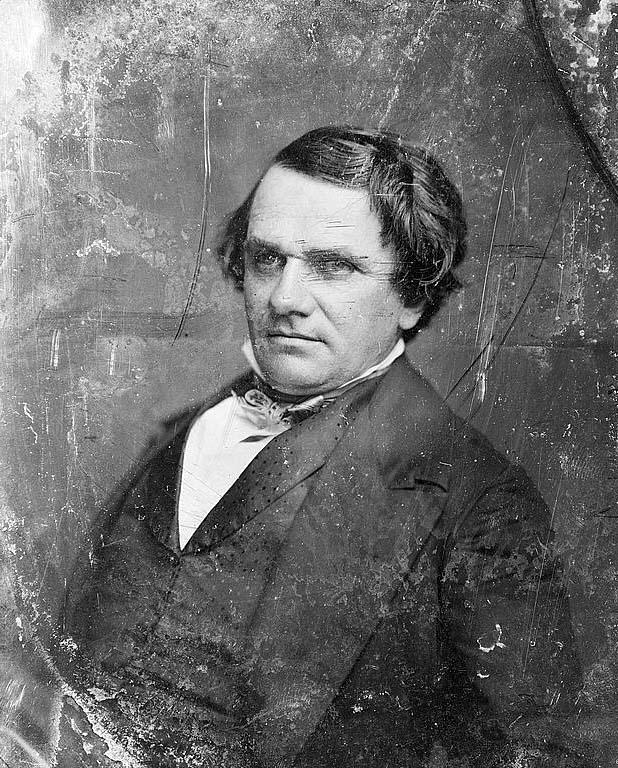
Stephen Douglas

It's important to keep in mind that the labels "Northern Democrat" and "Southern Democrat," in 1860, only referred to general regional loyalties.  There certainly would have been supporters of the "Northern Democrats" in the South, and vice versa.

The Republican party, in 1860, was still a new political party, formed primarily in response to the Kansas-Nebraska Act of 1854.  This Act, following the platform of Douglas and the group that would come to be known as the Northern Democrats, had allowed the Kansas and Nebraska territories to choose for themselves whether they would permit slavery.

Those Whigs and Democrats who were virulently opposed to the expansion of slavery, and who, in many cases, supported outright abolition of slavery, broke away from their respective parties after 1854 and formed the Republican party, whose platform was essentially to oppose any expansion of slavery in new territories and states.  In 1860, they nominated the anti-slavery Abraham Lincoln for the presidency.   

The Constitutional Union party was a fourth party formed during the 1860 election as an alternative to all the others.  Their basic platform was to avoid the slavery issue all together.  Their primary goal was to preserve the union - hence the name.  They opposed both factions of the Democratic party, because both were seen as pro-slavery, but they also opposed the Republicans, because they felt that the Republicans were too radical and believed that a Republican victory would lead to a dissolution of the union.  In short, the Constitutional Union party sought only to preserve the union and put off discussions about slavery until later.  They nominated a Tennessee politician and slave-owner named John Bell.  

Unlike modern elections, in which third-party candidates rarely make any significant run for the White House, all four candidates in 1860 had strong bases of support and ultimately won states in the electoral college.

Stephen Douglas, of the Northern Democrats, only carried one state (Missouri), but he garnered nearly 30% of the popular vote.  John Bell, the candidate of the Constitutional Union party, carried three states, but took only 12% of the popular vote, by far the least of any of the candidates.

John C. Breckinridge, the pro-slavery incumbent Vice-President, carried every southern state except for Tennessee, and took 19% of the popular vote.

John C. Breckinridge

Abraham Lincoln took most of the northern states, as well as California and Oregon, winning 39% of the popular vote and ultimately winning the election.  However, within 10 of the 15 slaves states, Lincoln did not receive a single, solitary vote from a single, solitary voter.  He wasn't even on the ticket there.  Of the 996 counties spanning the 15 slave states, Lincoln won only 2.  

As such, Lincoln won the election not by a majority, as most candidates do, but by a "plurality" - in other words, he didn't get a majority of the votes, but he got more than anyone else.  Still, more than 60% of the U.S. population voted for someone other than Abraham Lincoln in the 1860 election.  This is remarkable; Lincoln came into office with almost two-thirds of the country opposed to him.  

His election, in fact, was so divisive, that it ultimately led to the secession of the southern states, which began happening before he even took office.  The dire predictions of the Constitutional Union party were being played out before everyone's eyes.  The union was falling apart because of the election of a radical anti-slavery president.  Lincoln attempted to stop this, giving speeches aimed at the South, promising not to abolish slavery there.  It goes without saying that this failed to stem the tide.

Following Lincoln's election, the secession of the southern states, and the outbreak of the Civil War, Lincoln found himself up for re-election again in 1864.  Although a Union victory was no longer in doubt by the time the actual election took place in November of that year, much of the 1864 campaign season took place during a time when victory was by no means assured.

Still, considering Lincoln's confident and competent leadership of the country during the war, and considering that his famous Gettysburg Address, and his even more famous and profound Emancipation Proclamation, had both already taken place by this time, one would have expected Lincoln to win his re-election handily.

Not so.

In the 1864 election, only the northern and western states were eligible to vote - the southern states had seceded and, at that time, were no longer part of the United States.  This means that the only states who voted in the 1864 election were the states where Lincoln was already most popular.  They were made up of states that Lincoln had mostly won in 1860, and which he had subsequently led for the previous three years.  

Yet despite this, the election was not a clear-cut victory for Lincoln.  In fact, Lincoln failed to gain the re-nomination of his own Republican party in 1864.  The party, by this time, was pushing a platform that went even farther than Lincoln's Emancipation Proclamation.  They wanted a constitutional amendment barring slavery for good, and wanted legislation to guarantee racial equality for all people.  Lincoln was not willing to go this far, and so the party nominated John C. Fremont of California as the Republican presidential candidate.   

John C. Fremont

As such, Lincoln was forced to form a third party, called the National Union party, which included more moderate Republicans and a group of northerners known as "War Democrats."  These War Democrats were northern Democrats who were radically opposed to making peace with the Confederacy.  Their platform was essentially to win the Civil War at all costs, and ultimately re-unite the broken country through military victory.  

The Northern Democrats, by this time, had become a party advocating peace with the Confederacy.  They came to be known as the Copperheads or Peace Democrats, and their most vocal leader was Clement L. Vallandigham, an Ohio congressman.  They nominated Lincoln's former top general, George B. McClellan, as their candidate.  This was somewhat of a contradiction, because McClellan openly supported continuing the war with the Confederacy, and largely disagreed with the party platform written by Vallandigham. 

Clement L. Valladigham

As the campaign among these three candidates progressed, the Republican nominee Fremont expressed concerns about splitting the Republican vote with Lincoln's party.  He openly vowed to bow out of the election if the National Union party would nominate someone other than Abraham Lincoln.  The party, however, refused to do this, and Fremont himself finally relented, removing himself from the race in September of 1864.  

Fremont's decision to bow out of the race ultimately led to Lincoln winning the election in November of 1864.  The Northern Democrats had hurt their cause by nominating a candidate who didn't even fully agree with their own platform of peace.  

George McClellan

Furthermore, the entire peace platform was becoming irrelevant by this time, since it was becoming obvious that the Union was going to win and thus re-unite the country (this had not been the case earlier in the campaign).  As such, Americans voted to keep Lincoln in office.     

Still, while Lincoln won a landslide in the electoral college, he won only 55% of the popular vote.  Fifty-five percent!  This means that even despite his leadership during the war, and despite his Gettysburg Address and his Emancipation Proclamation, and despite the Northern Democrats making several political blunders, Lincoln was still opposed by almost half of Americans - and this, of course, does not count the southerners, who were opposed to him so dramatically that they seceded over his election and ultimately assassinated him.

In the modern day, we would consider a 55% to 45% victory in the popular vote to be a strong showing and an easy win.  And this would have been true in 1860 as well.  However, when you bear in mind what I said at the outset of this post - when you consider the way we revere Lincoln today and consider him the greatest of our American presidents - it is downright staggering that he only managed to win 55% of the popular vote in his 1864 re-election campaign. 

Abraham Lincoln's presidency was a strange one.  His entire presidency was taken up by the Civil War - which started just a few months after he took office, and ended only a few weeks before he was assassinated.  He never had the chance to be a "normal" president and to work on the "normal" things that presidents work on.  Instead, his entire presidency was marred by a civil war between the states.  He was elected initially with less than 40% of the popular vote - making him one of the most un-wanted presidents in U.S. history.  The states of the south literally seceded from the union, precipitating the Civil War, in protest of his election.  He failed to garner the re-nomination of his own party when he ran for re-election in 1864 because they didn't think his views on slavery and racial integration went far enough.  And in that race, he won only 55% of the popular vote, even though the southern states didn't even get to vote in that election.  He only had 55% support from the states where he was most widely liked!  

This fact of history, of course, is an important one to keep in mind when evaluating modern presidents.  It would be fair to say that Abraham Lincoln, if evaluated solely on his popularity during his time in the White House, may have been the most divisive person to ever serve the office of the presidency.  The simple fact is, he was not very widely popular, and was absolutely detested by a significant portion of the American people.  This is important to remember when considering the highly divisive presidents who have served over the last 20 years or so.    


Saturday, November 26, 2011

Notes from the Cave

I really wanted to blog about something worthwhile tonight, but I just didn't have it in me.  I've got some plans for a fascinating story about a 1972 plane crash in the Andes that I recently saw a documentary about, but tonight just isn't the night.

Black Friday was, for me, just another day at work, and a quite nice one at that.  I spent much of the day playing crossword puzzles.  Even though the day after Thanksgiving is not a holiday at my hospital, the workload was like you would expect on a holiday, meaning virtually nothing.  Even the ER wasn't that busy.

You might notice a new interactive Amazon.com frame below this blog post.  You can now shop Amazon right here on Serene Musings, without even leaving my website.  Pretty fancy, eh?  

So what's up with this Ndamukong Suh jackass who plays for the Detroit Lions?  In case you didn't see or hear about it, he was tackling a Packers player during Thursday's game, and got mad and shoved the guy's head into the ground several times, before standing up and stomping on his back with his foot.  Naturally, he was thrown out of the game.  How can the NFL allow something like this to happen?  If he is not suspended for the remainder of the season, and fined about $250,000, something is definitely wrong.

Of course, I hate football anyway. 

I learned tonight that my sister-in-law has bought me a ticket, along with my brother-in-law, to watch UK take on UNC on December 3rd at Rupp Arena.  This game is going to be a big one, as the teams are currently ranked #2 and #1 respectively, and will likely still be ranked that way when the game is played.  The game is already being hyped as one of the biggest games of the year in college basketball, and possibly a preview of an NCAA championship game.  I am uber-excited about it, particularly since I have never seen a basketball game at Rupp Arena.  Yes, I realize that this is blasphemy for a lifelong UK fan, but what can I say?  Tickets are hard to come by, and I am not keen enough on seeing it in person to shell out the cash it typically requires to attend one of their games.  I also tend to shy away from large crowds when possible.  But in any case, I am really excited about seeing my first UK game, especially since it's such a big one.  Maybe I'll manage to get on TV :) 

Third shift this weekend, so more than likely, I will see you on the flip side next week.  

Peace, we outta here.  

Friday, November 25, 2011

10 Fun Facts About Chester A. Arthur

Chester A. Arthur, the 21st President of the United States


1)  Chester Alan Arthur was born in Fairfield, Vermont, in 1829, the son of an Irish-American abolitionist preacher.  The family moved around extensively during his younger years, finally settling in Schenectady, New York.  

2)  In college, Arthur supported the Fenian Brotherhood, a group devoted to freeing Ireland from British rule.  This was in the late 1840's, during the height of the Irish Potato Famine.  In later years, the group would turn militant and begin conducting raids on British military posts in Canada in an effort to force the monarchy's hand.

3)  After college, Arthur was a teacher and headmaster for several years, before becoming a lawyer.  As an attorney, he was heavily involved in Civil Rights cases, famously winning a case for a black New York woman who was denied a seat on a streetcar because of her race.  The case led to the desegregation of New York streetcar lines.

4)  In the late 1850's, Arthur met Ellen Herndon, and they were married in 1859.  Ellen's father was a naval commander who had served with distinction in the Mexican-American War and had explored the Amazon River valley.  Two years before Chester and Ellen were married, her father died commanding the SS Central America, which went down in a hurricane carrying roughly 10 tons of California gold.  It was rediscovered and salvaged in 1987, and the gold recovered was valued at roughly 125 million dollars.

5)  In the 1880 presidential election, Arthur, a member of a Republican faction known as the Stalwarts, supported nominating former president Ulysses S. Grant.  However, another Republican group, the Half-Breeds, supported a Maine senator named James Blaine.  The split loyalties ultimately resulted in a third Republican, James Garfield, winning the nomination for the Republican party.  In an effort to unite the party after the fractious primaries, Garfield chose Arthur to be his running mate, and the ticket ultimately won the presidency, winning the popular vote by less than 8,000 votes.  Blaine would become Garfield's Secretary of State.  

6)  During the 1880 election, one of the criticisms leveled at the Garfield-Arthur ticket was that Chester A. Arthur was a foreigner.  With an Irish father who had only emigrated a few years before Arthur was born, rumors spread that Arthur had, in fact, been born in Ireland, thus disqualifying him for the office of Vice-President.  When that accusation did not stick, more rumors floated through the press suggesting that Arthur had been born in Canada.  Ultimately, the accusations proved fruitless, and Arthur remained on the ticket.  

7)  Garfield, with Arthur as his running mate, won the presidency in 1880.  Just a few months after taking office in 1881, Garfield was shot, and died in September of 1881 - the second president to be assassinated in only 16 years.  Thus, Arthur ascended to the presidency.  His wife had died less than two years earlier, so he was a widower by this time.  His sister served the role of First Lady.  

8)  While president, Chester A. Arthur signed several bills dealing with immigration, including a bill that disallowed mentally handicapped people from entering the United States from other countries.  He also signed a bill denying Chinese immigrants the right to apply for citizenship.  As he had done as a lawyer, he continued to fight for Civil Rights for American blacks, and also attempted to repair relations with Native American tribes.    

9)  While president, Arthur developed a chronic kidney disease, which somewhat limited his ability to handle the rigorous tasks associated with the Executive office.  Because of this, he gave only a token effort to attain the Republican nomination in 1884, and lost easily to James Blaine, his former political enemy and the Secretary of State during Garfield's brief term.  Blaine went on to lose the election to Grover Cleveland.  

10) Chester A. Arthur died the year after leaving office, in November of 1886, due to complications from kidney disease.  He was 57.

Thursday, November 24, 2011

Notes from the Cave: Thanksgiving Edition

Melanie: "Do you know what you need to get to fix the toilet?"

Me: "Yes, a ballcock."

Melanie: "You're disgusting."

It really is called a ballcock!


I've discovered this week that Thanksgiving is a somewhat contentious holiday in some circles. I never knew this. Apparently there are some folks out there who feel that Thanksgiving is a self-aggrandizing American holiday that fails to recognize the horrific atrocities committed by American forebears who stole this land from Native Americans. Consider this quote that I took from Wikipedia, from Robert Jensen, a professor of journalism at UT-Austin: One indication of moral progress in the United States would be the replacement of Thanksgiving Day and its self-indulgent family feasting with a National Day of Atonement accompanied by a self-reflective collective fasting.

I'm sure most of you probably regard that sentiment about the same way that I do - gimme a break.

However, another quote, this time by professor Dan Brook at UC-Berkeley, is perhaps a bit more realistic: We do not have to feel guilty, but we do need to feel something.

It's an absolute fact of history that the earliest pioneers in the New World, and later in the United States, committed unthinkable atrocities against the native populations. Estimates for the native population of the Americas prior to Columbus are difficult to establish, but most experts believe it was somewhere in the range of 75 million people. That population steadily declined through the intervening centuries. Today, there are about 2 million people in the United States who are legally considered "Native American." Many more, of course, live in Central and South America, but there is no question that the modern population of these native group is only a fraction of what it was 500 years ago.

Now, of the millions of Native Americans who died as a direct result of the "coming of the white man," the vast majority of those died from European diseases which they had no immunity to. Smallpox, for instance, was a big one. However, even if you eliminate those deaths caused inadvertently by disease, there were still millions, from 1500 to 1900, who were actually murdered, exploited, put into slavery, and starved to death.

In short, the settling of North and South America, primarily by European settlers, was one of the worst human atrocities ever committed in known human history. Now, as modern Americans, we can hardly be held personally responsible for the actions of our long-ago ancestors - just as modern Germans aren't exactly to blame for the Holocaust. Be that as it may, I like what Dr. Brook of UC-Berkeley had to say above: we don't have to feel guilty, as if we are personally to blame, but we can at least recognize, and be sensitive to, the fact that we are here today because our ancestors murdered and exploited millions of people.

Now, the strange thing about all this is that I am not entirely sure what any of this has to do with Thanksgiving. Obviously, Thanksgiving is a holiday we traditionally tie to the coming of the Pilgrims in Plymouth, Massachusetts, but by and large, we celebrate it today as a holiday of being thankful for things we have in our lives. From a practical standpoint, it really doesn't have anything to do with the European genocide against ancient native populations. Which is why I find cynicism about the holiday to be largely misplaced. A better National Day of Atonement might be Columbus Day.


Well, enough of that. My parents are here for Thanksgiving, for the first time ever. They live in Houston, and we typically do not see them at Thanksgiving. But this year they decided to come up now instead of at Christmas. So we are having early Christmas/Thanksgiving this week. This is the first time we have ever had Thanksgiving at our house. Normally my family and I go to my in-laws' house across town.

We got a turkey from Kroger - pre-cooked :)

I've been off work for the last two days, which has been nice, but I have to work tomorrow and all weekend. Frankly, I'd rather be working on Black Friday than shopping, so no big whoop.

I read an article earlier this week about how Michelle Obama and Jill Biden appeared at a NASCAR race this weekend. Apparently, a segment of the crowd booed them when they were introduced. Real classy, NASCAR fans. Then again, no one ever claimed NASCAR fans were classy. Assy, maybe, but not classy.

Happy Thanksgiving to all my friends and family, and to my readers, and remember to click the Amazon ads on my main page for any and all Amazon.com purchases you may make between now and the end of time.

Holla'

Sunday, November 20, 2011

Calipari and the UK Wildcats Ride Again


It's becoming a tradition here on Serene Musings for me to write about UK basketball, so since another season is upon us, it's time to reignite the tradition.

My loyal readers may recall my prediction two years ago about UK potentially going undefeated.  That was Calipari's first season, when he had 5 players, including 4 freshman, who went in the 1st round of the NBA draft.  One of those freshman first round picks wasn't even a starter for that UK team.

My prediction went fantastically until early January, when they finally lost.  Still, they managed to be the last team that year that was still undefeated, and went to the Elite Eight.  The following year, they got to the Final Four for the first time in 12 years.

Now, they are among the favorites to win it all in 2012.  They've got another unmatched freshman class this year, and most analysts seem to think this is probably their best team yet under Calipari.  Not only do they have a ton of talented freshman who will be in the NBA next year, but they also have some veteran leadership that they have not had in previous years under Coach Cal.  One of their best players from last year's team, Terrence Jones, stayed for another season, and together with a few other older players, that has made this team deeper and more experienced than Cal's previous two squads.  

They proved their ability last week when they faced off against fellow power house Kansas, who was ranked 10th in the preseason.  They won by double digits against them, then won the Naismith Hall of Fame Tip-Off tournament they played in this weekend.  

On December 3rd, they are playing UNC at Rupp Arena.  Currently UK is ranked #2 nationally behind UNC, so this is likely to be an early season 1-2 match-up.  Kentucky will benefit from playing the game at home (they played in North Carolina last year).  I've already heard some analysts say that they don't believe anyone is good enough to beat Kentucky on their own court this year, but we'll  have to just wait and see.  Being that UNC is probably Kentucky's number 1 arch rival, this will be a very important game, and will probably decide which team is going to be ranked number 1 come January and conference play.  

So far, I've only watched one UK game this year (I missed the first game, and the two games this weekend were not televised where I live) so I can't yet give an accurate analysis of what I think they are capable of.  In the Kansas game, they played horribly in the 1st half - probably one of the worst single-half performances that I have seen them play under Calipari, yet Kansas didn't play well either, and they were tied at halftime.  Kentucky got it together in the second half and played fairly well, although they tailed off at the end of the game.  

In any case, it's going to be an exciting year for Kentucky fans, and a frustrating year for all the rest who love to hate UK basketball.  


Ads for Amazon

What's with all the blatant Amazon advertising that has overtaken my blog, you ask yourself?

Well, to put it simply, I have become a so-called "Affiliate" for Amazon, meaning that I am putting their ads on my blog in order to make a little money.

Essentially, I get a commission every time you click one of these ads to buy something from Amazon.  What that means, dear reader, is that if you are going to buy something from Amazon, you can do me a world of help by simply accessing Amazon's site through one of my ads.  It doesn't cost you a thing, and it provides me with a nice advertising commission, which ultimately helps to support my writing endeavors.

If you buy one of my e-books from Amazon, and you use the links on the right side of the page to do so, not only will I get royalty payments on the sale of the book, but I will also get an advertising commission on top of that.

See how it works?

As I have said elsewhere, you don't have to have a Kindle to buy my e-books.  Amazon offers free Kindle Apps, which you can download (voila!) using the banner ad at the top of this page.  They have downloads for any major media device (computer, iPad, smart phones, etc.).  Download the free app, then you can buy my e-books.  


Thursday, November 17, 2011

Astros Move to the American League


USAToday.com Article.

I have long argued that it was silly for the American League to have 14 teams, broken up into divisions with 5, 5, and 4, while the National League has 16 teams, broken up as 5, 5, and 6.

Now they are finally fixing it.  The Astros will leave the NL Central and join the AL West, giving each of the 6 MLB division 5 teams apiece, 15 teams in each league.  They will also add two more Wild Card spots for the playoffs.

Only I wish they weren't fixing it with the Astros.

My friends tend to make fun of me for being a fan of more than one team, and this is made worse by the fact that my three favorite teams are all in the same division: the Reds, the Cubs, and the Astros.

But there is a method to my madness, or at least a good reason for it.

I grew up in Louisville, Kentucky.  Our Triple-A affiliate at the time was under the Cardinals.  However, the Reds were easily the closest major league team, geographically, to Louisville, and still are.

I was never really a Reds fan, however.  Instead, I was a fan of the Cubs, because, along with the Braves, they were the only team I could watch every day throughout the year, thanks to cable and WGN.  As a result, while I never really became much of a Braves or Cardinals fan, I did become a die-hard Cubs fan.

This childhood loyalty has never wavered, although I could certainly be called a "fair-weather fan" of the Cubs at this point - tending to largely ignore them unless they are doing well.

In 1988, when I was 13, we moved to Cincinnati.  I very quickly added the Reds to my fan list, simply because they were now the hometown team who I could go watch in person whenever I wanted.  Although I have not lived in Cincinnati non-stop since 1988, I live in the area now and have continued to follow the Reds.  At this point, they are my favorite team, the one team I follow closely year to year.

In 1993, I went off to college, staying in the Ohio Valley area, but my parents moved to Houston.  As it happened, during this period, the Astros were very good, and continued to be a dominating team throughout the 90's and into the 00's.  Within a few years, I became an Astros fan, as I was able to go see them play live every summer when I was home from college.  Like the Cubs, I have become a fair-weather Astros fan too, only "following" them when they are doing well, and generally shaking my head sadly when they have years like the last few years.

By sheer chance of geography, these three "favorite" teams of mine all happen to be in the National League Central Division.  As such, my three favorite teams represent fully 50% of the division in which they all play.

This gives me a pretty good likelihood in any given year of having a favorite team in the playoffs, although that certainly was never by design.

In any case, this is why I am upset to see the Astros move to the American League in order to solve the imbalance between the two leagues.  I would prefer for them to have stayed in the National League, simply because I am a "National League" person.  Whether it was the Triple-A team in Louisville growing up (the Cardinals), the teams (Cubs and Braves) I watched on cable, or the cities I have personally lived in, they have always been National League.  I lived for 12 years in Lexington, and their Single-A affiliate, strangely enough, was the Astros.  I have never had much interest in the American League and am not nearly as familiar with the teams and players in this league.  With the Astros' defection to the AL, I suspect I will follow them less and less in coming years.

So I applaud the MLB for finally fixing this problem that they created when the Brewers changed leagues 15 years ago or so.  I just wish it wasn't the Astros who were switching.


Thursday, November 10, 2011

Notes from the Cave

The college basketball season is upon us, and it promises to be another fun year for this UK Wildcats fan.  Kentucky again has a slew of top recruits, and this year they also have some veteran talent - their one lacking ingredient in the past few seasons.  Hopes are definitely running high in the Bluegrass for UK's chances this year of another Final Four and Championship.  You can wait with bated breath for upcoming UK basketball blog posts from yours truly.

I saw snow tonight for the first time this season.  So that's what...November 10th?  I guess that's not too bad.  I've certainly experienced it earlier than this before, so I won't complain.  No accumulation of course, just some flurries coming down in my headlights as I drove home from work.

Is it just me, or is Rick Perry a complete idiot?  Sheesh.  If he wasn't such a douchebag, I would feel sorry for him.  How utterly embarrassing.  I sure as hell wouldn't do any better in such a debate setting, but then again, I ain't running for president.

Anybody hear about this new so-called "Christmas Tree Tax" that Ebenezer Obama wants to assail hard-working Americans with?  A friend of mine posted a link to it on Facebook, and expressed his outrage that this was, in particular, targeting "Christians."

Let me give you a bit of background, in case you don't know the story.  A blog for the Heritage Foundation, a conservative think-tank in Washington, put out an article slamming the Obama administration for a so-called Christmas Tree Tax.  This "tax" consists of a 15 cent surcharge on live Christmas trees sold by farmers who sell more than 500 trees per year.  The blog post refers to "Obama's Department of Agriculture" putting together this policy, and taxing Americans to pay for it, so they can help to "market Christmas trees."

(One has to wonder if "Obama's Postal Service" will get the blame the next time stamp prices go up.)

The entire tone of this well-written piece of partisan bullshit is that Obama is running amok, secretly implementing taxes on unsuspecting middle class Americans, and is so out of control that now he is now taxing Christmas.

This article has gone viral very quickly among conservative websites, and among conservatives on social media sites.  I've now seen it posted twice on Facebook, and once on a messageboard forum that I frequent.  Just more evidence, for these conservatives, of what a terrible person Obama is.  For the friend I mentioned above, he was really mad because this "targeted Christians."  Pardon my French, but are you fucking kidding me?  Christians are the only ones who buy Christmas trees?  Since when do Christmas trees have anything to do with Baby Jesus?

The truth, of course, cannot be found in the blog post by the Heritage Foundation (and no, I'm not providing a link for it, because I refuse, on principle, to provide them any direct referral traffic - Google it if you want to read it; "Christmas Tree Tax" should be sufficient).

Anyway, the truth about this is that a trade group, which represents Christmas tree farmers, has lobbied the U.S. Department of Agriculture for several years to help them sell more Christmas trees.  This is what the Department of Agriculture does.  We can debate all day about whether we need a Department of Agriculture in the 21st century, but for good or bad, we have one, and their purpose is to help American farmers.  As a result of lobbying by trade groups representing Christmas tree farmers, the Department of Agriculture came up with a program to help them market and promote their trees, to increase their sales.  This is because the live Christmas tree industry has been sagging for decades behind the continuing popularity of fake trees - many of which, of course, are made in fucking China.

So the Department of Agriculture puts together this marketing plan, and charges the farmers a 15 cent surcharge for each tree sold, in order to pay for the assistance that they asked for in the first place.  There is nothing unusual or unreasonable about this.  They lobbied for assistance, the Department of Agriculture responded, and they are paying a surcharge on their trees to pay for the services the federal government is providing to them.

If the farmers want to pass that surcharge along to their consumers, by adding it to their retail price, that is their prerogative, but that does not, in any way, constitute a "Christmas tree tax."  One person on the messageboard thread discussing this matter said, "Well, if they're gonna tax me to buy a Christmas tree, I guess I'll just by a fake one from China!"

I'm sorry, but if 15 cents makes you decided not to buy a live Christmas tree, you need to have your brain examined by a board-certified neurologist.

The fact is, this is exactly the kind of thing that the Department of Agriculture should be doing: putting together low-cost programs, completely paid for and not added to the national debt, to help the U.S. economy, by helping U.S. farmers sell more live Christmas trees to U.S. consumers.   This is Washington actually doing it's fucking job.  If it works, some of the money flowing out of U.S. pockets and into the vaults of Chinese manufacturing companies will now, instead, be flowing into the vaults of U.S. farmers.

The fact that the right wing can criticize this, and politicize this, and turn this into a broad-based Obama bash-fest, simply shows you where the priorities of people like this really are.

Well, enough soapbox.  And sorry for all the F-bombs.  It's an F-bomb night.

Saturday, November 05, 2011

Income Inequality: The Occupy Wall Street Protests


Occupy Wall Street is a protest movement that has been gaining steam over the last two months and garnering a significant amount of media attention.  Honestly, I haven't paid that much attention to it until this week, and am only just now starting to give it some thought, simply because it has managed to have a little staying power - which is saying a lot in this day and age. 

Anytime something like this happens, my first reaction - as a self-described liberal - is to cringe.  Great, just what we need, another reason for conservatives to bash liberals.  Liberal ideology always seems to make itself so easy to parody, so easy to twist into something it's not.  Part of this is because liberals tend to be idealists, and idealists are usually good at seeing the big picture and envisioning something better, but not always so good at the practical implementation of those ideals.   

I've heard just about everything in regards to the OWS protests.  One friend on Facebook recently said: "Here's my suggestion...Occupy a Job, Occupy a Shower, Occupy Your Mom's Basement...Quit crying."  Another friend, on Twitter, said: "Some say the OWS protesters may resort to violence.  But that would require work....so therein lies the rub."

Others have given criticisms a bit more substantive, and a bit less ad hominem in nature.  One friend said: "It makes no sense to complain about unemployment and then advocate to take down the big corporations that provide the jobs that do exist." 

That seems reasonable.  But it also comes across to me as a bit of a strawman argument - a misrepresentation of what the movement is really about - a misrepresentation that is much easier to attack than the real issues being protested.  I haven't watched all the videos or listened to all the interviews or heard all the speeches, but I suspect the core group of folks involved in Occupy Wall Street are not so much interested in "taking down corporations" - in terms of destroying them - but overhauling the entire system for the betterment of all.  

So what is it, exactly, that the OWS protesters are saying?  What do they want? 

Well, this is one of the problems with the movement.  It does not seem to have a whole lot organization, and the people involved aren't necessarily all there for the same reasons.  Another factor is that the protests are, largely by design, leaderless.  According to a New York Times article  that I read, the whole point is to have what they call a "horizontal hierarchy" instead of a vertical one - meaning, essentially, that everyone is a leader.  This may sound ideologically attractive - particularly to a dyed-in-the-wool liberal - but it certainly is not practical.

Then again, the Tea Party movement began largely the same way - grass roots, mainly leaderless, comprised of people who were fed up with the system and who were connected by only the loosest of core philosophies.  

So what are the core philosophies of the Occupy Wall Street folks?  Their rallying cry, of course, has been "We are the 99%."  This has actually been a remarkably effective slogan which, in just a matter of weeks, has become widely familiar.  If only I could think of such a slogan to market my books!!  

The slogan, of course, refers to the wealth gap between the richest 1% of Americans, and everyone else.  More about that in a moment.

In general, it would appear that the core philosophies that tend to connect the various Occupy groups around the country include things like the aforementioned income gap, the role money plays in elections, federal tax structures, and the overpowering role of big banks.  On the OWS Facebook page, one of the more recent posts (as of November 4th), deals with encouraging people to move their bank accounts out of large national banks and into small, local financial institutions.  This, to my mind anyway, sounds reasonable enough - my wife and I have always banked with small, local banks, and I have never had much regard for the big national branches whose power reaches deep.

And I think, at its core, this is what the impetus of the protest is really about.  A general feeling that too much of the wealth is handled by too few people/corporations, and, as a result, those few people/corporations have an unfair share of the power and privilege and prestige and, most importantly, influence, over the direction our country has been taken in recent years and decades.  

This issue of the wealth gap - or income inequality, as I call it in the title - is one that is close to my heart, and one that makes me at the very least sympathetic towards the Occupy movement, even if I don't actually consider myself a part of it.

So what is this income gap?  Why do people like me have such strong feelings about income inequality?  What is the data that backs these feelings up?  Before I start, let me say that the following includes a lot of numbers and percentages, and while I have tried to use all my best writing skills to make it as easy to follow as possible, it might be a bit confusing and/or overwhelming.  I have included links to the sources I have used for the data, so if you feel confused, you can simply click those links to see the data and graphs for yourself. What I have written is essentially just a narrative of the information from the two sources I quote.  

The Center on Budget and Policy Priorities is a non-profit think-tank based in Washington, D.C.  According to its website, it is an organization "working at the federal and state levels on fiscal policy and public programs...to help shape public debates over proposed budget and tax policies."  It has used data from the Congressional Budget Office and the IRS to analyze wealth distribution in America.

According to the CBPP's findings, during the period of economic growth from 2002 to 2007, the wealthiest 1% of U.S. households saw their income grow by more than 60%.  During that same period, the bottom 90% saw its average household income grow by only about 3%.  In other words, those who were already very wealthy grew significantly wealthier, while those who were not as well off did not grow very much at all.    

To put this in perspective, imagine one person with 100 dollars, and another person with 1 dollar.  The person with 100 dollars would have seen their income rise to about 160 dollars.  The person with 1 dollar would have seen their income rise to about 3 dollars.  The net income gap was originally 99 dollars.  After the period of growth, the income gap grew to 157 dollars.  This is an excellent illustration of what people are talking about when they speak of income inequality and how "the rich get richer."  

The CBPP went on to demonstrate that during the first year of the recession - 2008 - the top 1% of earners lost about 20% of their income.  The lowest 90% of earners lost about 7% of their income.  So the recession hit the wealthy much harder than it did the rest of us.  

However, as the CBPP's graph demonstrates, the losses suffered by the bottom 90% were more than double the gains they had seen from 2002 to 2007 - during the years of prosperity.  During that time, they had seen growth of 3%.  So by the end of the first year of the recession, the lowest 90% of earners had an average net loss of 4% since 2002.  So while the wealthiest households lost more in the first year of the recession than most everyone else, their income change going back to 2002 was still a net gain of about 30% (after being adjusted for inflation).

This, of course, is a further illustration of how even during a recession, and even despite large losses by the wealthiest people during economic crises, it is still ultimately the middle class who suffers the most.  If you were among the top 1% of earners in 2008, your net gain over your income in 2002 was about 30%.  For everyone else (90% and below) you had no net gain at all, but rather a loss of about 4%.  To use our 100 dollar vs. 1 dollar analogy, the person with 100 dollars now has 130 dollars, and the person with 1 dollar now has 96 cents.

And just to put this in perspective, that 7% drop for the lowest 90% of earners was the biggest one-year drop for that group since before World War Two - 1938.  It left the income of the 90% at its lowest level since the mid-1990's - effectively pushing the middle class back more than a decade, economically-speaking.  

I realize everyone has a different perspective, but when I see data like this, it definitely makes me feel like something is inherently broken within our system. 

The CBPP's analysis also looked at how much of the total income of the United States was concentrated at the top.  In the late 1920's, just before the start of the Great Depression, nearly 25% of the nation's income went to the top 1% of earners.  To put that in perspective, if 100 people collectively earned 100 dollars, 25 of those dollars would be earned by one person, while the other 99 people would earn about 75 cents apiece.  

How can this be?  How can one person be worth that much more?  And wouldn't it be better, from a market and economic stability standpoint, for that wealth to be distributed a bit more evenly, to give as many people as possible as much buying power as possible?    

After the Great Depression, this enormous income gap steadily declined throughout the remainder of the 20th century, to a low of about 8% in the 1970's - meaning that in the '70's, the top 1% of earners made only about 8% of the total income earned in the United States - the remaining 99% of earners earned the remaining 92% of the income - as close as we've come to a break-even scenario since this sort of data has been collected.  

After the so-called "Reagan Revolution" of the 1980's, the income gap began to soar again.  After hovering around 10% for almost 30 years from about 1950 to 1980, by the middle of the 1980's, it spiked back up above 15% - the highest it had been since the 1930's.  It has continued to grow since then, peaking at about 23% just before the start of the recession in 2008 - its highest point since right before the Great Depression.

I hope you notice the pattern here.  The two highest points of the income gap over the last 100 years have been right before a major economic recession/depression.  What does this tell us about the dangers of rising income inequality and the public policies that permit it to happen?  I'll let you answer that question for yourselves (or, even better, put your thoughts in the comments section).  

Another key point from the CBPP's data concerns the top .01% of earners - the richest of the rich, the super wealthy.  From 2002 to 2007, that group's income grew by a staggering 123%.  Recall that the lowest 90% of incomes grew by only about 3% during that period.  During the first year of the recession, this super wealthy group lost about 25% of its income.  As such, it's net change from 2002 to 2008, adjusted for inflation, was nearly a 70% increase.  Again, even during a recession, it is not the rich who are harmed, but the middle class.

It may be important to note here that this data concerns personal, household incomes.  This is not about business incomes or corporate growth and decline.  This is about individual people and the money that they earn. 

The last graph presented by the CBPP is perhaps the most disconcerting.  It is a bit difficult to interpret, but it essentially looks at how income growth has stagnated for the bottom 90% since about 1980, while it has grown dramatically since that time for the top 1%.  

In 1950, the bottom 90% made about 50% less than what that same group was making by the late 1970's.  In other words, during those years from 1950 to the end of the 1970's, the bottom 90% saw significant growth in its income.  In fact, during many of those years, this group actually saw greater increases in their income than the top 1%.  Income inequality was falling by the wayside.  

However, starting in about 1980 (again, one can't help but note that this was when the Reagan Revolution began), income began stagnating for the bottom 90%.  In fact, and this is almost hard to believe, by 2007, the average pre-tax household income for the bottom 90% was actually about $900 lower than what it had been in 1979 (this, of course, is adjusted for inflation).  Among the top 1%, however, their pre-tax, household income was about $700,000 (that's seven hundred thousand) higher than in 1979.  

This is absolutely staggering.  According to this data, and when you adjust for inflation, the middle class - the bottom 90% of earners - actually lost income, overall, from 1980 to 2007, while the top 1% gained more than half a million dollars on average.         

How can we have created a system where income inequality like this exists so blatantly?  And again I have to ask, is this actually good for our country's economic health?    

Moving on now, I want to look briefly at a second analysis, this coming directly from the Congressional Budget Office, released in October of 2011 - in other words, as up to date as possible.  

This is a very long document and I have not scoured all of it.  What I have done, essentially, is gather information from the summary page.  

In short, this CBO study essentially confirms much of the data collated by the CBPP.  From 1979 to 2007, overall income, across the board for all households in the U.S., grew by about 62%.  However, this increase, as we saw above, was top-heavy among the top 1% of households.  The income of that top 1% grew by 275% during the period in question.  The 81st through 99th percentiles (the "upper middle class") grew by about 65%.  The 21st through 80th percentiles (the "middle class") grew by about 40%.  And the lowest group - the lowest 20th percentile (the "lower middle class" and the poor) - grew by roughly 18%.  

There are some interesting things to take from this.  Clearly the top 1% of earners earned the vast majority of the income throughout the period from 1979 to 2007.  By the mid-2000's, in fact, the income earned by the top 20% of earners (the upper middle class and the wealthy) was more than everyone else combined.  

However, all groups saw increases between 1979 and 2007.  Even the poorest households increased by 18%, and as one of my conservative friends pointed out, these are inflation-adjusted numbers, so that means that even among the poor, people generally have more buying power today than they had in the 1970's.  

I'm not sure how to reconcile all this with the data above from the CBPP report, which says that, after adjusting for inflation, the bottom 90% has actually lost income since 1979.  The CBO's report would seem to contradict that.  The difference in numbers is probably due to how the data is collated - with the CBPP looking at overall numbers among the entire bottom 90%, and the CBO breaking it up into discrete categories.  Still, because the CBO's report is the official report from the non-partisan Congressional Budget Office, I am inclined to trust its data more than that from the CBPP.  Interestingly, however, the CBO's report actually authoritatively cites the report by the same economists whose data informed the CBPP's report.  It's confusing, I know.   

Either way, it is clear that there is a major wealth gap in this country, and it has been growing exponentially for the last 30 years.  While this seems to have started with the Reagan Revolution, we certainly can't put all the blame on Republicans, because we've had two Democrats in the White House during that time too, not to mention plenty of Democratically-controlled Congresses, and none of the trends changed during those years.         

So what are we to make of all this?  Why does the wealth gap actually matter?  When I told one of my conservative friends that income inequality was the impetus behind the Occupy Wall Street protests, he said that if income inequality is what it's all about, then he understands it even less than he did before.  There will always be rich, and there will always be poor, he said.  Our job, according to him, is simply to ensure that everyone has equal opportunities - not, he said, to ensure that everyone is financially equal.  In short, "Say No To Socialism." 

I'm no Socialist, although I was called one by another conservative on the same Facebook thread where I was discussing this issue (this person, by the way, was not known to me - a friend of a friend).

Still, income inequality is something that is deeply concerning to me.  I suppose you could say that from an ideological standpoint, I believe in creating a world where people have reasonable opportunities to succeed, and where people have reasonable opportunities to make their way in the world from a financial standpoint.  And unlike my conservative friends, I believe the government has a role to play in this, through fair regulation, taxation, and other programs.  In short, I agree with Thomas Jefferson when he said that one of the responsibilities of a government is to provide for the life, liberty, and pursuit of happiness for its people.  When a government endorses gross income inequality, it is not providing for life, liberty, and the pursuit of happiness, in my opinion.    

When I look at data like what is described above, I see a government creating policies and economic systems that are primarily designed to help the wealthy grow wealthier, without much regard for everyone else.  In fact, I see a government that I suspect, in many cases, has every intention of ensuring stagnation among the middle classes - because the rich can't get richer if the middle class is prospering - that much is evidenced by the slow growth among the super wealthy from 1950 to 1980, while the middle class boomed.  I'm not suggesting a grand conspiracy theory here, I am simply saying that when all of our politicians have the money of wealthy donors in their back pockets, and when they, themselves, are primarily wealthy individuals with their own business interests,  it is little wonder that they enact policies that are primarily geared towards helping the wealthy. 

This, I believe, is the soul of the Occupy Wall Street protests.  Those with the most money are the very same people electing members of their own group to make all the policies that have clearly been designed to primarily help those with the most money.  It's a vicious cycle.

I wish, at this point, I could provide a profound solution to this problem.  It would be a great way to tie this analysis all up nice and pretty.  But, as I said at the outset, liberals tend to be idealists and not pragmatists.  I don't know what the answer is.  I don't know how to overhaul the system.  I suspect that sitting in a park on Wall Street won't do much to change anything.  But I can't help but secretly applaud those people who are idealistic enough to believe that they can change something, that they can make life better for the rest of us.

As a sort of postscript to this analysis, I want to end with a brief comment about how this issue meshes with my perspective on Christianity.  In discussing this issue on Facebook, I noted to one of my conservative friends that as Christians, we should be dedicated to helping the poor and needy and thus working towards ending income inequality.  I said this in response to his argument that it was not the job of the federal government to ensure "financial equality" among all people.  He responded by saying that he differentiates between what we, as Christians, should do, and what the federal government should legislate.  Christians, he agreed, should be dedicated to ending income inequality, but that shouldn't impact what our government does.    

I can't help but disagree.  Jesus's message was anything but non-political.  In fact, Jesus's entire message was as much a political and social commentary as it was a religious commentary.  Jesus, in the gospels, talks about income inequality - rich vs. poor - more than just about any other topic.  It was clearly an issue close to his heart.  His vision of the kingdom of God, in fact, was an earthly kingdom of radical equality, where everyone would share in God's bounty.  He wasn't talking about heaven.  He was talking about life right here on earth!  This is why the earliest Christian communities, as we are told explicitly by the writer of Acts, were communal groups of Christians living together and sharing everything they had.  They were attempting to live the kingdom of God as envisioned by Jesus.  

So as someone who attempts to follow the path opened by Jesus, I can't help but believe that while I have a personal responsibility to help the poor and needy and do all I can to provide equal opportunities for others, I also believe in my community's, and society's, responsibility to do the same.  I don't want to live in a theocracy that forces its religious beliefs on others, but helping the poor and providing for the needy and, in short, providing for the life, liberty, and pursuit of happiness of society, is not just a Christian ideal.  It's a human ideal, and it's one I believe in.  

Thursday, November 03, 2011

Notes from the Cave

This must be the sort of day Axl Rose was experiencing when he wrote "November Rain."

It's November, it's cold, and it's pissing with rain.

Had a good Halloween with the kids this year.  In fact, I think I can say it was my favorite Halloween as an adult.  I dressed up as an undead Druid, using a black hoodie and my Buddhist meditation robe, along with a bit of carefully applied face paint.  I scared the crap out of a bunch of kids, which always makes for a fantastic time.  This picture pretty much says it all.


My brother-in-law handed out the candy and provided comic relief, while I just sat there silently, staring menacingly at people.  When kids would get squirrelly, and start touching me and asking if I was real, I would jump suddenly at them.  Good times.

I have had the last two days off, but work again tomorrow morning at 5 a.m., then Saturday night and Sunday night.  This will be the second year in a row I have worked third shift on the night we switch the clocks back.  That means an extra hour of work.  In addition, my hospital will be updating its systems starting at 1 a.m., which means we will not only work an extra hour, but also have our computers down.  This always makes for an enormous pain in the ass.

My debit card expired on November 1st (Tuesday) without my knowledge.  I went to buy a soft drink at the gas station that day and discovered it was expired.  A computer glitch evidently kept the new card from arriving on time.  As such, I have no access to cash at the moment.  I was going to grab something for lunch today, planning on using a credit card.  Without my knowledge, my wife had removed the credit card from my wallet.  Fortunately, I checked my wallet before going inside and ordering food.  Why she took the card is a mystery, but I assume she took it to use it, then forgot to give it back to me.  

I am working on my next e-book publication.  It is a short historical narrative on the Donner Party - the group of California emigrants who got trapped in the Sierra Nevada Mountains in the 1840's and had to eat each other.  This was originally published here on my blog in a series.  I am going to e-publish it as a short book for 99 cents on Amazon.  Obviously, I will post a link to it once it is available.  Even if you have read it already here on my blog, and even though you could right now find the links for the series on the sidebar, I sure would appreciate my loyal readers ponying up the 99 cents to support me on Amazon :)  

For all you gmail users out there, have you started using the "new look"?  Right now you can choose to use the old look or the new look, but eventually the old look will go away.  I hate to sound like all the crybabies who whine every time Facebook gets updated, but I really hate this new gmail thing.  It's taking a lot of time for me to get used to.  Like the recent changes to Facebook, these changes are pretty dramatic, much more than they have been in the past. 

I'm planing a blog post soon discussing the Occupy Wall Street protests.  I figure this is only fair considering all my posts about the Tea Party.  The gist of the discussion will center on income inequality, which is the primary impetus of the OWS demonstrations.  I hope to make it readable and politically centrist, so I hope you will read it. 

I really would love to have wings and beer right now.  Wish I had access to my bank account.  I guess I'll just end up walking in the cold November rain.


Monday, October 24, 2011

Notes from the Cave

Had to leave work early today to pick up M at school.  She was having one of the esophageal spasms she gets from time to time, and it was worse this time than it has been before.  These started about 1 week after she had her gall bladder removed a few years ago.  Searing pain across the upper abdomen with shortness of breath, paleness, sweating, etc.  The school nurse basically insisted that she either call an ambulance, or call me.  So I came and got her.  The doctor wants her to try medication first, and if that doesn't work, then they will have to take further action - scoping, dilating the esophagus, etc.

I work early every day this week - 5 o'clock today, 6 tomorrow.  Even though I have to get up before the crack of dawn, I like these shifts because I get home so early in the afternoon.

My books have been selling okay on Amazon, although I suspect 99.9% of the sales have gone to friends and family.  And even with that, I haven't sold quite as many as I had hoped.  Not that I expected to sell thousands or anything, but it kind of seems that those who were willing to buy the books, because they know me, have bought them, and now the books are just sitting there and not moving much at this point.  Oh well, I still plan on publishing more in the future.

We went to the lake this weekend and had a good time, although it seemed to go by very quickly.  The weather was nice, and we went to a pumpkin patch on Saturday, where the kids had a good time.

God, this post is really awful.  I hate these sorts of blog posts.  I just don't have much to say tonight, but felt like I wanted to make a post.

Saw a clip of Jon Stewart from the Daily Show recently that was just totally priceless.   Link.  Well worth the watch.

I have been thinking about a possible new book - a memoir of my childhood growing up in Louisville, Kentucky.  It's main hook would be humor - sort of like the theme of A Christmas Story - a humorous look back at growing up in the 80's.  If it ever gets off the ground, I already know the title - "You Folk Better Stop that Gigglin' and Snigglin' and What-Not!" - which is something one of my teachers used to yell at our 6th grade class.  I guess we'll see if it goes anywhere.

Currently reading book 2 in the Warlord series by Bernard Cornwell, a fictional account of Arthur, set in late 5th century Britain.  Like all his historical fiction, it is sublime.

Saturday, October 15, 2011

Short Story Collection


As my regular readers will readily notice, I've become certifiably addicted to publishing my back catalogue of writing on amazon.com.

Today, I've published a second collection, this time a selection of my best short stories from roughly 1996 to 2006.  There are ten stories in all, with a variety of themes.  Many of them are what I would call "creepy" (making this the perfect time of year to read them), but there are also several others with varied themes, from political and humorous, to provocative and suggestive.  I've also included my four favorite stories from my so called "Great War" Series - stories about World War I.

Link to the book on amazon.com: Serendipity...And Other Stories

If you don't have a Kindle, you can download a free Kindle App from amazon.com.

Whether you purchase the book or not, you can help me out by clicking the "Like" button on the book's Amazon page.  Also, if you do buy the book, and enjoy the stories, I would greatly appreciate if you would write a review and post it to the book's page.  These things help tremendously.

Wednesday, October 12, 2011

Book Report: The Jesus Dynasty

The Jesus Dynasty is a book written a few years ago by religious scholar James D. Tabor.  Tabor, according to his website, is the head of the Department of Religious Studies at UNC-Charlotte, and his specialty is Christian Origins and Ancient Judaism.  He apparently leads a lot of archaeological expeditions in and around Jerusalem and modern Israel and Galilee.

It's taken me a long time to get through the book, but that isn't because the book wasn't any good - I just haven't had nearly as much interest, in the last year or so, in critical historical Jesus scholarship.  I've gotten a bit burned out, I think.

But in any case, the book presents a very provocative reconstruction of the historical Jesus and particularly of the early Christian church that sprang  up in his name.


To put Tabor's thesis simply, he argues that early Christianity was split into two main groups - Jewish Christians, based in Jerusalem, and led by James the brother of Jesus, and Gentile (or non-Jewish) Christians, spread in pockets throughout the Roman empire, and led by Paul.

He goes on to argue that the Jerusalem Christians - that is, the Jewish Christians - were the ones who were staying true to the teachings of Jesus, and the non-Jewish Christians, led by Paul, were the ones really creating a whole new religion - one which diverged from the teachings of Jesus in dramatic ways.

He also argues - and this is where the title comes from - that the "Jesus Movement," as he calls it, was really a dynastic movement.  He argues that Jesus started as a follower of John the Baptist, and that these two men - Jesus and John - viewed themselves in prophetic terms as the ones God had chosen to bring a message of repentance to Israel, in preparation for the inauguration of the Kingdom of God.  The Jewish scriptures spoke of two lines uniting Israel - the priestly line of Aaron, and the royal line of David.  John the Baptist, Tabor argues, represented this priestly line, while Jesus - descended through the house of David - represented the royal, or messianic, line.

When John was executed, this threw the movement into confusion for a while, but Jesus eventually returned to the scene, leading the movement by himself, and increasingly viewing himself in messianic terms.  He genuinely believed, Tabor argues, that God was going to intervene to free Israel from its Roman oppressors and that Jesus himself would become the new leader of a new Israelite nation.  Even on the cross, Tabor believes, Jesus still believed God was going to intervene.

As a result of this, his eventual death came as a great shock to his followers.  But once they had recovered from their mourning, they kept his movement alive by coming to understand him through Jewish scriptures as the "Suffering Servant" who had to die for the sins of the world.  And they continued to believe that Jesus would eventually return in a Second Coming to rule as God's authority on earth from a new Jerusalem.

Since this entire movement, according to Tabor, was predicated on the fact that Jesus was the Davidic Messiah, it stands to reason that after his death, one of his relatives would take over the movement - like a son ruling after a father.  Jesus had no son to inherit his "throne" as it were, so it went to his brother - James.  After James died, Tabor argues that it passed to another of Jesus's brothers, Simon - the same Simon known as "Simon the Zealot" from the gospel lists of Jesus's 12 disciples.  After Simon's death, it passed to yet another brother, Jude.  Jude, according to James, was the last of the Jesus Dynasty, because by that time - around 100 C.E. - the Jewish Christian movement was virtually dead (except for a few pockets here and there).   It had been marginalized and ultimately killed by Paul's movement.

Much of these arguments are not so earth-shattering.  Many scholars argue that Paul's movement marginalized those Christians who believed in practicing Judaism, and many scholars agree that Jesus had an apocalyptic worldview and saw himself as God's messiah.

What is ground-breaking about Tabor's argument is the assertion that the movement was dynastic - that Jesus really did come from the line of David, and that leadership of the movement passed on successively after his death through his brothers.  Tabor argues that three of Jesus's 12 disciples - James son of Alphaeus, Judas brother of James, and Simon the Zealot - were all Jesus's half brothers.  He argues that Jesus was Joseph's son with Mary, but that these other sons were the sons of Joseph's brother and Mary - his brother having married Mary after Joseph's death, which was customary.

I'm not really sure what to make of this argument.  I find it provocative, but ultimately I think he is on very shaky ground from a historical perspective.  He bases his conclusions on very questionable passages within the Gospels and in a few 2nd century texts, and I simply don't know if there is enough reliable evidence there to make some of the assertions he makes.

For instance, he relies on the genealogies of Jesus to support his assertion that Jesus was from the royal line of David.  For those who don't know, the genealogy of Jesus is provided by both Matthew and Luke, and is somewhat notorious for the fact that each writer gives a completely different genealogy.  Most modern scholars (that I am aware of, anyway), don't put much stock in the accuracy of these genealogies, simply because they are, in fact, contradictory.  Furthermore, how could the writers of Luke and Matthew have known this information?

But Tabor relies on them as factual, and reconciles their discrepancies by arguing that Matthew's genealogy is through Joseph, while Luke's is through Mary.  This is not a new argument - it has been the position of the Catholic Church since time immemorial.  And I find it totally insupportable.  Both writers make it obvious and explicit that their genealogies are given through Joseph.

Matthew's starts with Abraham, and ends like this: "Mathan the father of Jacob, and Jacob the father of Joseph, the husband of Mary, and Mary was the mother of Jesus."

Clearly that's a genealogy through Joseph's line.

Luke provides his genealogy the other way around - starting with Jesus and going all the way back to Adam.  Here's what Luke says: "He [Jesus] was the son, so it was thought, of Joseph, the son of Heli, the son of Matthat...."

Clearly both these writers are explicitly providing a male genealogy.  I just can't see how any argument can be made to the contrary.  Yet the notion that Luke's genealogy provides Mary's line is an important argument in Tabor's overall thesis, underlying the claims he makes later.  It's a problem, for sure.

He also accepts Luke's story about John the Baptist's heritage - with a priestly father named Zachariah and a mother who was a cousin to Mary - making John and Jesus cousins themselves.  This is what Luke tells us, but most scholars I am familiar with do not take these passages seriously.  This story of John the Baptist is Luke's way of writing theology, not history.

The problem with all these background arguments is that so much of what comes later in the book - all his arguments relating to the Jesus Movement and the Jesus Dynasty - are built on these assumptions about the biological background of Jesus and John.  If those assumptions are shaky, it casts doubt on all the subsequent arguments.

In the end, I have to say that the book provided a very thought-provoking perspective on Jesus and the movement that sprang up in his name after his death, but I am not sure that I agree with all of Tabor's ultimate conclusions.  At the very least, I feel like he has not adequately provided reliable evidence for these claims.  It comes across to me as a lot of speculation based on shaky evidence and the occasional grasping at straws.

Still, despite that rather harsh criticism, I think the book is a valuable asset in the growing body of work on the "historical Jesus," and I would certainly recommend it to anyone who has a serious interest in this field.    

Monday, October 10, 2011

Christianity is a Verb: My First e-Book


As mentioned in my previous post, I have recently published my first book on amazon.com.  It is an e-book available for the Kindle reader, and I hope to make it available soon for the Barnes & Noble Nook reader as well.   You can click the book cover at the right of the main page to see the listing on amazon.com.

The book is a collection of 18 essays, broken up into three groups of six, discussing Christian history, Christian theology, and Christian living in the 21st century.  It will set you back $1.99.

Even if you don't buy the book, I would surely appreciate it if you'd visit the Amazon page and hit the "Like" button.

Sunday, October 09, 2011

Notes from the Cave

I published an e-book last night.

It's not available for purchase yet, but should be within the next 24 hours.  It will be available as a Kindle book on amazon.com, and if I am able, I plan to make it available for Nook readers on barnesandnoble.com as well.  It's a collection of essays taken from my blog over the last few years, all dealing with religious scholarship and commentary.  I don't have any delusions about sales figures, but I decided this would be a nice way to break the ice on e-book publishing for myself.  I'd like to eventually put some of my historical essays together as well, in addition to some of my fiction.  I really want to get back into fiction writing, but it is extremely difficult now, after so many years away from it.  I may publish one of my old novels, and I also have plans for a new short story collection.

Once the current book is available, I will make another post about it and provide a link. 

I was sick for several days last week and had to miss three days of work.  I can't remember the last time I missed that many days with an illness.  I had bronchitis, and although I feel fine now, I still have a lingering cough.  It's especially bad when I lay down.  Perhaps I should stop smoking.  

I mowed today for what I hope will be the final time this year.  I was extremely displeased to see a snake while I was mowing.  It was just a tiny little thing - not even as thick as my pinkie - but where there are baby snakes, there are papa and mama snakes.  Of course, I think I mentioned in a previous post that we found a rather large snakeskin in the backyard about a month ago.  

I find this to be extraordinarily disturbing.  

I don't do snakes.

I've been enjoying watching the MLB playoffs this week, though my own team - the Reds - failed to qualify.  Still, it's always fun watching post-season baseball.  It's a good alternative to all the boring football that fills the sports channels this time of year.  I'm already starting to get excited about the upcoming NCAA basketball season, which should be starting in another month or so.  

Work is the same as always.  I had to miss a wedding last Friday night because I was sick - I had been looking forward to it for a long time.  Fun was apparently had by all.  This coming weekend some people at work are having a get together, so I may try to get off on Saturday night if I can.  Otherwise, I'll be missing out again, because I am currently scheduled to work that night.  

On the reading front I recently finished The Jesus Dynasty, which I will be doing a post on soon, and I also finished a Douglas Preston & Lincoln Child novel called Gideon's Sword.  I'm currently working on book two of the so-called "Millennium Trilogy" - The Girl Who Played With Fire.  It's pretty good, and the story line starts clipping right along from the very first page, unlike the first installment, which took about 300 pages to really get moving.  

I got pulled over a few weeks ago on my way to work on a Sunday night, and although the cop let me go without giving me a speeding ticket (hospital scrubs save you every time), he did cite me for failing to have proof of insurance in my car.  It was sitting at home on the counter, where it's been for about 6 months.  So I have to go to court on Tuesday and show the insurance card so I can get the ticket dismissed.  It shouldn't cost me any money, but it's a big pain in the ass.  I'll have to miss half a day of work over it.  

That's about all I've got.  I've been dying to go out with someone and have a few beers, but everyone I know sucks.  Anybody wanna hang out?